
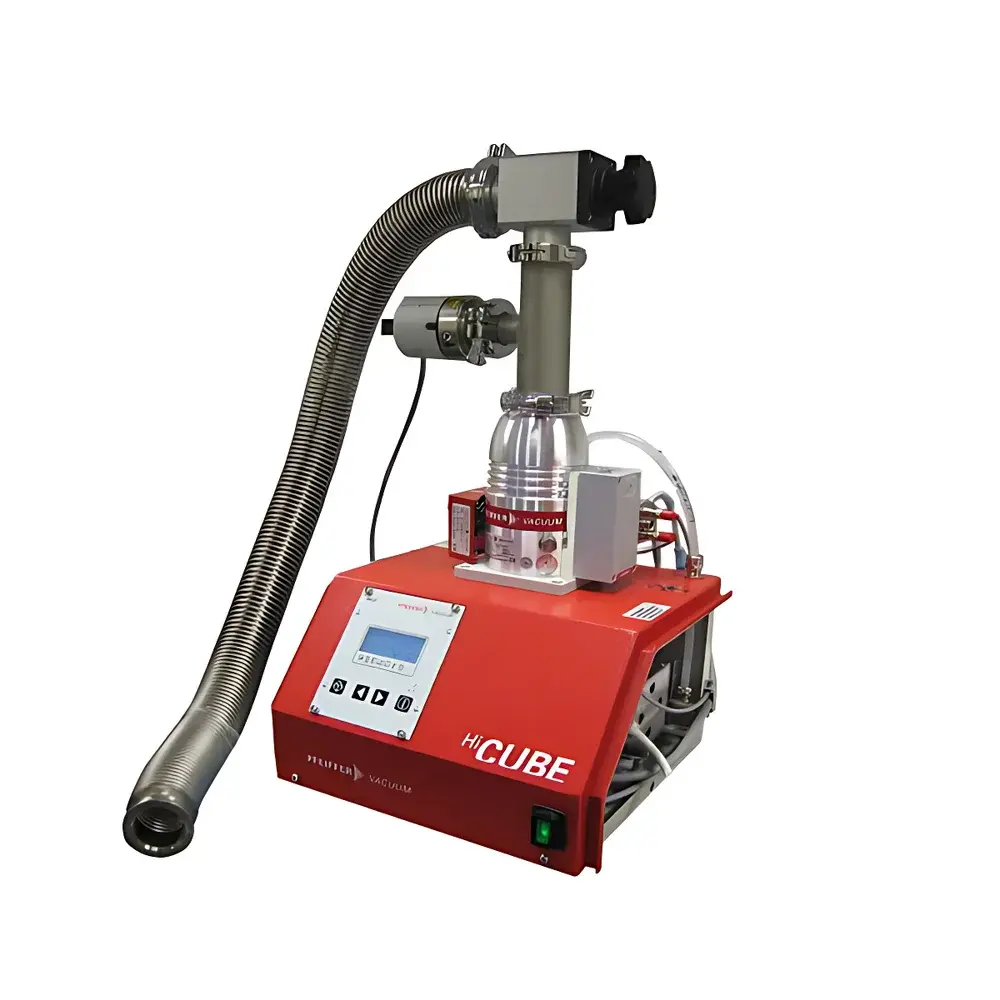
KJ GROUP EQ-PV-HVS Compact Turbo Molecular Pump
| Brand | KJ GROUP |
|---|---|
| Origin | Germany |
| Manufacturer Type | Authorized Distributor |
| Country of Manufacture | Germany |
| Model | EQ-PV-HVS |
| Power Supply | 90–132 V / 185–265 V AC, 50/60 Hz |
| Continuous/Max Power | 100 W / 110 W |
| Startup Time | ≤2 min |
| Pumping Speed (N₂) | 33 L/s |
| Pumping Speed (He) | 39 L/s |
| Pumping Speed (H₂) | 32 L/s |
| Compression Ratio (N₂) | >1×10¹¹ |
| Compression Ratio (He) | 6×10⁶ |
| Compression Ratio (H₂) | >1×10⁵ |
| Ultimate Pressure (leak-free system) | <1×10⁻⁸ mbar |
| Foreline Pump Requirement | 0.9 m³/h (50 Hz) / 1.0 m³/h (60 Hz) |
| Weight | 15 kg |
| Vacuum Interface | KF40 flange |
| Integrated Vacuum Gauge Port | KF25 |
Overview
The KJ GROUP EQ-PV-HVS is a compact, high-performance turbo molecular pump engineered for reliable ultra-high vacuum (UHV) generation in space-constrained laboratory and industrial systems. Based on the proven principles of momentum transfer via high-speed rotor blades rotating at up to 90,000 rpm, the EQ-PV-HVS achieves rapid evacuation from rough vacuum (10⁻³ mbar) down to base pressures below 1×10⁻⁸ mbar under leak-tight conditions. Its optimized blade geometry and precision-balanced rotor assembly ensure stable operation across a wide range of gas species—including nitrogen, helium, and hydrogen—with differential pumping speeds reflecting inherent molecular mass dependence. Designed for integration into vacuum chambers, thin-film deposition systems, surface analysis tools (e.g., XPS, AES), and analytical instrumentation requiring clean, oil-free vacuum environments, the EQ-PV-HVS eliminates hydrocarbon backstreaming associated with diffusion or scroll pumps, thereby preserving sample integrity and detector sensitivity.
Key Features
- Compact footprint and lightweight design (15 kg) enables seamless integration into modular vacuum systems and portable analytical platforms.
- Integrated KF40 vacuum flange and auxiliary KF25 port for direct connection of Pirani or capacitance manometers—no external adapters required.
- Low-noise operation (<45 dB(A) at 1 m), achieved through advanced magnetic bearing damping and acoustic enclosure optimization—critical for noise-sensitive environments such as metrology labs and cleanrooms.
- Wide-input universal power supply (90–265 V AC, 50/60 Hz) ensures compatibility with global electrical infrastructure without external transformers.
- Fast startup sequence: reaches operational speed and stabilizes vacuum performance within ≤2 minutes after cold start—reducing system idle time and improving experimental throughput.
- High compression ratios (>1×10¹¹ for N₂; >1×10⁵ for H₂) enable effective isolation of foreline pressure fluctuations and support operation with small-capacity backing pumps (≥0.9 m³/h).
Sample Compatibility & Compliance
The EQ-PV-HVS is compatible with inert, non-corrosive, and non-condensable gases typical in UHV applications—including N₂, Ar, He, H₂, O₂, and residual atmospheric constituents. It is not rated for use with reactive vapors (e.g., Cl₂, NH₃), solvent vapors, or particulate-laden streams without upstream trapping. The pump complies with IEC 61000-6-3 (EMC emission standards) and IEC 61000-6-2 (immunity). Its mechanical construction adheres to ISO 16063-11 vibration calibration requirements for rotating machinery. While the pump itself does not carry CE marking for medical devices, its vacuum performance supports GLP-compliant processes when integrated into validated systems meeting ISO/IEC 17025 and ASTM E2877-22 (standard guide for vacuum system qualification).
Software & Data Management
The EQ-PV-HVS operates via an embedded digital controller with RS-485 interface (Modbus RTU protocol), enabling remote monitoring and control through host SCADA or LabVIEW-based vacuum management software. Real-time parameters—including rotational speed, bearing temperature, motor current, and status flags (e.g., overtemperature, overspeed, communication fault)—are accessible for logging and audit trail generation. When deployed in regulated environments (e.g., pharmaceutical R&D or semiconductor process development), the controller supports timestamped event logging aligned with FDA 21 CFR Part 11 requirements when paired with compliant data acquisition architecture and user access controls.
Applications
- Ultra-high vacuum chambers for electron microscopy (SEM, TEM) and surface science instrumentation.
- Thin-film coating systems (PVD, sputtering, evaporation) requiring low partial pressures of water vapor and hydrocarbons.
- Residual gas analyzers (RGAs) and quadrupole mass spectrometers requiring stable, vibration-minimized vacuum sources.
- Calibration standards laboratories performing pressure standard intercomparisons in the 10⁻³–10⁻⁸ mbar range.
- Research-scale atomic physics setups, including cold atom traps and ion beam sources.
FAQ
What backing pump is required for optimal operation?
A dry scroll or diaphragm pump with ≥0.9 m³/h displacement at 50 Hz (or ≥1.0 m³/h at 60 Hz) and ultimate pressure ≤1×10⁻² mbar is recommended. Oil-sealed rotary vane pumps may be used if equipped with effective hydrocarbon traps.
Can the EQ-PV-HVS operate continuously at full speed?
Yes—the pump is rated for continuous duty at nominal rotational speed under ambient temperatures ≤40 °C and relative humidity ≤80% non-condensing, provided cooling airflow meets manufacturer-specified minimums (≥1.2 m/s across heatsink fins).
Is helium leak testing supported?
Yes. The high helium pumping speed (39 L/s) and >6×10⁶ compression ratio make the EQ-PV-HVS suitable for integration into helium mass spectrometer leak detection systems, particularly where compactness and low background signal are critical.
Does the pump include built-in diagnostics?
Yes. The onboard controller provides LED status indicators and serial diagnostic output for rotor acceleration profile, thermal margin, and power supply stability—enabling predictive maintenance planning and root-cause analysis of vacuum anomalies.
Related Products



