
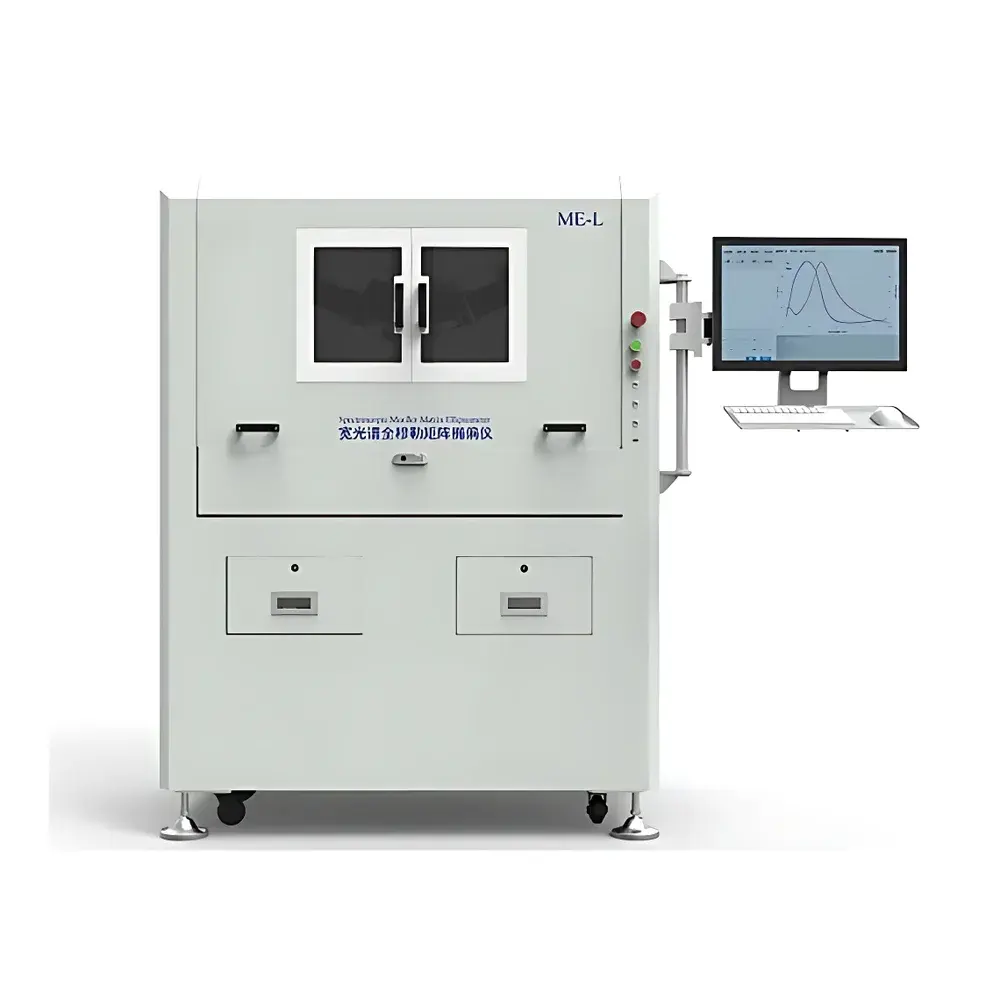
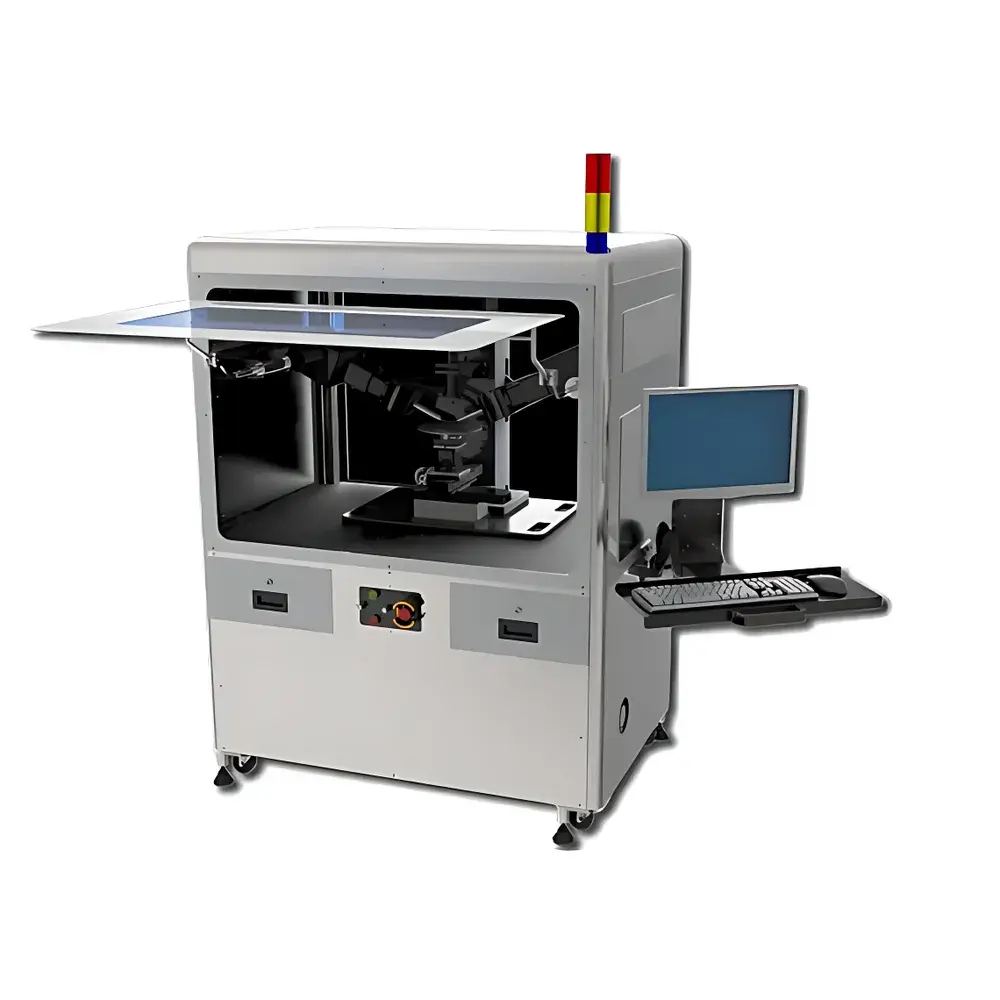
KJ GROUP KJ-EPi AutoEllipsometry Integrated Platform
| Brand | KJ GROUP |
|---|---|
| Origin | Liaoning, China |
| Manufacturer Type | Authorized Distributor |
| Country of Origin | China |
| Model | KJ-EPi |
| Automation Level | Configurable (Fixed or Variable Angle) |
| Application Class | High-Precision Research & Industrial Offline Metrology |
| Single-Measurement Time | 0.5–5 s |
| Spectral Range | 380–1000 nm (extendable to 193–2500 nm) |
| Mapping Travel | 100 × 100 mm (expandable) |
| Maximum Sample Size | Ø200 mm |
| Optical Configuration | Modular Mueller Matrix / Rotating Analyzer / Rotating Compensator Compatible |
| Compliance Framework | ASTM E2476, ISO 15558-1, JIS K 7105 |
Overview
The KJ GROUP KJ-EPi AutoEllipsometry Integrated Platform is a fully automated, modular ellipsometric metrology system engineered for high-precision, non-contact characterization of thin-film and nanostructured optical materials. Based on the fundamental principle of spectroscopic ellipsometry—measuring the change in polarization state of reflected light—the platform quantifies complex refractive index (n, k), physical thickness, interfacial roughness, and anisotropic optical dispersion with sub-nanometer resolution in film thickness and <0.002 precision in psi/delta values. Its architecture integrates optomechanical, electrical, and pneumatic subsystems into a compact, vibration-damped enclosure, enabling both laboratory-scale research deployment and offline production-line metrology. Unlike conventional benchtop ellipsometers, the KJ-EPi supports configurable incidence angles (fixed or motorized variable), multi-spectral acquisition across visible-NIR (380–1000 nm), and optional deep-UV to SWIR extension (193–2500 nm) to address wide-bandgap semiconductors, ultra-thin dielectrics, and plasmonic metamaterials.
Key Features
- Modular optical head design accommodating rotating analyzer (RAE), rotating compensator (RCE), and full Mueller matrix configurations—enabling universal ellipsometry for isotropic, uniaxial, and biaxial anisotropic films.
- Motorized XYZ stage with 100 × 100 mm travel range and ±0.5 µm repeatability, supporting automated wafer-scale mapping of Ø200 mm substrates—including glass, silicon, quartz, and flexible polymer foils.
- Real-time spectral acquisition engine with thermoelectrically cooled CCD detector, delivering signal-to-noise ratio >10,000:1 at 1 s integration time across the base spectral band.
- Hardware-synchronized shutter and polarization control ensure measurement stability under ambient lab conditions—no vacuum or purging required for standard operation.
- Configurable automation logic: supports single-point calibration, grid-based mapping, ROI-triggered adaptive sampling, and edge-detection guided scan path optimization.
- Tool-level firmware abstraction layer allows OEM integration with factory MES/SECS-GEM interfaces via TCP/IP or RS-232 protocols.
Sample Compatibility & Compliance
The KJ-EPi accommodates rigid and semi-flexible substrates up to 200 mm in diameter and 25 mm in thickness, including patterned wafers, lithographically defined gratings (1D/2D), transparent conductive oxides (ITO, AZO), alignment layers (PI, SEBS), photoresists (g/i/h-line, EUV), emissive organic stacks (OLED, QLED), and encapsulation barriers (SiNx, Al2O3). All measurements adhere to ASTM E2476 (Standard Practice for Spectroscopic Ellipsometry Measurements), ISO 15558-1 (Optical Properties of Thin Films), and JIS K 7105 (Measurement of Refractive Index and Thickness of Transparent Films). The system’s audit trail, user access controls, and electronic signature capability align with GLP and GMP documentation requirements per FDA 21 CFR Part 11 when deployed with validated software modules.
Software & Data Management
Control and analysis are executed via KJ-EllipSuite v4.x—a Windows-based application built on Qt and Python 3.11 with native support for multithreaded modeling. It includes embedded libraries for Cauchy, Tauc-Lorentz, Cody-Lorentz, and B-spline dispersion models; supports constrained and global fitting across multiple spectra and angles; and exports results in HDF5, CSV, and industry-standard SE-XML formats. Raw data, fit parameters, covariance matrices, and residual plots are archived with timestamped metadata. Optional cloud synchronization enables cross-site model sharing and remote expert review. Software validation packages—including IQ/OQ documentation, traceable calibration certificates, and regression test reports—are available upon request for regulated environments.
Applications
- Academic & national lab research: thickness and optical constant extraction of 2D materials (MoS2, h-BN), perovskite absorbers, and atomic-layer-deposited high-k gate dielectrics.
- Flat-panel display manufacturing: offline uniformity mapping of polyimide alignment layers and touch sensor ITO films across Gen 4–Gen 6 glass substrates.
- Semiconductor packaging: quantification of low-k dielectric porosity and moisture uptake via n/k dispersion analysis in 193–400 nm UV-VIS range.
- Photovoltaics R&D: real-time monitoring of anti-reflection coating degradation under UV aging and humidity cycling tests.
- Nanophotonics: reconstruction of grating profile parameters (line width, sidewall angle, CD, pitch) using rigorous coupled-wave analysis (RCWA) coupled with ellipsometric constraints.
FAQ
Does the KJ-EPi support in-situ measurements during deposition or etching?
No—it is designed exclusively for ex-situ, offline metrology. In-situ configurations require custom vacuum-compatible optics and feedthrough integration, available under NRE engineering services.
Can the system be calibrated traceably to NIST standards?
Yes. Certified reference samples (Si/SiO2 wafers with NIST-traceable oxide thicknesses) and calibration protocols compliant with ISO/IEC 17025 are provided with each delivery.
Is remote diagnostics and firmware update supported?
Yes. Secure SSH-enabled remote access (with customer-configurable firewall rules) allows KJ GROUP application engineers to perform diagnostics, log analysis, and over-the-air firmware updates under signed authorization.
What level of training is included with system installation?
A 3-day on-site commissioning and operator training program is standard, covering safety protocols, measurement workflow, basic modeling, report generation, and preventive maintenance procedures.
Are third-party modeling tools (e.g., WVASE, CompleteEASE) compatible with KJ-EPi data exports?
Yes. Raw psi/delta spectra and metadata are exported in ASCII and SE-XML formats, fully interoperable with commercial ellipsometry analysis platforms.



