
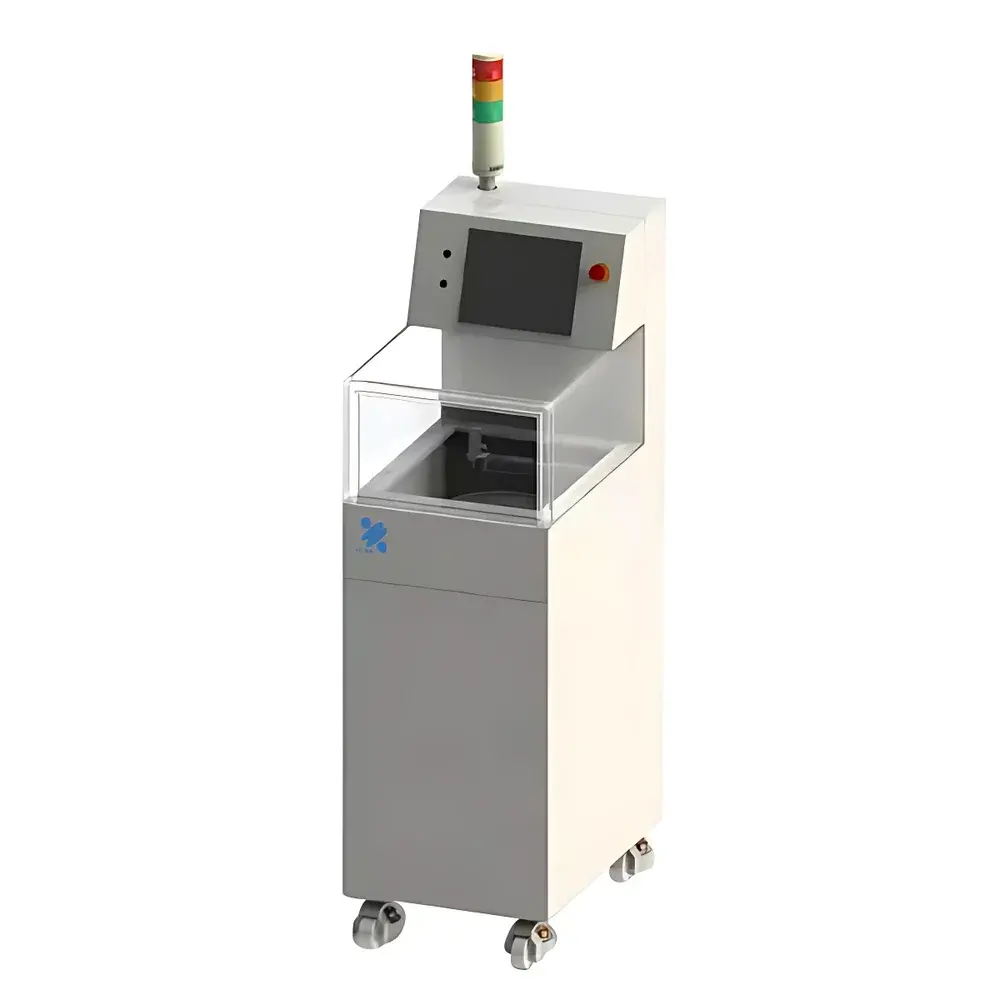
KJ GROUP CE-600 & CE-800 Dual-Fluid Automatic Wafer Cleaning System
| Brand | KJ GROUP |
|---|---|
| Origin | Liaoning, China |
| Model | CE-600, CE-800 |
| Applicable Substrate Size | 3–6 inch (CE-600), 3–8 inch (CE-800) |
| Cleaning Pressure Range | 0.1–0.5 MPa |
| Workstage Rotation Speed | 200–3000 rpm |
| Cleaning Duration | 3–1000 s |
| Touchscreen | 7-inch Full-Color HMI |
| Equipment Dimensions | 400 × 800 × 1250 mm |
| Fluid Delivery | Dual-fluid (gas–liquid) nozzle system |
| Chuck Mechanism | Centrifugal automatic locking clamp |
| Spindle Sealing | Aerospace-grade rotary seal |
| Compatible Films | Blue tape, UV-curable tape, PET carrier film, dual-layer adhesive films |
| Control System | Programmable logic controller (PLC) with editable recipe management |
Overview
The KJ GROUP CE-600 and CE-800 Dual-Fluid Automatic Wafer Cleaning Systems are engineered for post-dicing residue removal from semiconductor wafers, QFN packages, optical glass substrates, ceramic modules, and precision electronics assemblies. These systems implement a controlled two-phase fluid delivery principle—where pressurized gas shears and atomizes liquid (typically deionized water or low-surface-tension solvent) into a finely dispersed mist or targeted coarse droplet spray—enabling high-efficiency particle dislodgement without mechanical contact. The cleaning mechanism relies on tunable momentum transfer: increasing gas pressure or reducing liquid flow rate elevates the gas-to-liquid mass flow ratio, generating higher-velocity micro-droplets that produce localized shock waves within narrow kerf regions. This hydrodynamic impact effectively mobilizes sub-10 µm particulates lodged in saw streets, undercut areas, and edge interfaces—critical for preventing post-packaging defects, wire bond contamination, or optical scattering in sensor modules.
Key Features
- Dual-fluid nozzle architecture with independent pneumatic and hydraulic pressure regulation, enabling real-time optimization of droplet size distribution (Sauter mean diameter adjustable via operational parameters)
- Aerospace-grade rotary spindle sealing system ensures long-term vacuum integrity and rotational stability under continuous high-speed operation (up to 3000 rpm)
- Centrifugal automatic chucking mechanism provides uniform radial clamping force across substrate diameters from 3 to 8 inches, minimizing warpage-induced misalignment
- 7-inch full-color resistive touchscreen HMI with intuitive icon-based navigation, multi-language support (English, Chinese, Korean), and password-protected parameter editing
- PLC-based control architecture supporting up to 99 user-defined cleaning recipes, each storing pressure setpoints, rotation profile, dwell time, and sequence logic
- Integrated fault diagnostics with real-time alarm logging—including pressure deviation, motor stall, temperature anomaly, and door interlock status
Sample Compatibility & Compliance
The CE-600/800 accommodates rigid and semi-rigid substrates mounted on standard dicing tapes, including acrylic-based blue tapes, UV-curable temporary bonding films, PET carrier substrates, and multilayer adhesive systems. Its non-contact cleaning methodology preserves tape adhesion integrity while avoiding delamination risks associated with ultrasonic cavitation or aggressive brushing. The system complies with general cleanroom compatibility requirements (ISO Class 5–7 ambient integration) and supports integration into automated material handling workflows via optional SECS/GEM interface. While not certified to specific ISO/IEC 17025 or SEMI S2 standards out-of-the-box, its programmable repeatability (±0.5% rotational speed control, ±0.02 MPa pressure resolution) enables users to validate cleaning efficacy per internal SOPs aligned with JEDEC J-STD-033 or IPC-A-610 criteria.
Software & Data Management
The embedded HMI firmware supports audit-trail-capable operation logging: timestamped records of recipe execution, operator ID (via optional RFID badge reader), parameter deviations, and alarm events are stored locally on industrial-grade SD card (16 GB). Export formats include CSV and PDF reports compatible with LIMS integration. For regulated environments, optional software add-ons provide 21 CFR Part 11-compliant electronic signatures, role-based access control (admin/operator/maintenance tiers), and encrypted data archiving. All system updates are delivered via secure USB firmware loader with SHA-256 signature verification.
Applications
- Post-dicing cleaning of silicon, GaAs, and SiC wafers prior to wafer-level packaging or probe testing
- Removal of diamond slurry residues and silicon debris from QFN leadframes and molded package edges
- Cleaning of sapphire and fused silica optical windows used in MEMS sensors and camera modules
- Pre-bond surface preparation for temporary adhesive lamination processes in TSV and 3D-IC fabrication
- Contamination control in ceramic substrate manufacturing for power electronics and RF modules
FAQ
What substrate thicknesses can the CE-600/800 accommodate?
The system supports standard thickness ranges for 3–8 inch wafers and substrates (e.g., 200–1000 µm silicon, 300–700 µm glass), provided mechanical rigidity prevents excessive flexure during high-RPM rotation.
Is solvent compatibility documented for organic cleaning agents?
Yes—system wetted materials (stainless steel 316L nozzles, EPDM seals, PTFE-lined fluid paths) are compatible with IPA, acetone, and low-concentration alkaline solutions; full chemical resistance documentation is available upon request.
Can the CE-800 process 8-inch wafers with full rotational uniformity?
Yes—the CE-800’s reinforced workstage and dynamically balanced chuck maintain ≤±0.05 mm runout at 3000 rpm across the full 200 mm diameter envelope.
Does the system support remote monitoring or Ethernet connectivity?
Standard configuration includes RS-232 and optional Ethernet/IP or Modbus TCP modules for factory automation integration and predictive maintenance telemetry.
Are validation protocols (IQ/OQ/PQ) provided with the equipment?
KJ GROUP supplies baseline OQ test templates and calibration certificates for pressure transducers and tachometers; site-specific PQ execution requires customer-defined acceptance criteria and particle-counting verification methods.



