
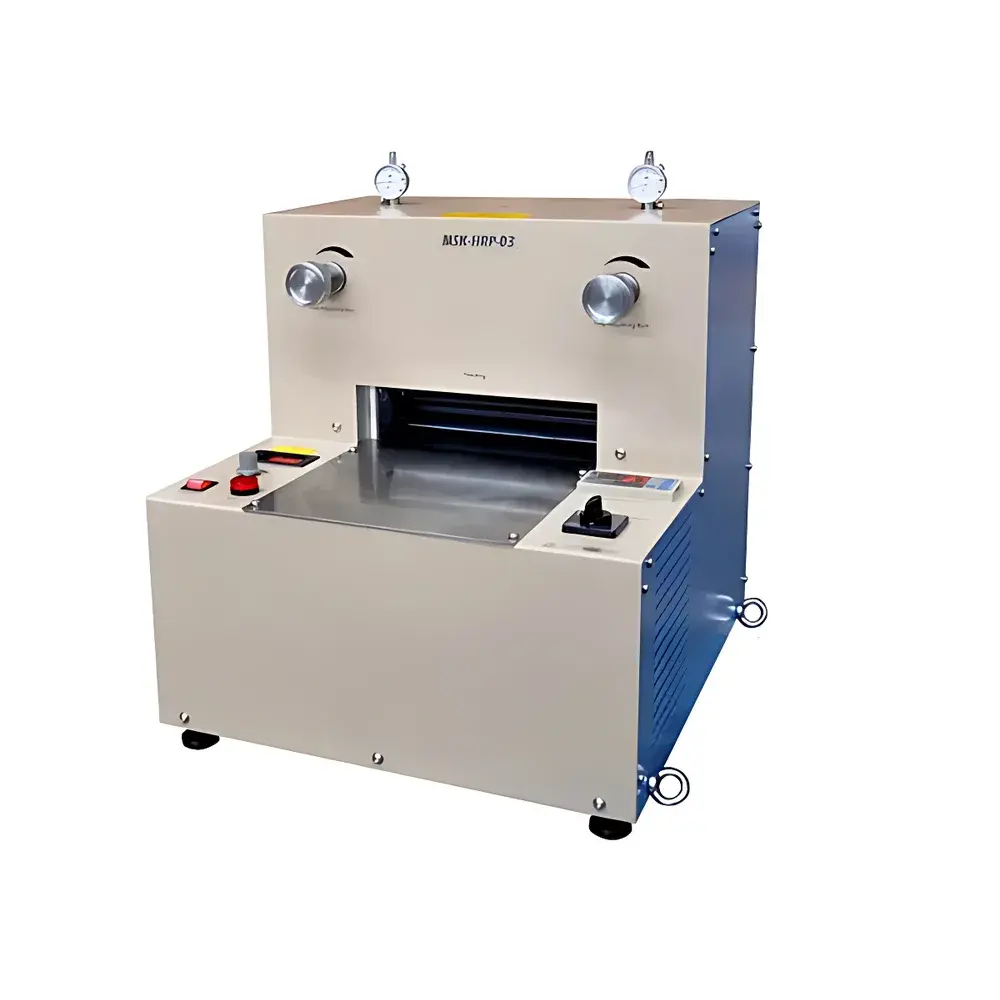
KJ GROUP MSK-HRP-03 Electrically Heated Roll Press
| Brand | KJ GROUP |
|---|---|
| Origin | Liaoning, China |
| Manufacturer Type | Authorized Distributor |
| Country of Origin | China |
| Model | MSK-HRP-03 |
| Quotation | Upon Request |
| Roll Diameter | 200 mm |
| Roll Surface Hardness | >HV900 |
| Max. Feed Thickness | 2 mm |
| Max. Feed Width | 250 mm |
| Linear Roll Speed | 5–100 mm/s (digital display & stepless speed control) |
| Max. Heating Temperature | <80 °C |
| Roll Radial Runout | ≤0.004 mm |
| Roll Surface Roughness | Ra ≥0.4 µm |
| Adjustable Gap Range | 0–2 mm |
| Standard Minimum Gap Setting | 0.01 mm |
| Power Supply | AC 220 V, 50/60 Hz |
| Motor | DC 90 V, 300 W |
| Heating Power | AC 220 V, 1600 W |
| Dimensions (L×W×H) | 590 × 570 × 530 mm |
| Net Weight | 197 kg |
| Warranty | 12 months (lifetime technical support) |
Overview
The KJ GROUP MSK-HRP-03 Electrically Heated Roll Press is an engineered laboratory-scale calendering system designed for precision thickness reduction and density enhancement of thin-sheet functional materials under controlled thermal and mechanical conditions. It operates on the principle of two-counter-rotating hardened steel rolls applying uniform compressive force across a material web, with simultaneous resistive heating of the roll surfaces to modulate material rheology during deformation. This dual-mode (mechanical + thermal) capability makes it especially suitable for processing electrode composites in lithium-ion battery R&D—where controlled densification without cracking, binder redistribution, or particle fracture is critical. Unlike cold rolling systems, the integrated temperature control (up to 80 °C) enables improved plasticity in polymer-bonded active layers and facilitates interfacial adhesion between current collector and coating. The unit is constructed around a rigid cast-iron frame with high-precision gear-driven transmission, ensuring minimal torque fluctuation and consistent line speed across the full operating range.
Key Features
- High-hardness rolls (surface hardness >HV900) fabricated from alloy tool steel, optimized for wear resistance and dimensional stability during repeated thermal cycling.
- Digitally controlled linear speed adjustment (5–100 mm/s) with real-time LED readout, enabling reproducible strain-rate application for comparative process studies.
- Electrically heated rolls with independent temperature monitoring and closed-loop regulation, maintaining ±2 °C uniformity across the 250 mm working width.
- Adjustable roll gap mechanism with micrometer-scale resolution (0.01 mm standard increment), calibrated against ISO 2768-mK general tolerances.
- Reversible DC motor drive supporting forward/reverse operation—essential for safe material recovery, alignment correction, and troubleshooting without disassembly.
- Integrated polycarbonate safety shield meeting EN 13857 Category I requirements for finger protection, with interlocked power cutoff upon door opening.
- CE-marked compliance confirming conformity with EU Machinery Directive 2006/42/EC and Low Voltage Directive 2014/35/EU.
Sample Compatibility & Compliance
The MSK-HRP-03 accommodates foil- and film-based substrates up to 2 mm thick and 250 mm wide—including copper and aluminum current collectors, slurry-cast cathode/anode electrodes (NMC, LFP, graphite, silicon composites), precious metal foils (Au, Ag, Pt), and polymer electrolyte membranes. Material compatibility requires feedstock hardness below HRC45 to prevent premature roll wear; rolls retain HRC52 hardness only below 200 °C—thus the operational heating limit of 80 °C ensures long-term surface integrity. All mechanical adjustments and thermal settings are documented per GLP guidelines, supporting audit-ready process records in regulated development environments. The system supports ASTM F1979 (battery electrode calendering test method) and ISO 2409 (cross-cut adhesion testing post-calendering) workflows.
Software & Data Management
While the MSK-HRP-03 operates via front-panel analog/digital controls without embedded firmware, its operational parameters—including speed setpoint, actual RPM (derived from encoder feedback), surface temperature (dual-point thermocouple input), and cumulative runtime—are manually loggable in standardized lab notebooks or LIMS-integrated spreadsheets. For automated data capture, optional RS-485 interface modules (sold separately) enable integration with LabVIEW™ or Python-based acquisition scripts compliant with IEEE 11073-10201 standards. All calibration certificates—including roll parallelism verification (≤0.004 mm runout), surface roughness profiling (Ra ≥0.4 µm per ISO 4287), and gap repeatability testing—are provided with shipment and traceable to NIM (National Institute of Metrology, China).
Applications
- Lithium-ion battery electrode fabrication: thickness homogenization, porosity reduction, and interfacial contact improvement prior to cell assembly.
- Functional thin-film development: densification of solid-state electrolyte tapes, flexible perovskite absorber layers, and thermoelectric nanocomposites.
- Precious metal processing: cold-welding and grain refinement of Au/Ag foils for microelectronics interconnects.
- Research into roll-to-roll (R2R) manufacturing scalability: parameter mapping for transfer to pilot-scale continuous lines.
- Material property correlation studies: linking calendering pressure, temperature, and speed to electrochemical impedance, adhesion strength (ASTM D3359), and tensile modulus (ISO 527-3).
FAQ
What is the maximum recommended operating temperature for the rolls, and why is it limited to 80 °C?
The upper thermal limit is set at 80 °C to preserve roll surface hardness (>HV900) and avoid irreversible tempering effects. At temperatures exceeding 200 °C, hardness drops significantly (to ~HRC52); limiting operation to 80 °C ensures long-term dimensional stability and surface finish.
Can the MSK-HRP-03 be used for calendering dry-powder films without binders?
Yes—though cohesive strength must be verified empirically. Unbound powders require pre-compaction or low-temperature sintering assistance to prevent delamination during feeding; optimal results are observed with binder-containing slurries cured to ≥80% solvent removal.
Is the gap adjustment mechanism repeatable at sub-10 µm levels?
The mechanical micrometer feed provides 0.01 mm (10 µm) minimum increments, but absolute repeatability at ≤5 µm requires periodic verification using certified gauge blocks per ISO 3650 and laser interferometry.
Does the CE marking cover electromagnetic compatibility (EMC)?
Yes—the CE declaration includes compliance with EMC Directive 2014/30/EU, verified through conducted and radiated emission testing (EN 61000-6-3) and immunity validation (EN 61000-6-2).
What maintenance intervals are recommended for gear train lubrication and roll surface inspection?
Gearbox oil should be replaced every 1,000 operational hours; roll surfaces require visual and profilometric inspection every 500 hours or after processing abrasive materials such as SiO₂-filled composites.



