
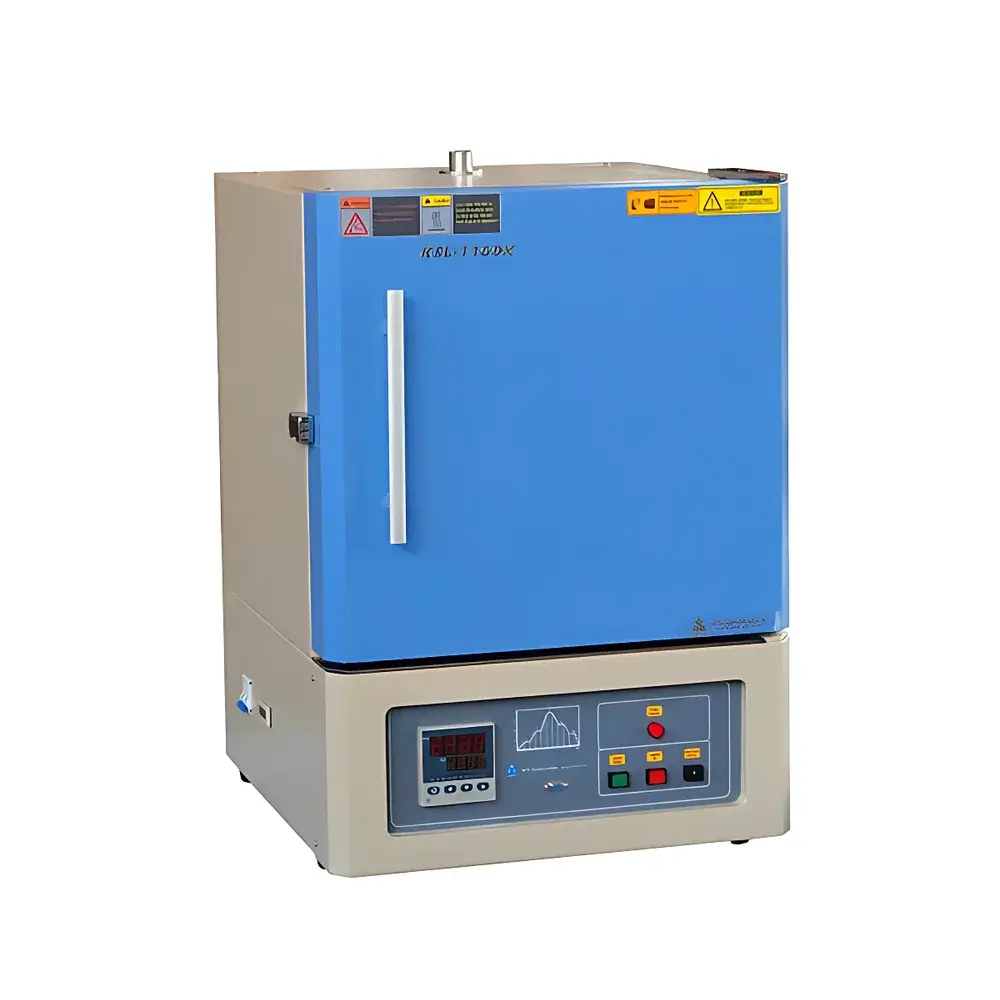
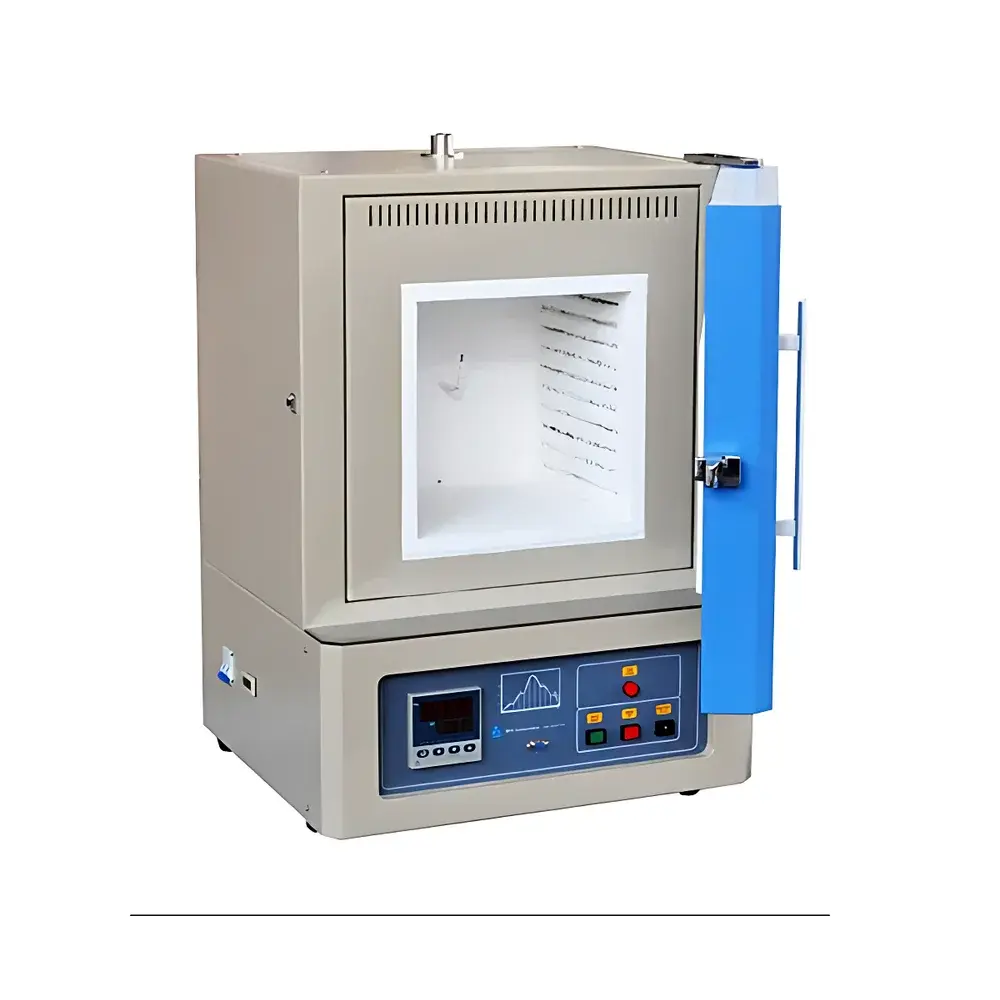
KJ GROUP KSL-1200X-M 27L High-Temperature Box Furnace (1200°C)
| Brand | KJ GROUP |
|---|---|
| Origin | Anhui, China |
| Model | KSL-1200X-M |
| Maximum Temperature | 1200°C (<3 h), Continuous Operation at 1100°C |
| Temperature Uniformity | ±3.45°C at 1000°C |
| Control Accuracy | ±1°C |
| Heating Rate | 20°C/min (to max temp) |
| Rated Power | 5.5 kW, AC 208–240 V, 50/60 Hz |
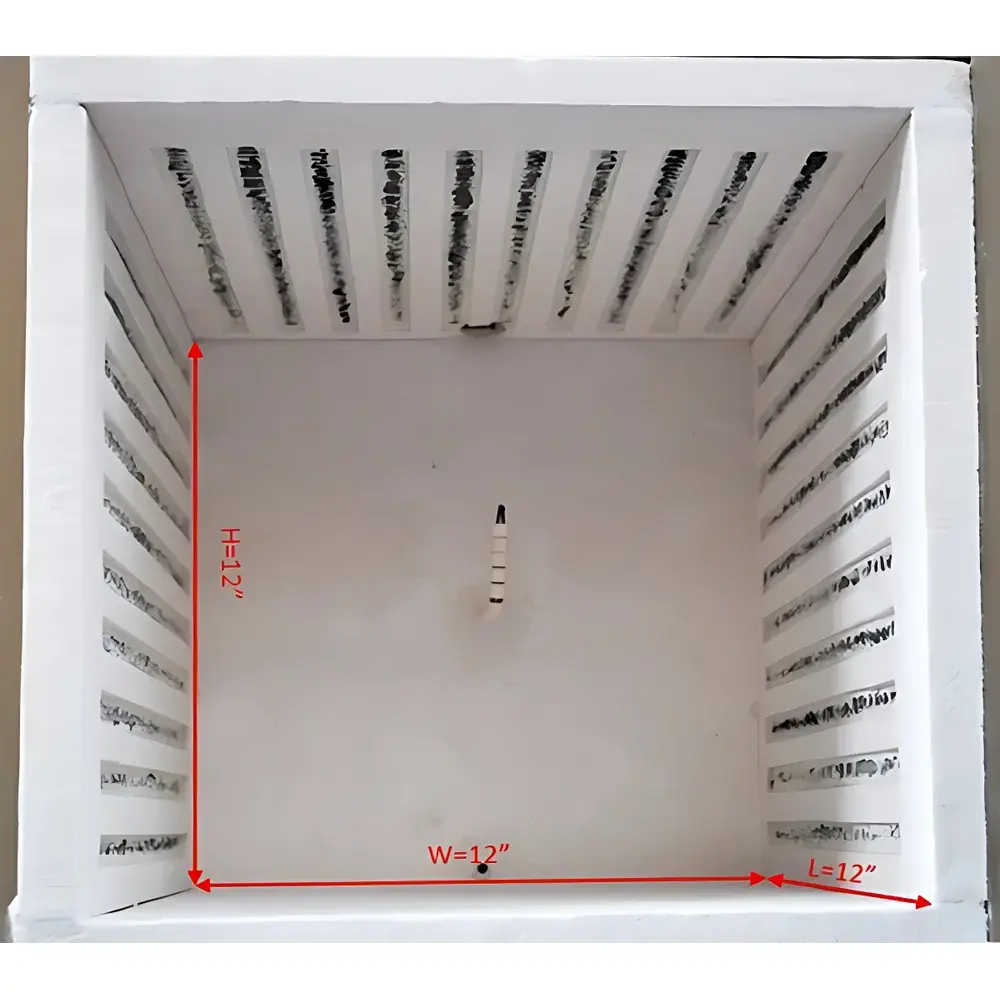
| Chamber Dimensions | 300 × 300 × 300 mm (27 L) |
| Heating Element | Mo-doped Fe-Cr-Al resistance wire with ZrO₂ coating |
| Insulation | High-purity Al₂O₃ chamber with imported Al₂O₃ reflective coating |
| Thermocouple Type | K-type |
| Cooling | Dual-shell air-cooled structure (outer surface <60°C) |
| Programmable Controller | 30-segment PID with overheat and thermocouple break protection |
| Certifications | CE compliant |
| Inlet/Outlet | Rear-mounted 1/4″ gas inlet, top exhaust port |
Overview
The KJ GROUP KSL-1200X-M is a precision-engineered 27-liter high-temperature box furnace designed for controlled thermal processing in research laboratories, materials science facilities, and quality control environments. Operating on the principle of resistive heating via Mo-doped Fe-Cr-Al alloy elements, it delivers stable, repeatable thermal profiles up to 1200°C for short-duration cycles (≤3 hours) and sustained operation at 1100°C. Its high-purity alumina (Al₂O₃) chamber—coated with a proprietary, high-emissivity aluminum oxide layer—enhances thermal reflectivity, improves energy efficiency, and resists degradation from repeated thermal cycling. The dual-shell construction incorporates an integrated forced-air cooling system, ensuring outer surface temperatures remain below 60°C during operation—a critical safety feature for shared lab spaces. Designed for compliance with fundamental laboratory safety and electromagnetic compatibility requirements, the furnace carries CE marking and supports traceable thermal processing under GLP-aligned workflows.
Key Features
- Dual-shell stainless steel housing with active air circulation, limiting external surface temperature to <60°C even at full operational load.
- 27 L internal chamber (300 × 300 × 300 mm) fabricated from ≥99.7% pure Al₂O₃, coated with a US-sourced high-reflection Al₂O₃ layer to minimize thermal loss and extend service life.
- PID-based temperature controller with 30 programmable ramp-hold segments, enabling complex multi-stage sintering, annealing, or ashing protocols.
- Mo-doped Fe-Cr-Al resistance heating elements with ZrO₂ ceramic coating—optimized for oxidation resistance and uniform heat distribution across the chamber volume.
- Integrated safety architecture including over-temperature cutoff, thermocouple break detection, and automatic shutdown upon fault condition.
- Rear-mounted 1/4″ NPT gas inlet and top-mounted passive exhaust port—enabling controlled atmosphere processing (e.g., inert, reducing, or mildly oxidizing environments).
Sample Compatibility & Compliance
The KSL-1200X-M accommodates standard crucibles (alumina, quartz, silicon carbide) and sample boats up to 200 mm in height and 250 mm in diameter. It is suitable for non-vacuum thermal treatments including calcination, sintering of ceramics and battery cathode precursors, ashing of organic matrices, and pre-oxidation of metallic foils. While not rated for vacuum or explosive atmospheres, its top exhaust facilitates safe venting of low-concentration corrosive byproducts (e.g., Cl⁻, F⁻, SO₂) when used with appropriate fume hood integration. CE certification confirms conformity with EU Machinery Directive 2006/42/EC and Electromagnetic Compatibility Directive 2014/30/EU. For regulated environments, the furnace supports audit-ready documentation when paired with external data loggers meeting FDA 21 CFR Part 11 requirements.
Software & Data Management
The embedded PID controller includes RS485 communication capability (Modbus RTU protocol), allowing integration with third-party SCADA systems or centralized lab monitoring platforms. Optional PC-based control software enables real-time temperature logging, remote parameter adjustment, and export of CSV-formatted thermal profiles—including timestamps, setpoints, and actual readings—for inclusion in analytical reports or regulatory submissions. All program sequences are stored in non-volatile memory and retain settings after power interruption. Audit trails—comprising operator ID, timestamped parameter changes, and alarm events—can be generated manually or scheduled, supporting ISO/IEC 17025 and GLP documentation standards.
Applications
- Sintering of oxide ceramics (e.g., Al₂O₃, ZrO₂, BaTiO₃) and solid-state battery electrode composites.
- Thermal decomposition and ash content determination per ASTM E1755 and ISO 1171.
- Pre-oxidation of Ni-based superalloy powders prior to HIP processing.
- Heat treatment of catalyst supports and metal-organic framework (MOF) activation protocols.
- Calibration verification of thermocouples and reference materials within accredited metrology labs.
- Controlled pyrolysis of polymer-derived ceramics under argon or nitrogen flow.
FAQ
What is the recommended maximum ramp rate for long-term reliability?
For optimal element longevity and thermal stress management, KJ GROUP recommends limiting ramp rates to ≤10°C/min during both heating and cooling phases—even though the furnace is capable of 20°C/min.
Can this furnace be used under vacuum or with hydrogen?
No. The KSL-1200X-M lacks vacuum sealing and is not rated for flammable, explosive, or highly reducing atmospheres. Hydrogen, acetylene, or methane must not be introduced.
Is the furnace compatible with inert gas purging?
Yes—using the rear 1/4″ inlet and top exhaust, continuous N₂ or Ar purge is supported at flow rates up to 1 L/min. A mass flow controller is recommended for reproducibility.
How is temperature uniformity verified and maintained?
Uniformity is validated per ASTM E2203 using a 9-point thermocouple mapping procedure at 1000°C. The layered Al₂O₃ insulation and symmetric heater layout ensure ±3.45°C tolerance across the usable zone.
What maintenance is required for the alumina chamber?
Microcracking may occur after extended use above 1000°C; this is normal and does not impair function. Reapplication of the OEM Al₂O₃ coating restores emissivity and surface integrity—service kits and application guidelines are available upon request.



