
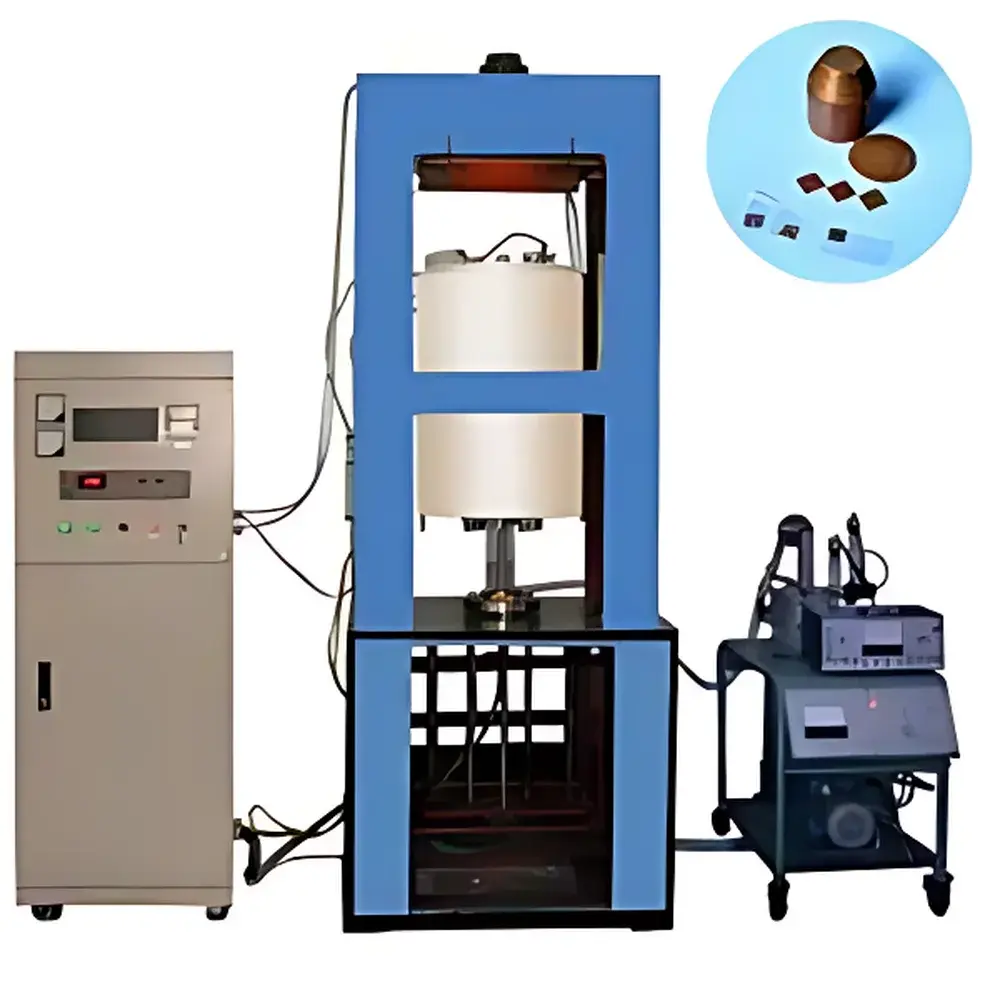
KJ GROUP SKJ-M50-16 Metal Crystal Growth Furnace
| Brand | KJ GROUP |
|---|---|
| Origin | Liaoning, China |
| Manufacturer Type | Authorized Distributor |
| Country of Origin | China |
| Model | SKJ-M50-16 Metal Crystal Growth Furnace |
| Heating Method | Medium-Frequency Induction or Graphite Resistance Heating |
| Temperature Control | Eurotherm Microprocessor + Thermocouple Closed-Loop System |
| Max Continuous Operating Temperature | 1600 °C |
| Max Short-Term Temperature | 1700 °C |
| Temperature Uniformity | ±1 °C |
| Crucible Type | High-Purity Graphite |
| Tube Material | Quartz or Alumina |
| Heating Element | Grade 1800 Molybdenum Disilicide (MoSi₂) Rods |
| Vacuum System | Mechanical Pump + Diffusion Pump |
| Ultimate Vacuum | 1×10⁻⁵ Torr |
| Growth Method | Vertical Bridgman / Crucible-Down Technique |
| Translation Speed | 1–10 mm/h (motorized, programmable) |
| Manual Rapid Traverse | Yes |
| Rotation Speed | 1–50 rpm |
| Cooling System | Integrated Recirculating Chiller (deionized water required) |
| Power Supply | 208–240 V AC, 3-phase, 50/60 Hz, 15 kW |
| Ambient Requirements | Altitude <1000 m |
| Gas Compatibility | Argon (≥99.99% purity), N₂, or vacuum/inert atmosphere |
| Footprint | 1500 mm × 600 mm × 700 mm |
Overview
The KJ GROUP SKJ-M50-16 Metal Crystal Growth Furnace is a precision-engineered vertical Bridgman (crucible-down) system designed for controlled solidification and single-crystal growth of metallic alloys—including refractory metals (e.g., Mo, W, Nb), intermetallic compounds (e.g., NiAl, TiAl), and high-entropy alloys. Unlike horizontal zone melting, the SKJ-M50-16 maintains sample stability while moving the furnace relative to a stationary crucible—enabling precise thermal gradient control across the solid–liquid interface. The system operates under programmable pressure regimes: high vacuum (1×10⁻⁵ Torr), inert gas (Ar ≥99.99%), or regulated partial-pressure atmospheres. Dual heating options—medium-frequency induction (for conductive melts) and graphite resistance heating (for broader compatibility)—allow adaptation to material-specific thermal conductivity, emissivity, and susceptibility to contamination. Temperature uniformity of ±1 °C over the growth zone is sustained via Eurotherm 3500-series microprocessor controllers with Type S or B thermocouples, supporting up to 50-segment ramp-soak profiles essential for multi-stage annealing, homogenization, and directional solidification.
Key Features
- Vertical crucible-down architecture with motorized translation stage (1–10 mm/h, repeatable to ±0.02 mm), enabling reproducible growth rates critical for defect minimization in metal crystals.
- High-stability rotation mechanism (1–50 rpm, adjustable torque) for melt homogenization and suppression of constitutional supercooling during solidification.
- Dual-mode heating compatibility: configurable for medium-frequency induction (optimized for Fe-, Ni-, Co-based alloys) or resistive graphite heating (ideal for low-emissivity or reactive metals such as Ti and Zr).
- Robust thermal insulation design using multilayer molybdenum foil and high-purity alumina fiber, ensuring >85% thermal efficiency at 1600 °C and minimizing axial/radial temperature gradients.
- Integrated recirculating chiller with deionized water loop for consistent cooling of furnace flanges, feedthroughs, and vacuum seals—reducing thermal drift and extending component service life.
- Modular vacuum train comprising dual-stage mechanical pump and oil diffusion pump, achieving ≤1×10⁻⁵ Torr base pressure without cryogenic assistance—compatible with residual gas analysis (RGA) integration for process validation.
Sample Compatibility & Compliance
The SKJ-M50-16 accommodates cylindrical samples up to Ø50 mm × 150 mm height within high-purity graphite crucibles (density ≥1.75 g/cm³, ash content <5 ppm). Compatible tube materials include fused quartz (≤1100 °C) and reaction-sintered alumina (up to 1700 °C), selected based on melt reactivity and thermal shock resistance. All wetted components comply with ASTM F2885-21 (standard specification for high-purity graphite used in semiconductor and crystal growth applications). The furnace meets CE machinery directive 2006/42/EC requirements for electrical safety, thermal shielding, and emergency stop functionality. Optional documentation packages support GLP/GMP-aligned lab audits, including IQ/OQ protocols, calibration certificates traceable to NIST standards, and full traceability logs for temperature, pressure, position, and rotation parameters.
Software & Data Management
Control is executed via KJ GROUP’s proprietary FurnaceMaster™ v4.2 software, running on an embedded industrial PC with real-time Windows OS. The interface provides synchronized logging of all process variables (temperature, position, rotation speed, vacuum level, power draw) at 100 ms intervals, stored in .csv and HDF5 formats for post-processing in MATLAB, Python (Pandas), or Thermo-Calc. Audit trails comply with FDA 21 CFR Part 11 requirements when configured with electronic signatures and role-based access control. Remote monitoring is supported via secure TLS 1.2 Ethernet connection, enabling supervised operation from adjacent cleanrooms or central control rooms. Data export includes ISO/IEC 17025-compliant uncertainty budgets for temperature and positional measurements.
Applications
- Growth of orientation-controlled single crystals for X-ray monochromator substrates (e.g., Cu, Mo, Si).
- Directional solidification studies of eutectic and peritectic alloys to map phase selection under controlled G/R ratios (thermal gradient G, growth rate R).
- Thermal history simulation for aerospace turbine disk materials (e.g., Inconel 718, Rene 88DT) to replicate industrial casting conditions.
- Diffusion couple experiments to quantify interdiffusion coefficients in multi-principal element alloys (MPEAs) at elevated temperatures.
- In-situ observation-ready configuration (optional viewport + IR pyrometer) for real-time meniscus shape and solid–liquid interface tracking.
FAQ
What vacuum level is required for reactive metal crystal growth?
For Ti, Zr, or V-based systems, a base pressure ≤5×10⁻⁵ Torr is recommended prior to backfilling with high-purity argon (99.999%) to minimize oxide inclusion formation.
Can the furnace be upgraded for in-situ XRD or synchrotron experiments?
Yes—custom flange configurations (CF-100 or DN160 ISO-KF) and beryllium/tungsten window ports are available upon request for beamline integration.
Is the temperature controller compliant with ISO/IEC 17025 calibration requirements?
All Eurotherm units ship with factory calibration certificates traceable to NPL (UK) and include provisions for user-performed verification using reference thermocouples per IEC 60584-1.
What maintenance intervals are recommended for the MoSi₂ heating elements?
Under continuous 1600 °C operation, expect 800–1200 hours of service life; quarterly visual inspection and resistance measurement are advised to detect early-stage aging.
Does the system support automated recipe transfer between multiple furnaces?
Yes—FurnaceMaster™ supports XML-based recipe import/export and network-synchronized parameter loading across up to 8 linked SKJ-series units via Modbus TCP.



