
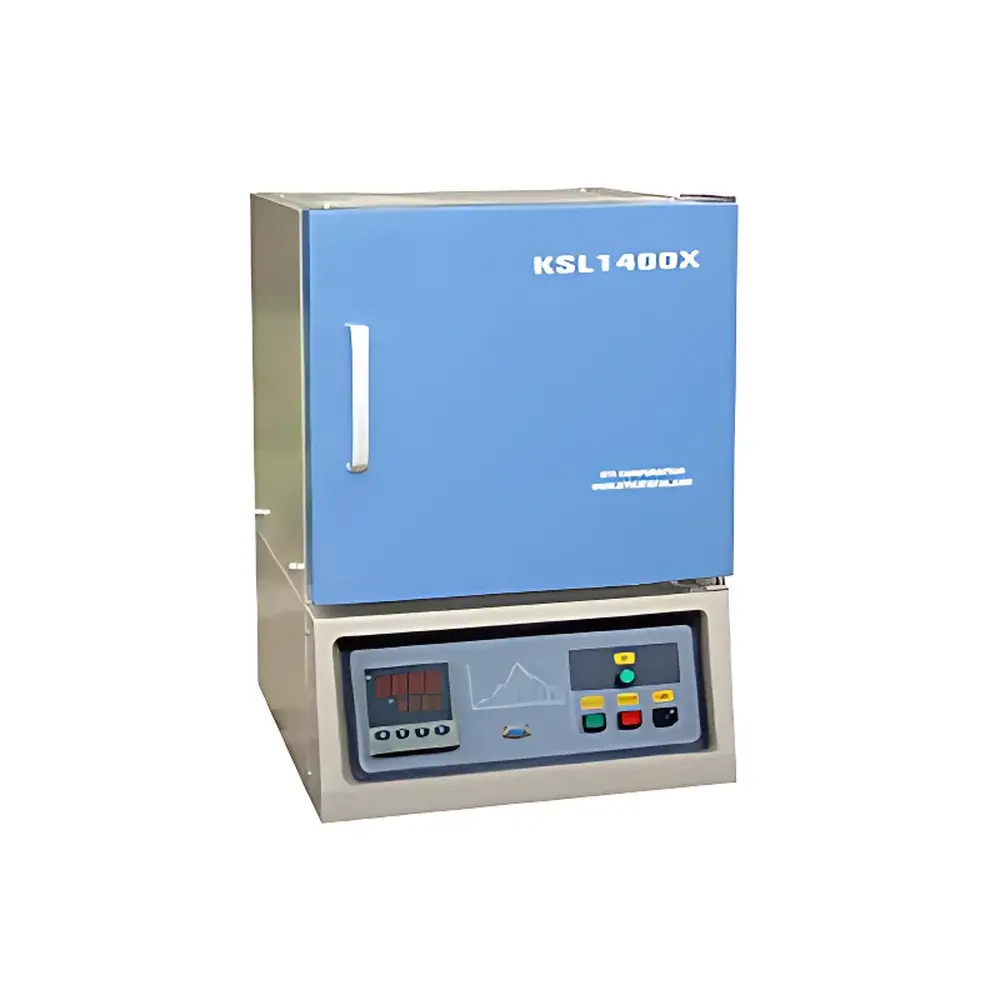
KJ GROUP KSL-1400X-A1 High-Temperature Box Furnace (3.4 L, 1400 °C)
| Brand | KJ GROUP |
|---|---|
| Origin | Anhui, China |
| Manufacturer Type | Authorized Distributor |
| Instrument Type | Box-Type Muffle Furnace |
| Model | KSL-1400X-A1 |
| Max Temperature | 1400 °C (continuous operation ≤1300 °C) |
| Temperature Control Accuracy | ±1 °C |
| Power Supply | AC 220 V, 50 Hz, 3 kW |
| Heating Rate (to max temp) | 10 °C/min |
| Heating Element | Silicon Carbide (SiC) Rods |
| Internal Chamber Dimensions | 150 mm × 150 mm × 150 mm (3.4 L) |
| Chamber Lining | High-Purity Polycrystalline Alumina Fiber with Imported Al₂O₃ Reflective Coating |
| Temperature Sensor | S-Type Single Platinum-Rhodium Thermocouple (PtRh10–Pt) |
| Controller | PID-Based Programmable Temperature Controller (30-Stage Ramp/Soak Profiles) |
| Certification | CE Compliant |
| External Dimensions | 500 mm × 490 mm × 700 mm |
| Net Weight | 120 kg |
Overview
The KJ GROUP KSL-1400X-A1 is a precision-engineered high-temperature box furnace designed for controlled thermal processing in research laboratories, materials science departments, and quality control environments. Operating on the principle of resistive heating via silicon carbide (SiC) rod elements, it delivers stable, uniform temperature distribution across its 3.4 L insulated chamber—enabling reliable annealing, sintering, ashing, calcination, and heat treatment of ceramics, metals, composites, and advanced functional materials. The furnace integrates an S-type platinum-rhodium thermocouple (PtRh10–Pt), known for its long-term stability and accuracy above 1000 °C, with a dedicated 30-segment PID programmable controller. This architecture ensures repeatable thermal profiles under both static and dynamic ramp conditions—critical for process validation and method transfer in GLP- and GMP-aligned workflows.
Key Features
- Double-walled steel enclosure with active air-gap insulation, maintaining external surface temperature below 60 °C during continuous operation at 1300 °C—enhancing operator safety and reducing ambient heat load.
- High-purity polycrystalline alumina fiber insulation (≥99.8% Al₂O₃) offering low thermal conductivity, minimal outgassing, and excellent dimensional stability up to 1400 °C.
- Internally coated chamber walls with a proprietary U.S.-sourced alumina reflective layer, increasing radiant efficiency by optimizing infrared reflectivity and reducing energy consumption per thermal cycle.
- Robust silicon carbide heating elements mounted in corrosion-resistant ceramic holders, rated for >2000 hours of service life at 1300 °C under proper operating conditions.
- CE-certified electrical architecture compliant with EN 61000-6-3 (EMC emission) and EN 61000-6-2 (immunity), supporting integration into regulated laboratory infrastructure.
- Side-opening door with high-temperature ceramic fiber gasket and mechanical latch system ensuring consistent sealing integrity and minimizing thermal leakage during hold phases.
Sample Compatibility & Compliance
The KSL-1400X-A1 accommodates standard crucibles (alumina, quartz, graphite, or molybdenum) up to 120 mm in diameter and 100 mm in height. Its non-vacuum, atmospheric-pressure design prohibits use with flammable, explosive, or reducing atmospheres (e.g., H₂, CO). While inert gas purging (N₂, Ar) is permissible via optional inlet/outlet ports, introduction of strongly corrosive species—including sulfur-containing compounds, alkali vapors (Na, K), or halogenated gases—requires prior consultation for custom chamber coating or liner upgrades. The furnace meets CE marking requirements for electrical safety and electromagnetic compatibility; however, users implementing it in FDA-regulated environments must validate thermal uniformity (per ASTM E220, IEC 60584-1), document calibration traceability (NIST-traceable S-type thermocouple), and maintain audit-ready records of controller firmware version, calibration dates, and operational logs per 21 CFR Part 11 if electronic data acquisition is employed.
Software & Data Management
The integrated 518P-series intelligent temperature controller supports local programming via membrane keypad and LCD display. It stores up to 30 independent ramp/soak segments with user-defined rates (0.1–30 °C/min), dwell times (1 min–99 h 59 min), and alarm thresholds. Optional RS485 Modbus RTU interface enables connection to SCADA systems or LabVIEW-based monitoring platforms for remote parameter setting, real-time temperature logging, and automated report generation. All thermal profiles are timestamped and retain power-failure recovery functionality. For full 21 CFR Part 11 compliance, third-party validated software solutions (e.g., WinWedge Pro with digital signature and audit trail modules) may be deployed in conjunction with external data loggers meeting ISO/IEC 17025 calibration standards.
Applications
- Sintering of oxide ceramics (Al₂O₃, ZrO₂, Y₂O₃-stabilized systems) and non-oxide ceramics (SiC, Si₃N₄).
- Thermal gravimetric analysis (TGA) pre-conditioning and residue quantification in cementitious and polymer-derived ceramic precursors.
- Heat treatment of battery cathode materials (e.g., LiCoO₂, NMC, LiFePO₄) for crystallinity optimization and phase stabilization.
- Ashing of biological, pharmaceutical, or environmental samples prior to elemental analysis (ICP-OES/MS).
- Calibration of high-temperature reference materials and inter-laboratory round-robin testing under ISO/IEC 17043 guidelines.
- Development of refractory coatings and thermal barrier systems requiring precise soak-time control at ≥1200 °C.
FAQ
What is the recommended maximum heating and cooling rate for optimal element longevity?
For extended service life of silicon carbide rods, the manufacturer specifies a maximum ramp rate of 10 °C/min—both during heating and controlled cooling. Exceeding this rate accelerates thermal stress-induced microcracking in the SiC matrix.
Can this furnace operate under vacuum or reduced pressure?
No. The KSL-1400X-A1 is designed exclusively for atmospheric-pressure operation. It lacks vacuum seals, pressure-rated construction, or gas-tight porting. Vacuum or inert-gas glovebox integration requires a purpose-built variant (e.g., KSL-1400X-V or KSL-1400X-G).
Is the S-type thermocouple calibrated and traceable to national standards?
The supplied S-type thermocouple is factory-calibrated against reference standards. Users must perform periodic recalibration using a certified dry-block calibrator or fixed-point cell (e.g., Ag, Au freezing points) traceable to NIST or equivalent NMIs—especially before critical qualification studies.
How often should the alumina fiber insulation be inspected or replaced?
Under normal usage (≤1300 °C, 5%, visible dusting, or structural collapse) compromises thermal performance or introduces particulate contamination into samples.
Does the CE marking cover electromagnetic compatibility for lab-wide networked operation?
Yes—the CE declaration includes conformity with EN 61000-6-2 (immunity) and EN 61000-6-3 (emission). However, co-location with sensitive analytical instruments (e.g., mass spectrometers, electron microscopes) warrants evaluation of local EMI levels and potential shielding requirements per IEC 61326-1.
Related Products



