
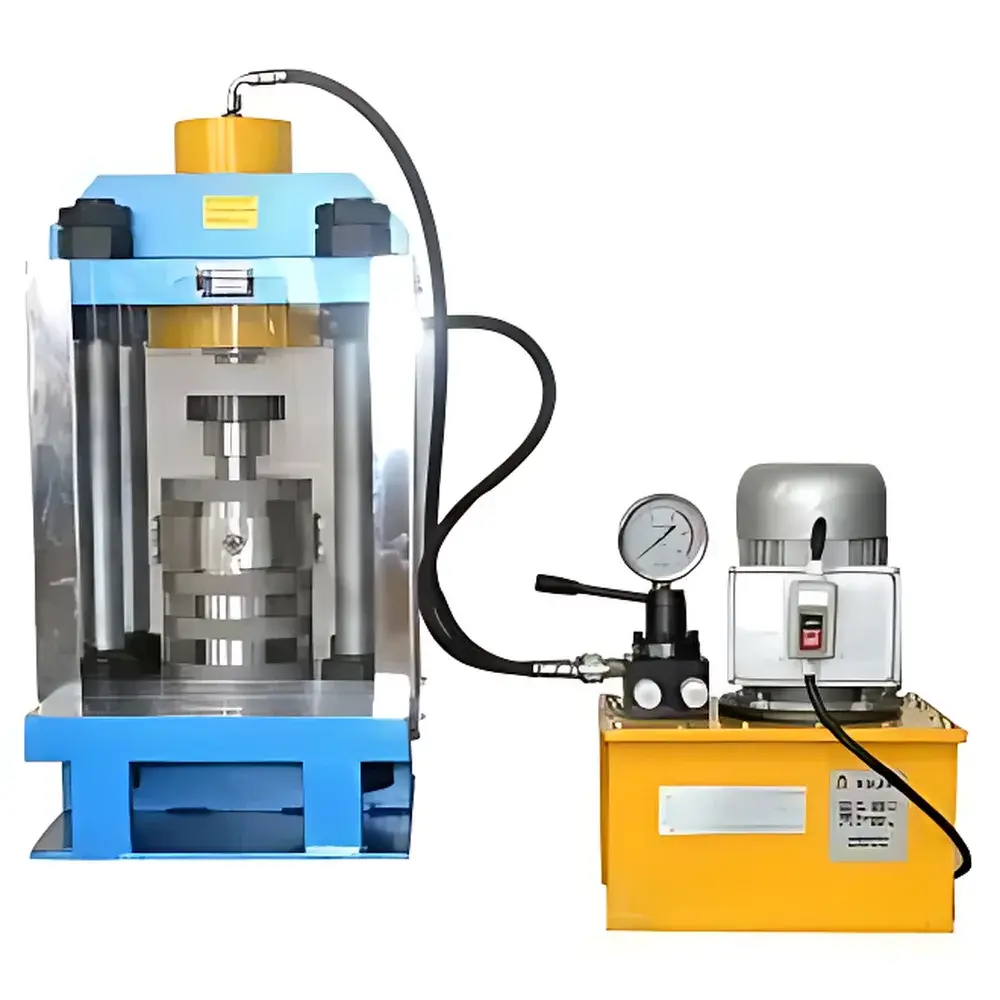
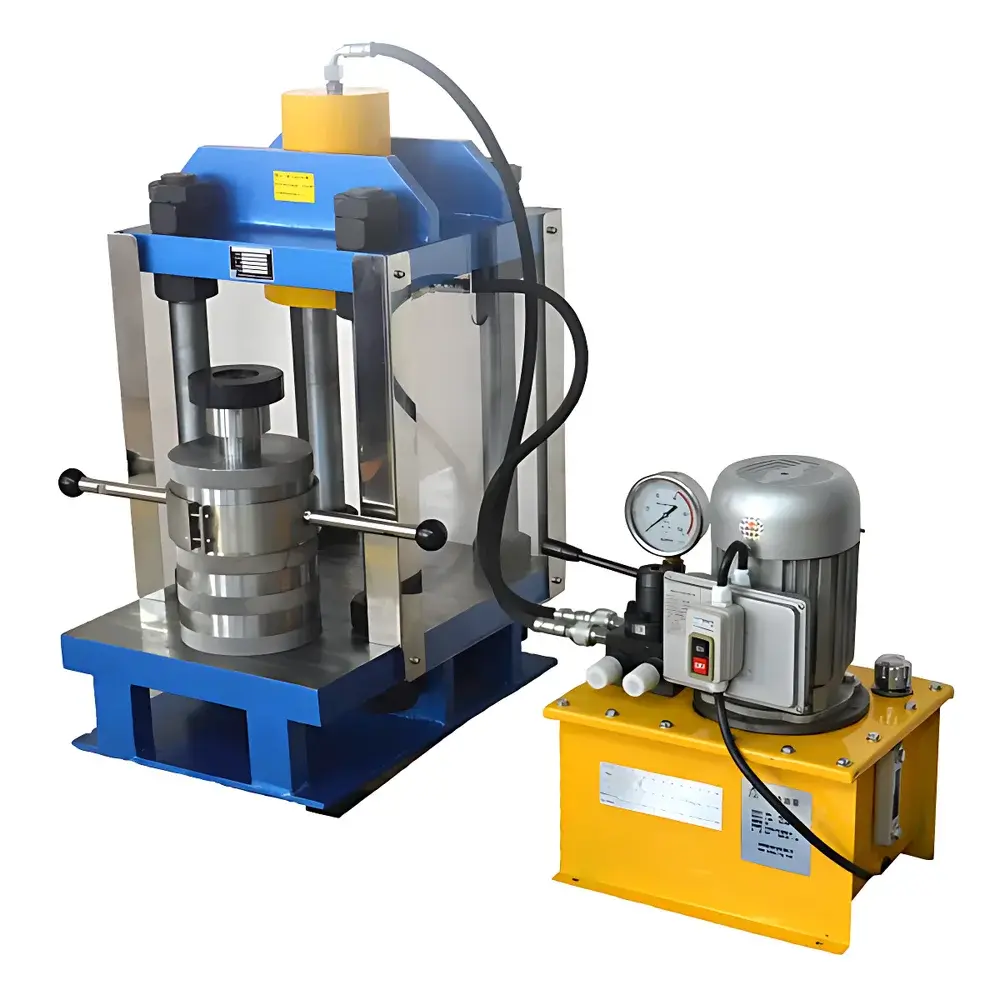
KJ GROUP CIP-50MAF Split-Body Electric Cold Isostatic Press
| Brand | KJ GROUP |
|---|---|
| Origin | Liaoning, China |
| Manufacturer Type | Authorized Distributor |
| Country of Origin | China |
| Model | CIP-50MAF |
| Quotation | Upon Request |
| Max. Applied Force | 0–65 T (637 kN) |
| Power Supply | 220 V, 50 Hz |
| Motor Power | 1.5 kW |
| Holding Time Range | 0–999 min |
| Piston Diameter | φ180 mm |
| Max. Piston Stroke | 50 mm |
| Main Frame Dimensions (W×D×H) | 335 × 225 × 870 mm |
| Control Cabinet Dimensions (W×D×H) | 220 × 200 × 420 mm |
| Control Cabinet Weight | 75 kg |
| Press Frame Weight | 145 kg |
| Maximum Mold Load Capacity | 60 T (300 MPa) |
| Pressure Chamber Bore | φ51 × 150 mm |
| Mold Dimensions | φ210 × 350 mm |
| Mold Weight | 49 kg |
| Standard Mold ID | φ50 mm |
Overview
The KJ GROUP CIP-50MAF Split-Body Electric Cold Isostatic Press is a laboratory-scale hydraulic system engineered for uniform, omnidirectional compaction of powdered materials under isostatic pressure. It operates on the principle of Pascal’s law: pressurized hydraulic fluid—typically low-viscosity mineral oil—is transmitted equally in all directions within a sealed elastomeric mold housed inside a rigid pressure chamber. This ensures homogeneous densification without preferential grain alignment or shear-induced defects, making it fundamentally distinct from uniaxial mechanical pressing. Designed specifically for academic and R&D environments, the CIP-50MAF delivers reproducible green body density enhancement across ceramic, carbide, refractory, and composite powder systems—enabling downstream sintering with minimized distortion and improved microstructural uniformity.
Key Features
- Split-body architecture separates the high-pressure press frame (145 kg) from the dedicated control cabinet (75 kg), facilitating modular installation, maintenance access, and vibration isolation in shared lab spaces.
- Electromechanically driven hydraulic pump station eliminates reliance on external compressed air or centralized hydraulics—reducing infrastructure requirements and operational noise.
- Digital time-based pressure holding (0–999 minutes) with real-time pressure monitoring ensures precise dwell control for optimizing particle rearrangement and interparticle bonding kinetics.
- Robust steel frame with integrated safety shielding conforms to ISO 13857 clearance requirements; physical interlocks prevent access during pressurization.
- Standard φ50 mm cylindrical mold set includes pre-installed sealing elements, centering fixtures, and dedicated handling tools—minimizing setup time and operator variability.
- Maximum rated chamber pressure of 300 MPa (60 T load equivalent) supports advanced ceramic formulations including silicon nitride, alumina, and zirconia requiring >60% theoretical density in green state.
Sample Compatibility & Compliance
The CIP-50MAF accommodates elastomeric molds (rubber or polyurethane) with internal diameters up to φ51 mm and lengths up to 150 mm. Compatible feedstocks include oxide ceramics (Al₂O₃, ZrO₂), non-oxides (SiC, Si₃N₄), cemented carbides (WC-Co), metal powders (Ti, Ni, stainless steel), and polymer-bonded composites. All operational procedures align with ASTM B971 (Standard Guide for Cold Isostatic Pressing of Powder Metallurgy Products) and ISO 3252 (Metallic Powders — Determination of Green Strength After Compaction). The system supports GLP-compliant documentation workflows when paired with external data loggers meeting IEC 61000-4-30 immunity standards.
Software & Data Management
While the CIP-50MAF employs a standalone digital controller with LED interface (no embedded PC or proprietary software), its analog pressure output signal (0–10 V DC) and digital timer relay contacts are compatible with third-party SCADA platforms (e.g., LabVIEW, Ignition, Siemens SIMATIC S7) for full audit trail generation. Pressure-time profiles can be recorded at user-defined intervals to support FDA 21 CFR Part 11–compliant electronic records when integrated with validated acquisition hardware and timestamped storage protocols.
Applications
- Development of near-net-shape ceramic components for aerospace thermal protection systems.
- Green body fabrication of solid oxide fuel cell (SOFC) electrolyte discs with controlled porosity gradients.
- Consolidation of nanostructured tungsten heavy alloys for radiation shielding prototypes.
- Processing of binder-jetted metal parts prior to debinding and sintering to suppress warpage.
- Teaching laboratories demonstrating fundamental powder consolidation mechanics and density–pressure relationships per ASTM B243.
FAQ
Can the standard φ50 mm mold be replaced with a custom-sized elastomeric mold?
Yes—provided the outer diameter does not exceed φ51 mm and total length remains ≤150 mm to maintain chamber seal integrity and pressure containment rating.
Is the system suitable for hot isostatic pressing (HIP)?
No—the CIP-50MAF is strictly a cold isostatic press (CIP); it lacks integrated heating elements, inert gas purge capability, or vacuum-rated pressure vessels required for HIP.
What safety certifications does the unit carry?
The press frame and control cabinet comply with CE marking requirements under Machinery Directive 2006/42/EC and Low Voltage Directive 2014/35/EU; full test reports are available upon request for institutional procurement review.
Does the system require periodic calibration?
Yes—annual verification of pressure transducer accuracy against NIST-traceable deadweight testers is recommended to maintain ASTM E4 compliance for force measurement uncertainty.
Can the holding time be interrupted and resumed manually?
Yes—the digital timer allows pausing and resuming without resetting; however, pressure decay during pause must be monitored independently using the analog output signal.



