
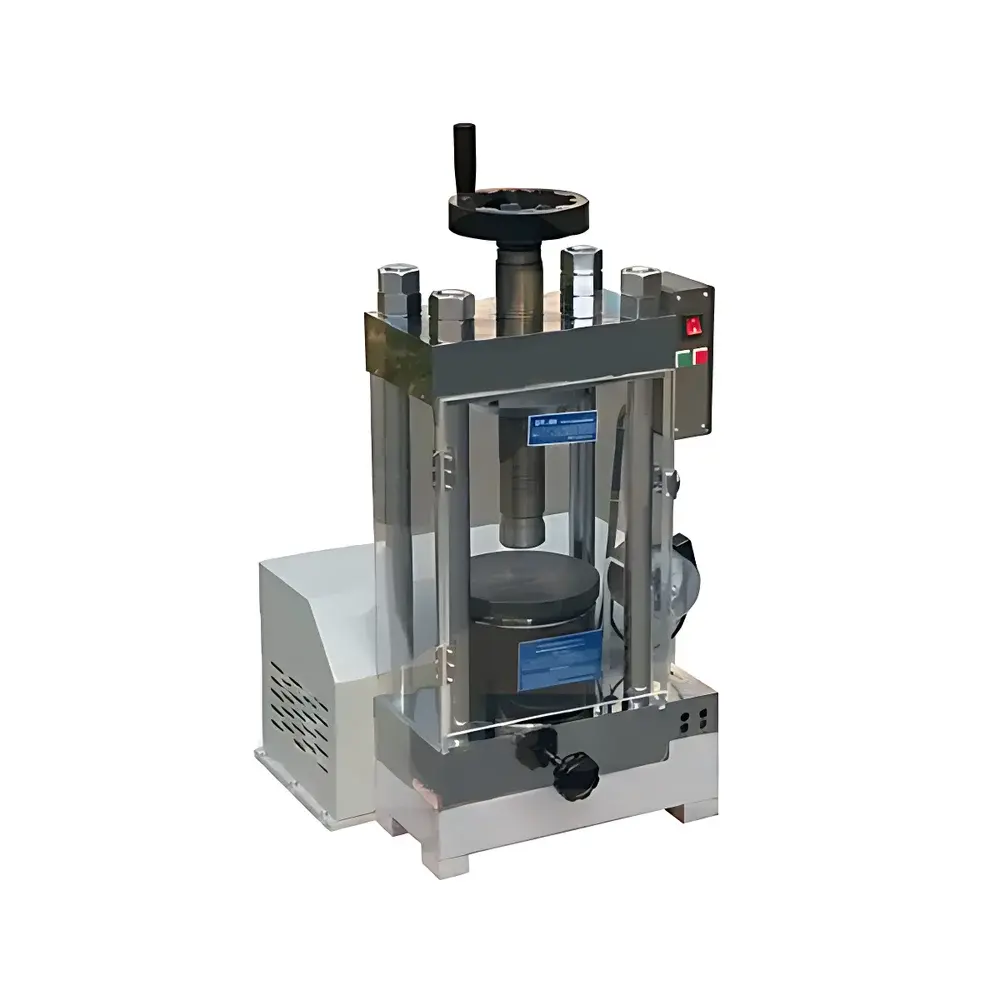
KJ GROUP YLJ-60TA Electric Hydraulic Pellet Press
| Brand | KJ GROUP |
|---|---|
| Origin | Liaoning, China |
| Manufacturer Type | Authorized Distributor |
| Country of Origin | China |
| Model | YLJ-60TA |
| Instrument Type | Semi-Automatic Hydraulic Pellet Press |
| Power Supply | AC 220 V, 50 Hz |
| Rated Power | 180 W |
| Maximum Pressure | 0–60 Ton (≈0–588 kN) |
| Pressure Stability | ≤1 MPa per 5 min |
| Cylinder Stroke | 0–20 mm (optional: 0–50 mm) |
| Working Chamber Dimensions | 220 mm × 220 mm × 280 mm (W×D×H) |
| Platen Diameter | Ø190 mm |
| Piston Diameter | Ø150 mm |
| Max. Piston Travel | 50 mm |
| Overall Dimensions | 480 mm × 380 mm × 720 mm (W×D×H) |
| Net Weight | 160 kg |
Overview
The KJ GROUP YLJ-60TA Electric Hydraulic Pellet Press is a semi-automatic laboratory-scale hydraulic press engineered for reproducible, high-force compaction of powdered samples into dense, dimensionally stable pellets—essential for quantitative elemental and molecular analysis. Operating on the principle of controlled hydraulic force transmission via an electrically driven pump system, the YLJ-60TA delivers precise pressure application within a rigid C-frame architecture, minimizing frame deflection and ensuring uniform stress distribution across the die cavity. Its design adheres to fundamental mechanical standards for laboratory pelletization, supporting standardized sample preparation workflows required by ASTM E1336 (for XRF pellet preparation), ISO 12845 (for pressed-pellet methodology in geochemical analysis), and USP (for pharmaceutical solid dosage form development). The press is routinely deployed prior to spectroscopic analysis—including wavelength-dispersive X-ray fluorescence (WD-XRF), energy-dispersive XRF (ED-XRF), Fourier-transform infrared (FTIR) spectroscopy, and X-ray diffraction (XRD)—where homogeneity, surface flatness, and binder-free integrity are critical for calibration accuracy and inter-laboratory comparability.
Key Features
- Electric-hydraulic actuation enables rapid pressurization (≤15 s to reach 60 T) and equally fast demolding—reducing cycle time without compromising dwell consistency.
- Integrated pressure-hold circuit maintains setpoint stability at ≤1 MPa drift over 5 minutes, ensuring minimal relaxation during critical consolidation phases (e.g., for low-cohesion ceramics or battery cathode powders).
- Low-noise operation (<65 dB(A)) achieved through optimized gear-motor coupling and sealed hydraulic reservoir design—suitable for shared analytical lab environments with acoustic sensitivity requirements.
- Robust C-frame construction (high-tensile steel, precision-machined platens) guarantees parallelism tolerance <0.02 mm/m across the Ø190 mm platen surface, directly contributing to uniform pellet thickness and density distribution.
- Safety interlock system prevents unintended ram movement during loading/unloading; emergency stop button complies with IEC 60204-1 machinery safety directives.
Sample Compatibility & Compliance
The YLJ-60TA accommodates standard die sets (including 13 mm, 32 mm, and custom-diameter tooling) and supports both single- and multi-layer pellet fabrication. It is compatible with common binders (e.g., boric acid, cellulose, wax-based matrices) and binder-free compaction protocols for conductive materials (e.g., LiCoO₂, SiC, YBCO superconductors). All operational parameters—including pressure ramp rate, dwell time, and decompression profile—are manually adjustable to meet method-specific requirements outlined in ASTM D7348 (for coal ash analysis), ISO 29581-1 (cement XRF prep), and GLP-aligned internal SOPs. The unit’s mechanical design conforms to CE marking prerequisites for laboratory equipment (2006/42/EC Machinery Directive), and its pressure control system supports audit-ready documentation when integrated with external data loggers.
Software & Data Management
As a semi-automatic press, the YLJ-60TA does not include embedded digital control software or onboard data storage. However, its analog pressure gauge (0–60 T, ±1.5% FS) and mechanical dwell timer (0–999 s) provide traceable, operator-recorded parameters suitable for paper-based or LIMS-integrated batch records. For laboratories requiring electronic audit trails, the press can be paired with third-party pressure transducers (e.g., 4–20 mA output sensors) and validated SCADA-compatible acquisition systems compliant with FDA 21 CFR Part 11 for electronic signatures and data integrity.
Applications
- Preparation of homogeneous pressed pellets for quantitative XRF analysis of geological, metallurgical, and environmental samples.
- Consolidation of ceramic green bodies (e.g., Al₂O₃, ZrO₂) and advanced functional oxides for sintering trials and phase-purity evaluation.
- Routine tablet formation in R&D labs developing solid-state battery electrodes, fuel cell catalyst layers, or thermoelectric modules.
- IR spectroscopy sample support—producing translucent KBr or polyethylene pellets with minimal scattering artifacts.
- Reference material certification workflows where certified pellet density and dimensional repeatability are prerequisite for uncertainty budgeting.
FAQ
What is the maximum recommended operating pressure for routine use?
The rated maximum pressure is 60 metric tons (588 kN); however, for optimal long-term cylinder seal life and pressure stability, continuous operation above 50 T is discouraged unless validated for specific high-density applications.
Can the YLJ-60TA be used with evacuated or inert-atmosphere die enclosures?
Yes—the open-top C-frame design permits integration with glovebox-compatible die holders or vacuum-sealed pressing chambers (up to 10⁻² mbar), provided external vacuum feedthroughs and O-ring sealing interfaces are mechanically secured.
Is calibration certification available for this model?
KJ GROUP provides factory-assembled verification reports (traceable to CNAS-accredited force standards); full ISO/IEC 17025 calibration with uncertainty budgets requires engagement of an accredited third-party metrology lab.
What maintenance intervals are recommended for hydraulic oil and seals?
Hydraulic oil (ISO VG 46 anti-wear mineral oil) should be replaced every 1,500 operating hours or biannually; piston rod seals and O-rings are inspected during each oil change and replaced every 3,000 hours or per visual wear assessment.
Does the press meet requirements for GMP-regulated pharmaceutical development?
While the YLJ-60TA itself is not GMP-certified, its mechanical reliability, pressure repeatability, and compatibility with documented SOPs enable its use in non-sterile pharmaceutical R&D settings—provided users implement supplementary controls for cleaning validation, equipment logbooks, and change management per ICH Q7 Annex 19.



