
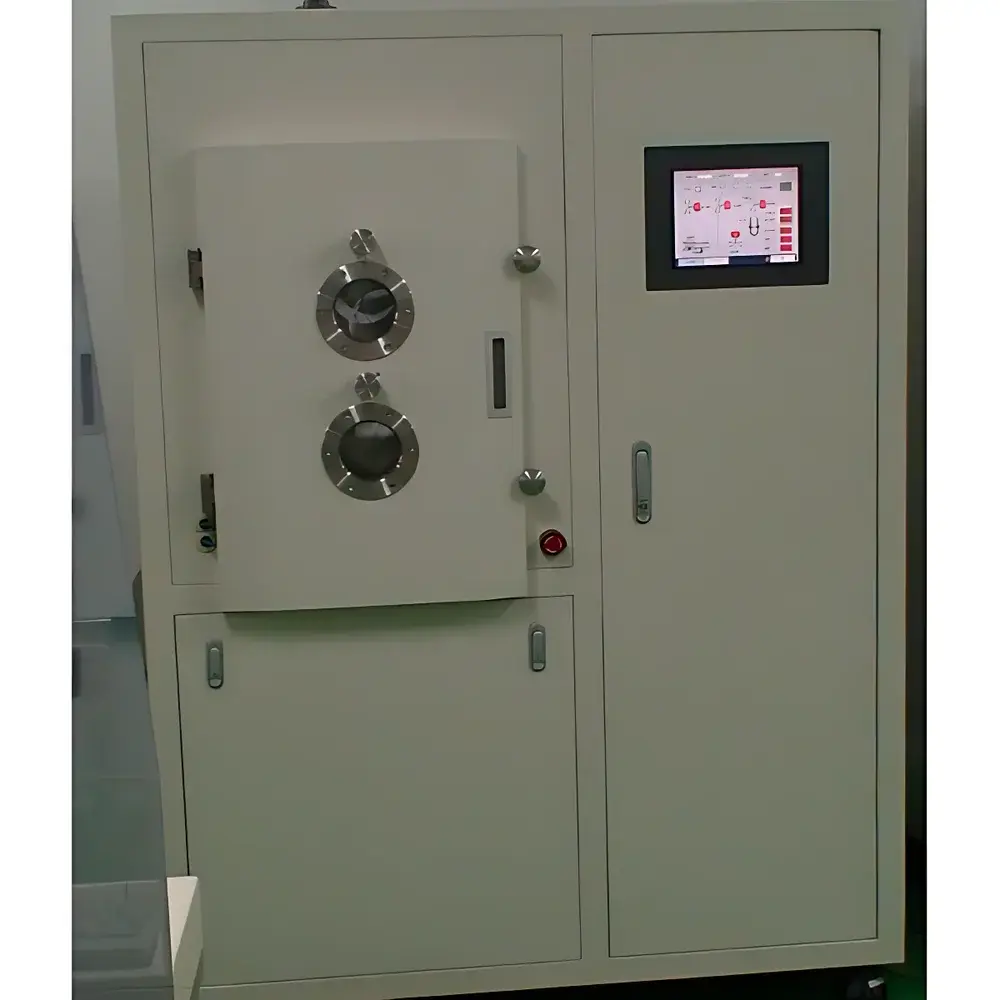
KJ GROUP GSL-ZDDZS-500 Electron Beam Evaporator
| Brand | KJ GROUP |
|---|---|
| Origin | Liaoning, China |
| Manufacturer Type | Authorized Distributor |
| Country of Origin | China |
| Model | GSL-ZDDZS-500 |
| Pricing | Upon Request |
| Ultimate Vacuum | ≤6.67×10⁻⁵ Pa (after bake-out) |
| Leak Rate | ≤5.0×10⁻⁷ Pa·L/s |
| Base Pressure Recovery | 6.6×10⁻⁴ Pa within 45 min after N₂ purge and pump-down |
| Chamber Dimensions | Ø500 mm × 600 mm (U-shaped, 304 stainless steel, electropolished, metal or Viton-sealed) |
| Substrate Holder | Accommodates Ø4″ wafers with manual shutter |
| E-Gun | E-type, anode voltage 6 kV / 8 kV |
| Cooling | Integrated recirculating chiller (deionized water, <25 °C, 0.25–0.4 MPa, ≥12 L/min) |
| Electrical Supply | AC 380 V, 50 Hz, ≥10 kW, voltage fluctuation <±6%, grounding resistance <2 Ω |
| Process Gas | High-purity N₂ or Ar (≥99.99%, supplied via 10 mm double-ferrule fitting with regulator) |
| Footprint | 1800 mm × 1200 mm × 2000 mm (W×D×H) |
| Ventilation | Required external exhaust ducting |
Overview
The KJ GROUP GSL-ZDDZS-500 Electron Beam Evaporator is a compact, high-vacuum thin-film deposition system engineered for precision physical vapor deposition (PVD) of refractory metals, oxides, nitrides, and compound semiconductors. It operates on the principle of electron beam heating: a focused, high-energy electron beam impinges upon a solid target material contained in a water-cooled copper crucible, inducing localized melting and evaporation without bulk heating of the crucible itself. This enables clean, high-purity film growth—critical for superconducting, ferroelectric, semiconductor, and ultra-hard coating applications in academic research and small-batch R&D environments. The system achieves ultimate vacuum levels ≤6.67×10⁻⁵ Pa following chamber bake-out and maintains exceptional leak integrity (<5.0×10⁻⁷ Pa·L/s), ensuring low background gas incorporation and minimal oxidation during deposition. Its U-shaped 304 stainless steel vacuum chamber (Ø500 × 600 mm) features electropolished interior surfaces, metal or Viton-sealed flanges, and front-hinged access with dual observation ports—facilitating real-time visual monitoring of both e-gun operation and substrate behavior.
Key Features
- High-power E-type electron gun with selectable anode voltages (6 kV / 8 kV) and continuously adjustable beam power (0–6 kW), enabling stable evaporation of high-melting-point materials including W, Mo, Ta, TiN, Al₂O₃, and YBCO.
- Water-cooled quad-pocket copper crucible (11 mL per pocket) minimizes thermal cross-contamination and eliminates crucible-derived impurities—essential for high-purity epitaxial and stoichiometric film synthesis.
- Compact footprint (1800 × 1200 × 2000 mm) and front-access chamber design simplify integration into space-constrained laboratories and streamline substrate loading, crucible servicing, and routine maintenance.
- Substrate stage with closed-loop thermocouple-controlled heating (up to 800 °C ±1 °C), continuous rotation (5–60 rpm), and precise vertical adjustment (300–350 mm from source) ensures uniform thickness distribution and controlled interfacial kinetics.
- Integrated recirculating chiller system (compatible with deionized water), high-vacuum molecular pumping station with gate valve isolation, and modular instrumentation interfaces support reproducible process execution under ISO/IEC 17025-aligned laboratory conditions.
Sample Compatibility & Compliance
The GSL-ZDDZS-500 supports deposition onto standard Ø4″ (100 mm) substrates—including Si, sapphire, MgO, SrTiO₃, quartz, and flexible metallic foils—with optional manual shutter control for sequential multilayer fabrication. Its vacuum architecture complies with widely adopted safety and performance benchmarks for Class II PVD systems, including ISO 27423 (vacuum system leak testing), ASTM F1470 (vacuum chamber surface cleanliness), and IEC 61000-6-3 (EMC emission limits). While not certified for GMP production, its stable thermal control, repeatable vacuum recovery profile (≤45 min to 6.6×10⁻⁴ Pa post-N₂ purge), and traceable parameter logging capability make it suitable for GLP-compliant research workflows where audit-ready process documentation is required.
Software & Data Management
The system employs a dedicated industrial PLC-based control interface with analog and digital I/O modules for synchronized regulation of e-beam power, substrate temperature, rotation speed, vacuum pressure, and cooling flow. All operational parameters—including real-time thermocouple readings, chamber pressure traces, and beam current/voltage logs—are timestamped and exportable in CSV format. Optional RS-485 or Ethernet connectivity allows integration with centralized lab data management platforms. Though no proprietary software suite is bundled, the controller’s open communication protocol supports third-party SCADA or LIMS interfacing, facilitating alignment with FDA 21 CFR Part 11 requirements when paired with validated electronic signature and audit trail modules.
Applications
- Growth of high-Tc superconducting thin films (e.g., YBa₂Cu₃O₇₋δ on STO substrates) requiring precise stoichiometry and low oxygen partial pressure control.
- Deposition of transparent conductive oxides (ITO, AZO) and dielectric layers (SiO₂, Al₂O₃, HfO₂) for optoelectronic device prototyping.
- Fabrication of hard wear-resistant coatings (TiN, CrN, DLC composites) on microelectromechanical systems (MEMS) components.
- Preparation of ferroelectric Pb(Zr,Ti)O₃ (PZT) and BiFeO₃ films for non-volatile memory and piezoelectric sensor development.
- In-situ multi-step evaporation sequences enabled by quad-pocket crucible configuration—ideal for graded heterostructures and interfacial engineering studies.
FAQ
What vacuum level is required before initiating electron beam evaporation?
A base pressure ≤1×10⁻⁴ Pa is recommended prior to beam activation; the system achieves ≤6.67×10⁻⁵ Pa after chamber bake-out at 150 °C for 6 hours.
Can the system be configured for reactive evaporation (e.g., with O₂ or N₂ partial pressure)?
Yes—the chamber includes a dedicated mass flow controller (MFC) port and calibrated leak valve option for introducing reactive gases at controlled partial pressures up to 1×10⁻² Pa.
Is the substrate heater compatible with ultra-high vacuum (UHV) conditions?
The resistive heater and K-type thermocouple assembly are UHV-compatible when operated below 800 °C; outgassing rates remain within acceptable limits for extended deposition runs.
What maintenance intervals are recommended for the electron gun and water-cooling system?
Crucible inspection and tungsten filament replacement are advised every 200–300 operating hours; chiller fluid (deionized water) should be replaced quarterly and conductivity monitored weekly.
Does the system support automated recipe storage and recall?
The PLC controller stores up to 32 user-defined process profiles with parameter setpoints, ramp rates, and dwell times—accessible via password-protected front-panel navigation.



