
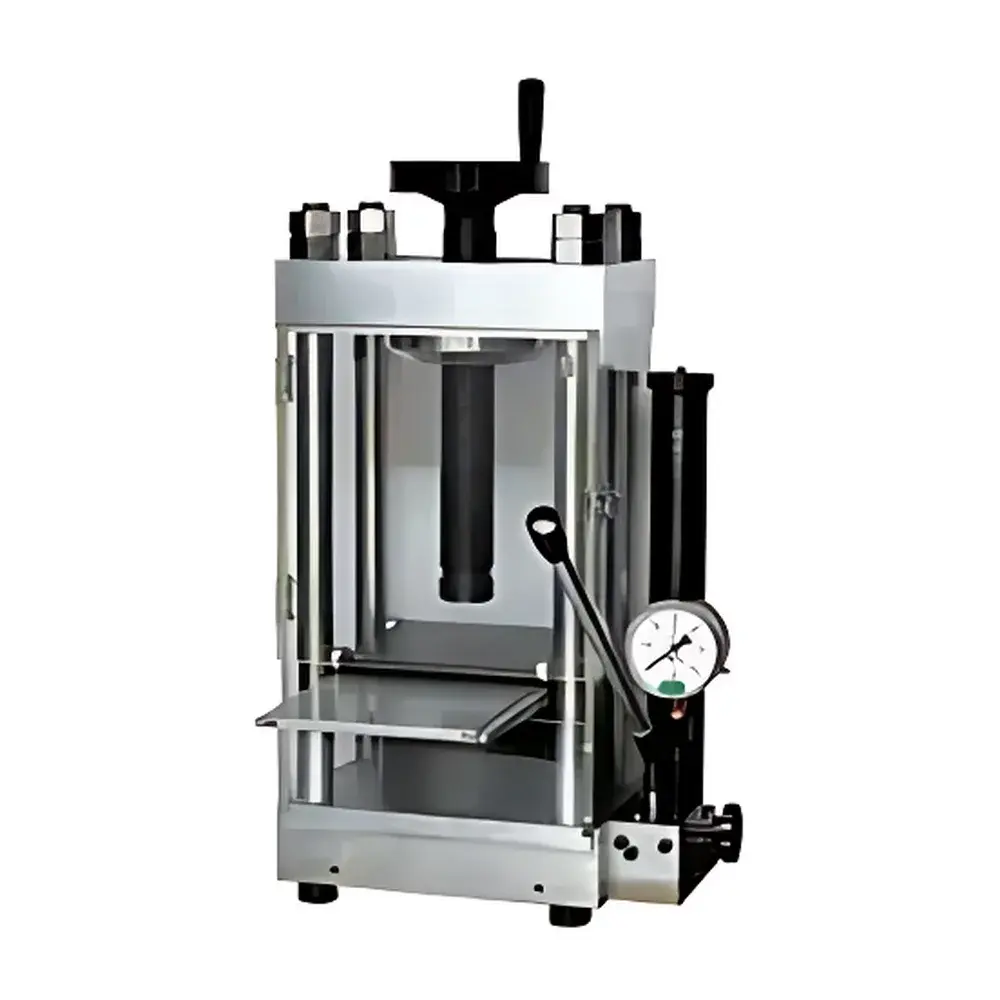
KJ GROUP YLJ-60T Manual Hydraulic Pellet Press
| Brand | KJ GROUP |
|---|---|
| Origin | Liaoning, China |
| Manufacturer Type | Authorized Distributor |
| Country of Origin | China |
| Model | YLJ-60T |
| Instrument Type | Manual Hydraulic Pellet Press |
| Maximum Pressure | 0–60 Ton (≈0–588 kN) |
| Gauge Pressure Range | 0–34 MPa |
| Piston Stroke | ≤40 mm |
| Working Chamber Dimensions | 220 mm × 220 mm × 260 mm (W×D×H) |
| Pressure Stability | ≤1 MPa drop per 5 minutes |
| Overall Dimensions | 445 mm × 240 mm × 740 mm (W×D×H) |
| Net Weight | 155 kg |
| Hydraulic Fluid | ISO VG 46 Mineral Oil |
Overview
The KJ GROUP YLJ-60T Manual Hydraulic Pellet Press is a precision-engineered laboratory press designed for reproducible, high-force sample compaction under controlled mechanical loading. Operating on a direct-acting hydraulic principle, the press utilizes a manually actuated dual-stage pump system to generate compressive forces up to 60 metric tons (588 kN) within a rigid C-frame architecture. Its core function is to consolidate powdered or granular specimens—including catalysts, battery electrode materials, ceramic precursors, metallurgical powders, and geological samples—into geometrically defined pellets or cylindrical briquettes suitable for quantitative elemental analysis, spectroscopic characterization, and physical property evaluation. The device complies with fundamental mechanical safety principles outlined in ISO 12100 and incorporates pressure-holding stability critical for ASTM E1779-compliant pellet preparation in X-ray fluorescence (XRF) and Fourier-transform infrared (FTIR) sample workflows.
Key Features
- Rugged C-frame construction with high-tensile steel columns and precision-machined load-bearing surfaces ensures long-term dimensional stability and minimal frame deflection under maximum load.
- Two-stage manual hydraulic pump enables fine pressure control: low-force pre-compaction via small piston, followed by high-force consolidation using the main 60-ton piston—optimized for both delicate pre-forming and final densification.
- Adjustable vertical clearance (up to 260 mm height) and generous working chamber (220 mm × 220 mm footprint) accommodate standard and custom die sets—including stainless steel, hardened tool steel, and tungsten carbide dies for corrosive or abrasive samples.
- Integrated analog pressure gauge (0–34 MPa range) with ±1.5% full-scale accuracy provides real-time force monitoring; calibrated against traceable dead-weight standards.
- Pressure retention performance ≤1 MPa/5 min meets ISO 7500-1 Class 2 requirements for static load holding, essential for uniform density distribution across pellet cross-sections.
- Modular oil reservoir with ISO VG 46 hydraulic fluid and sealed quick-disconnect fittings minimizes contamination risk and simplifies maintenance in GLP-compliant environments.
Sample Compatibility & Compliance
The YLJ-60T supports universal die compatibility per ISO 17353 and ASTM D7420 specifications, enabling fabrication of 13 mm, 32 mm, and custom-diameter pellets for XRF fusion disks, IR KBr tablets, and electrochemical electrode discs. It is routinely deployed in accredited laboratories preparing samples for USP , ISO 18385, and IEC 62321-5 compliant testing. All structural components conform to RoHS Directive 2011/65/EU material restrictions. The press does not incorporate electronic controls or data logging; therefore, it falls outside FDA 21 CFR Part 11 scope but remains fully compatible with audit-trail-enabled downstream analytical instruments (e.g., Rigaku ZSX Primus IV, Thermo Scientific Nicolet iS50).
Software & Data Management
As a purely mechanical, non-electronic instrument, the YLJ-60T requires no embedded firmware, drivers, or proprietary software. Force application is operator-determined and documented manually via lab notebook entries or LIMS-integrated digital forms. Users are advised to record: applied gauge pressure (MPa), corresponding tonnage (via calibration curve), dwell time, die geometry, and sample mass—enabling full traceability per ISO/IEC 17025:2017 clause 7.7. Calibration certificates (traceable to NIM, China) are provided with each unit and recommended annually or after 500 operational cycles.
Applications
- XRF sample preparation: Production of homogeneous fused beads and pressed powder pellets for major/minor element quantification in cement, ores, and environmental soils.
- FTIR spectroscopy: High-transparency KBr or polyethylene matrix pellets for functional group identification in polymers, pharmaceuticals, and nanomaterials.
- Battery R&D: Electrode slurry compaction into standardized 10–16 mm discs for coin-cell assembly and impedance spectroscopy.
- Catalyst testing: Fabrication of mechanically stable, gas-permeable monoliths for fixed-bed reactor screening under simulated industrial conditions.
- Geological analysis: Preparation of consolidated rock powder tablets for portable XRF field validation and petrographic correlation studies.
FAQ
What is the maximum safe operating pressure, and how is overpressure prevented?
The rated maximum hydraulic pressure is 34 MPa (60 ton force). Overpressure is physically constrained by the pump’s pressure relief mechanism and must never be exceeded—exceeding this limit risks seal failure, column deformation, or catastrophic oil ejection.
Can the press be used with corrosive or high-temperature die materials?
Yes—provided die sets are constructed from chemically resistant alloys (e.g., Inconel 718, Hastelloy C-276) and thermal expansion differentials are accounted for during dwell time selection. The press itself operates at ambient temperature only.
How often should hydraulic oil be replaced, and what is the procedure?
ISO VG 46 mineral oil must be replaced every 12 months or after 2000 compression cycles, whichever occurs first. Drainage requires closing the rear service valve, opening the reservoir drain plug, and refilling to the marked level while bleeding air from the pump head.
Is technical support available for calibration and maintenance outside China?
KJ GROUP maintains authorized service partners in Germany, USA, and Singapore. On-site calibration and preventive maintenance kits—including O-rings, pressure gauge assemblies, and die alignment tools—are available under contract.
Does the YLJ-60T meet CE or UL certification requirements?
It carries CE marking per Machinery Directive 2006/42/EC Annex IV (Category 1 hazardous machinery), verified by TÜV Rheinland. UL listing is not applicable as the device contains no electrical components.



