

COMECAUSE IN-DM Rice Appearance Quality Analyzer
| Brand | COMECAUSE |
|---|---|
| Origin | Shandong, China |
| Manufacturer Type | Direct Manufacturer |
| Model | IN-DM |
| Optical Resolution | 4800 × 9600 dpi |
| Scan Area (Transmissive) | 30 cm × 20 cm |
| Minimum Pixel Size | 0.0053 mm × 0.0026 mm |
| Measurement Accuracy (Length) | ≤ ±0.05 mm |
| Length-to-Width Ratio Accuracy | ≤ ±0.05 |
| Repeatability Error (Morphometric Parameters) | ≤ ±0.02 |
| Whole-Milled Kernel Rate & Broken Kernel Rate Accuracy | ≤ ±1.0% |
| Repeatability Error (Rate Metrics) | ≤ ±0.25% |
| Grain Counting Accuracy (Auto) | ≥ 99%, 100% after manual correction |
| Detectable Grain Size Range | 0.25–20 mm |
| Compliance Standards | GB/T 1350, GB/T 17891, GB 1354–2018, NY/T 2334–2013, LS/T 6116–2016, LS/T 3247–2017, GB/T 35881–2018, NY/T 832–2004 |
Overview
The COMECAUSE IN-DM Rice Appearance Quality Analyzer is an industrial-grade image-based metrology system engineered for objective, high-throughput assessment of morphological and optical quality parameters in paddy rice, milled rice, glutinous rice, brown rice, and black rice. It operates on the principle of high-resolution transmissive color imaging combined with adaptive computer vision algorithms to extract sub-pixel-level geometric features—including area, length, width, aspect ratio, equivalent diameter, roundness—and optical attributes such as whiteness index, yellowness index, translucency grade, chalkiness degree/rate, blackness degree (for black rice), and color heterogeneity. Designed specifically for grain laboratories, seed certification centers, and rice processing QA/QC departments, the IN-DM delivers standardized, auditable measurements aligned with national and industry reference methods—eliminating subjective visual grading and enabling traceable, reproducible data generation under GLP-compliant workflows.
Key Features
- High-fidelity dual-illumination A4+ transmissive scanner with 4800 × 9600 dpi optical resolution and 30 cm × 20 cm active scan area—optimized for uniform backlighting and minimal shadow artifacts across heterogeneous grain beds.
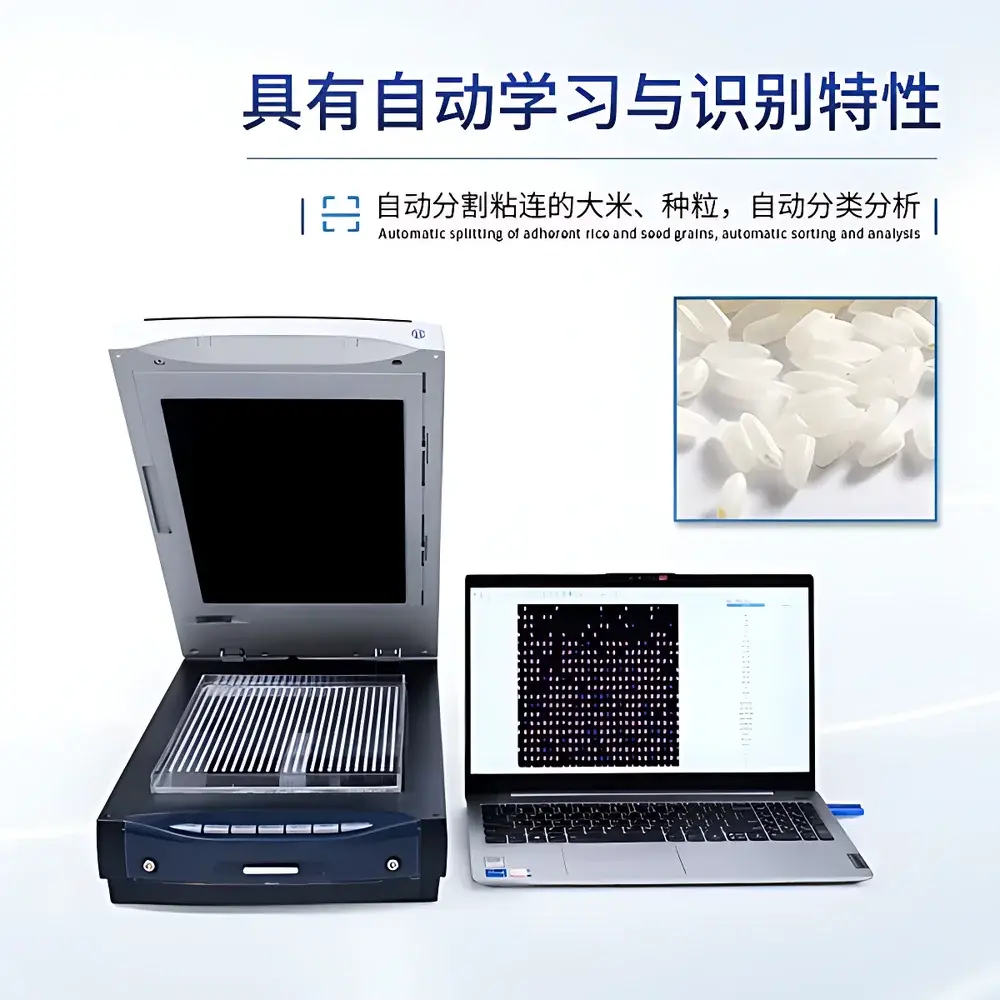
- Automated segmentation engine with deep-learning-assisted adhesion splitting: reliably separates touching or overlapping grains (including irregularly shaped or cracked kernels) without user intervention.
- Multi-parameter simultaneous quantification per kernel: area (mm²), length (mm), width (mm), aspect ratio, equivalent diameter (mm), roundness (dimensionless), chalky area ratio (%), broken kernel count/percentage, head rice count/percentage, yellow grain count/percentage, foreign matter mass/percentage, immature kernel count, fissure detection rate, and glutinous rice yin-mi rate.
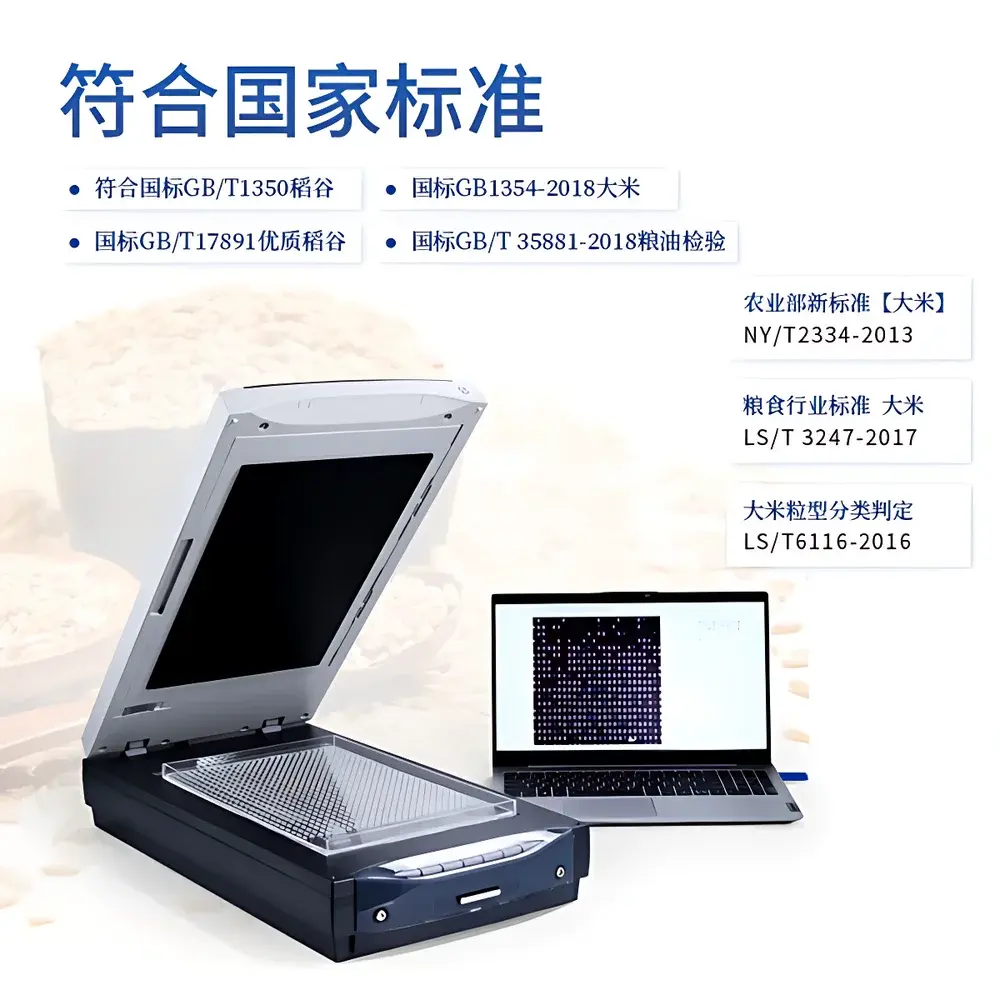
- Compliance-ready analysis modules calibrated against Chinese national standards—including GB/T 1350 (paddy), GB/T 17891 (premium paddy), GB 1354–2018 (milled rice), NY/T 2334–2013 (rice quality specification), LS/T 6116–2016 (grain type classification), LS/T 3247–2017 (specialty rice), GB/T 35881–2018 (yellow grain determination via image analysis), and NY/T 832–2004 (black rice evaluation).
- Integrated hardware interfaces: RS232 port for direct integration with analytical balances; barcode scanner support for sample tracking; USB 3.0 connectivity for software lock and firmware updates.
- Cloud-enabled architecture: encrypted data synchronization to secure web portal with role-based access control, audit trail logging, and long-term archival—supporting remote review, cross-site comparison, and regulatory inspection readiness.
Sample Compatibility & Compliance
The IN-DM accommodates a broad spectrum of cereal grain forms—from intact paddy and brown rice to polished white rice, glutinous rice, parboiled rice, and black rice—with no reconfiguration required. Its 0.25–20 mm detectable size range covers standard cultivars as well as specialty varieties (e.g., japonica, indica, aromatic, and hybrid lines). All measurement protocols adhere strictly to statutory definitions in referenced standards, ensuring metrological equivalence during inter-laboratory validation studies. The system supports both mass-based (%) and count-based (%) reporting modes, with automatic conversion between grain count and weight using user-defined average kernel mass. Data outputs include full-resolution annotated TIFF images, statistical distribution histograms (by length, width, area), scatter plots (length vs. width), and cumulative frequency curves—each embedded with timestamp, operator ID, instrument serial number, and calibration certificate ID for full traceability.
Software & Data Management
The proprietary COMECAUSE GrainVision™ analysis suite runs on Windows-based laptops (included) and provides a validated, FDA 21 CFR Part 11–ready environment. Core functionalities include batch import/export (CSV, XLSX), customizable report templates (PDF/Excel), real-time result preview with interactive zoom/pan, and granular permission settings for data export restrictions. Audit trails record every action—including parameter modification, manual correction events, and image annotation changes—with immutable timestamps and operator signatures. Raw image archives are stored locally with SHA-256 checksum verification; cloud backups retain versioned history for up to 12 months. Optional API integration enables bidirectional data exchange with LIMS platforms via RESTful endpoints compliant with HL7 FHIR standards.
Applications
- Rice breeding programs: high-throughput phenotyping of grain shape, chalkiness, and translucency traits across segregating populations.
- Grain procurement & trading: objective verification of contract-specified quality grades prior to bulk acceptance.
- Mill process optimization: real-time monitoring of head rice yield, breakage patterns, and polishing uniformity across production shifts.
- Regulatory compliance testing: certified testing labs performing official inspections under CNAS/ISO/IEC 17025 accreditation scopes.
- Research in postharvest physiology: quantitative correlation of fissure formation, moisture gradient effects, and storage-induced discoloration.
- Seed certification: varietal purity assessment via morphometric clustering and outlier detection in mixed lots.
FAQ
Does the IN-DM require manual thresholding or parameter tuning for different rice types?
No. The system employs adaptive illumination normalization and self-calibrating segmentation models trained on >12,000 labeled grain images across 47 cultivars—requiring zero user-defined thresholds for routine operation.
Can it distinguish between natural chalkiness and surface contamination?
Yes. Multi-spectral reflectance modeling (via RGB channel decomposition and HSV space filtering) differentiates internal opaque regions from external dust or oil film based on edge sharpness, texture homogeneity, and chromatic deviation.
Is the software validated for GMP/GLP environments?
Yes. Full IQ/OQ/PQ documentation packages—including installation qualification checklists, operational performance tests (e.g., repeatability across 5 operators, 3 days, 10 replicates), and electronic signature configuration guides—are provided with each unit.
What is the maximum throughput per hour?
With automated tray loading and parallel image acquisition + analysis pipelines, the system processes up to 400 g batches (~2,500–3,200 kernels) in under 90 seconds, achieving ~40 samples/hour at full capacity.
Does it support third-party calibration verification tools?
Yes. NIST-traceable ceramic grain phantoms (available as optional accessory) enable periodic verification of pixel-to-mm mapping accuracy and color fidelity across time and instruments.