
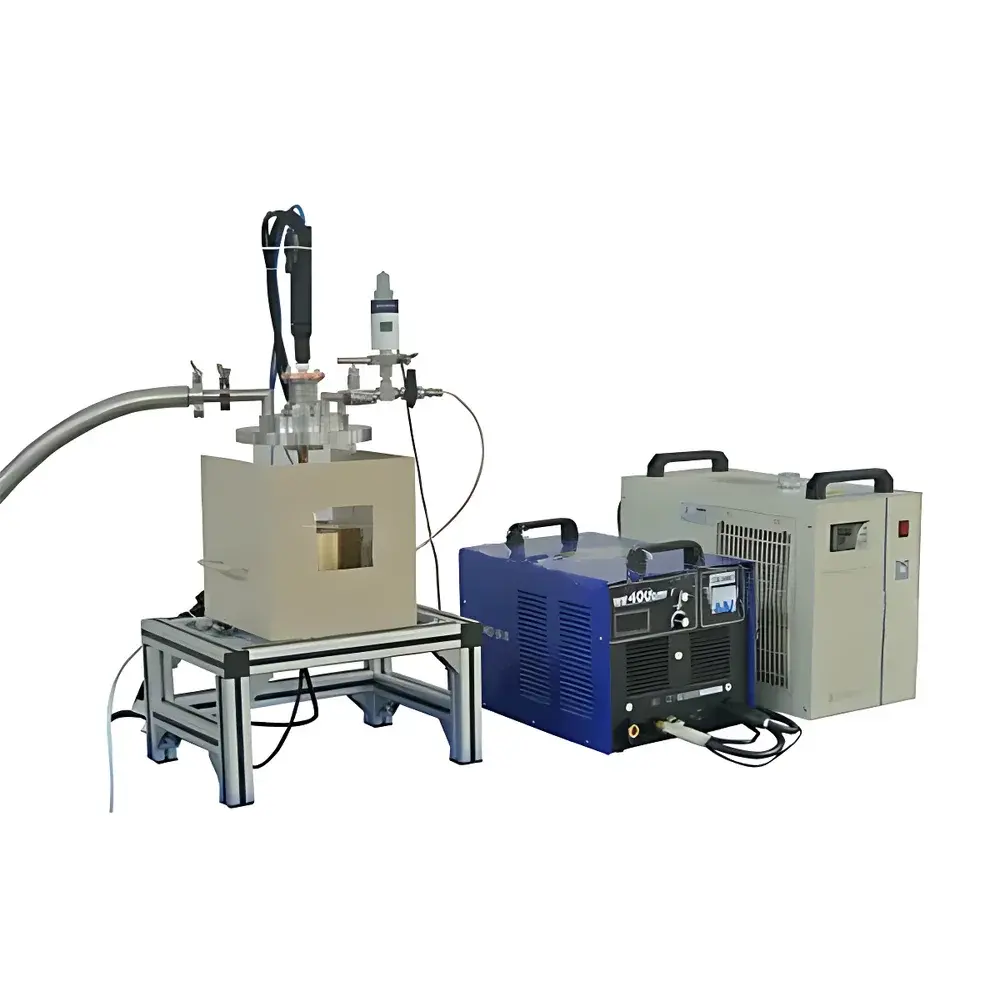
KJ GROUP SP-MSM-130 Miniature Vacuum Arc Melting Furnace with Quartz Chamber
| Brand | KJ GROUP |
|---|---|
| Origin | Liaoning, China |
| Manufacturer Type | Authorized Distributor |
| Origin Category | Domestic |
| Model | SP-MSM-130 |
| Pricing | Upon Request |
Overview
The KJ GROUP SP-MSM-130 Miniature Vacuum Arc Melting Furnace is a compact, laboratory-scale arc melting system engineered for high-temperature synthesis and compositional homogenization of refractory metals and intermetallic alloys under controlled inert or reducing atmospheres. Operating on the principle of direct-current (DC) arc discharge between a consumable tungsten electrode and a water-cooled copper crucible, the furnace generates localized plasma temperatures exceeding 3000 °C—sufficient to melt tungsten, molybdenum, niobium, tantalum, and their alloys. Its transparent fused-quartz chamber (Φ150 mm × 150 mm H) enables real-time, 360° optical observation of melt dynamics, solidification behavior, and phase segregation without vacuum breakage. Designed for small-batch research—typically ≤10 g per melt—the SP-MSM-130 serves as a critical tool in phase diagram determination, alloy development, master alloy preparation, and rapid prototyping of novel metallic systems where conventional induction or resistance furnaces lack sufficient thermal intensity or atmospheric control.
Key Features
- High-temperature capability: DC arc plasma up to >3000 °C, validated with pure tungsten (melting point: 3422 °C) and molybdenum (2623 °C) samples
- Optically accessible quartz chamber with integrated safety shield, permitting continuous visual monitoring during active melting and cooling
- Five-position water-cooled copper crucible (Φ25 mm × 8 mm per cavity); optional Ta-tube-compatible crucible geometry available
- Adjustable tungsten electrode assembly with 15 mm vertical travel and angular articulation via flexible metal bellows coupling—enabling precise arc positioning across multiple sample locations
- Vacuum-integrated manual flip rod mounted on the main flange, allowing in-situ sample inversion (e.g., for directional solidification or remelting) without venting the chamber
- Modular power interface: 380 VAC, 3-phase input; 24.4 V / 360 A output at 40% duty cycle; foot-pedal power modulation for fine arc energy control
Sample Compatibility & Compliance
The SP-MSM-130 accommodates conductive metallic and intermetallic feedstock in button, rod, or pellet form (≤10 g per cavity). It supports processing under high-purity argon (≥99.999%, 5N) or Ar–H₂ (95/5) reducing mixtures—critical for preventing oxidation of Ti, Zr, V, and rare-earth-containing alloys. The quartz chamber complies with ISO 719 (hydrolytic resistance Class HGB 1) and withstands repeated thermal cycling from ambient to >3000 °C with appropriate cooldown protocols. Vacuum integrity is maintained via ISO-KF40 flanges and Viton O-rings; base pressure reaches ≤1×10⁻² Torr with mechanical pump, or ≤1×10⁻⁵ Torr when paired with a turbomolecular pumping station (optional). All electrical components conform to IEC 61000-6-3 (EMC emission standards) and IEC 61000-6-2 (immunity), ensuring safe integration into shared laboratory infrastructure.
Software & Data Management
The SP-MSM-130 operates as a manually supervised, hardware-controlled instrument without embedded digital control software. Process parameters—including arc current, voltage, gas flow rate, and chamber pressure—are monitored via analog gauges (mechanical vacuum gauge standard; optional digital corrosion-resistant Pirani gauge available) and external instrumentation. For traceability in GLP/GMP-aligned labs, users integrate third-party data loggers (e.g., Omega OM-DAQPRO-5300) connected to thermocouple outputs (Type C, W–Re5/26, optional) and pressure transducers. All operational records—including gas purity certification, vacuum pump maintenance logs, and electrode wear history—must be retained per ISO/IEC 17025 clause 7.5.2 for method validation and audit readiness.
Applications
- Phase equilibria studies: Rapid preparation of multi-component alloy buttons for subsequent DSC, XRD, or SEM-EDS analysis
- Refractory metal purification: Zone-refining-like homogenization of W, Mo, Nb, and Ta via repeated arc melting under inert gas
- Intermetallic compound synthesis: Controlled stoichiometric fusion of Ni–Al, Ti–Al, Fe–Al, and Co–Cr systems
- Master alloy fabrication: Small-volume production of doped or trace-element-modified alloys for subsequent casting or additive manufacturing feedstock
- Thermal shock testing: Observation of crack propagation, dendritic growth, and melt pool stability under extreme thermal gradients
- Tantalum capsule sealing: Utilizing the optional Ta-specific crucible for hermetic encapsulation of air-sensitive samples prior to neutron irradiation or high-pressure experiments
FAQ
What is the maximum recommended single-melt mass for reproducible homogeneity?
For optimal compositional uniformity and complete melt pool formation, ≤8 g is recommended for most binary and ternary systems; 10 g is the absolute upper limit and requires extended arc dwell time.
Can the furnace operate under hydrogen-containing atmospheres long-term?
Yes—Ar–H₂ (5%) is supported for oxide reduction, but quartz chamber lifetime decreases above 500 cycles due to hydrogen diffusion; annual chamber inspection is advised.
Is the water cooling circuit compatible with standard laboratory chillers?
Yes—the system uses 12 mm OD × 8 mm ID tubing and requires ≥3 L/min flow at 0.3–0.6 MPa; KJ-5000 recirculating chiller (optional) meets ASTM F2622 specifications for temperature stability ±0.5 °C.
Does the SP-MSM-130 meet FDA 21 CFR Part 11 requirements for electronic records?
No—it lacks built-in audit trail, electronic signature, or user-access controls; compliance requires external validation of connected data acquisition hardware and procedural documentation per ALCOA+ principles.
What maintenance intervals are recommended for the tungsten electrode?
Electrode tip reshaping is required after every 15–20 melts involving reactive metals (e.g., Ti, Zr); full replacement is advised after 100 arc-hours or visible cratering >1.5 mm depth.
Related Products



