
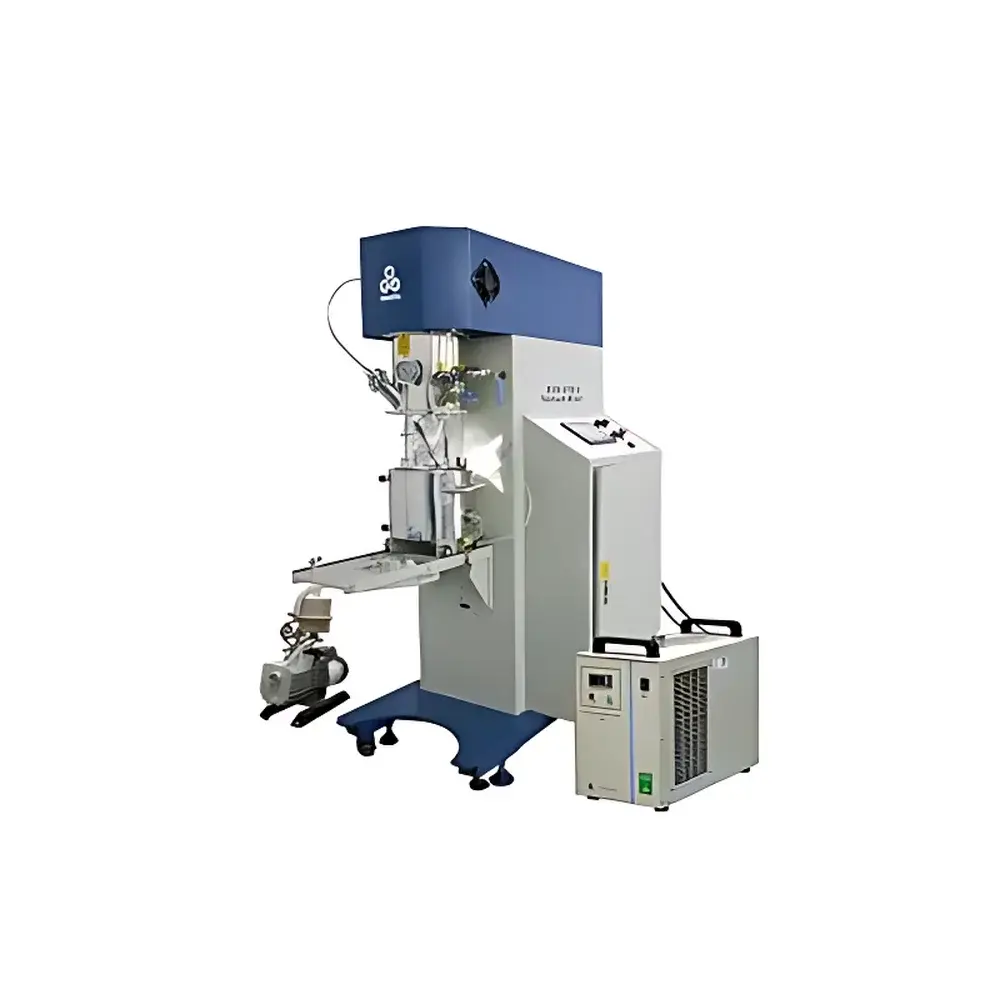
KJ GROUP MSK-SFM-9 Dual Planetary Vacuum Mixer
| Brand | KJ GROUP |
|---|---|
| Origin | Liaoning, China |
| Manufacturer Type | Authorized Distributor |
| Origin Category | Domestic (China) |
| Model | MSK-SFM-9 |
| Pricing | Upon Request |
| Voltage | AC 208–240 V, 50/60 Hz |
| Total Power | 4 kW |
| Mixing Vessel | Ø240 mm × 180 mm (5 L), 304 stainless steel with circulating water jacket |
| Stirring Blade Clearance | 2–4 mm from bottom, 2–5 mm from wall, 3–8 mm between blades |
| Orbital Speed | 0–70 rpm |
| Stirring Speed | 0–112 rpm |
| Dispersion Speed | 0–6100 rpm |
| Lift Motor Power | 370 W |
| Dimensions (W×D×H) | 1000 × 800 × 1930 mm |
| Weight | 300 kg |
| Certifications | CE-compliant |
Overview
The KJ GROUP MSK-SFM-9 Dual Planetary Vacuum Mixer is an engineered solution for high-shear, high-uniformity mixing of viscous slurries and pastes under controlled vacuum conditions. It operates on the principle of dual-axis planetary motion—where stirring arms rotate about their own axes (spin) while simultaneously orbiting the central axis of the mixing vessel (revolution)—combined with high-speed dispersion and vacuum-assisted degassing. This architecture eliminates stagnant zones and ensures homogeneous shear distribution across the entire batch volume. Designed specifically for advanced materials R&D and pilot-scale production, the MSK-SFM-9 supports reproducible formulation development in battery electrode slurries (e.g., LiCoO₂, LiFePO₄), phosphor suspensions, ceramic green bodies, and functional nanocomposites. Its 304 stainless-steel mixing vessel—with integrated water-jacketed cooling—and vacuum-rated sealing system enable operation at pressures down to ≤10 mbar, effectively removing entrapped air and microbubbles that compromise coating uniformity and interfacial integrity in subsequent thin-film processing steps.
Key Features
- Dual planetary motion with independent speed control for orbital rotation (0–70 rpm), blade stirring (0–112 rpm), and high-speed dispersion (0–6100 rpm), enabling multi-stage rheological conditioning.
- 5 L capacity mixing vessel fabricated from electropolished 304 stainless steel, resistant to acidic, alkaline, and organic solvent environments per ASTM A240 standards.
- Water-jacketed vessel design with dedicated 1/2″ cooling inlet/outlet ports supports active temperature regulation; compatible with external chillers to maintain slurry temperature within 35–50 °C during extended mixing cycles.
- Vacuum-integrated architecture featuring M14×1.5 vacuum port, DN-viewports for real-time process monitoring, and a 3/4″ tri-clamp discharge valve compliant with ASME BPE surface finish requirements.
- Precision mechanical clearances: 2–4 mm between blade tip and vessel bottom, 2–5 mm between blade edge and sidewall, and 3–8 mm inter-blade gap—optimized to balance shear intensity and particle suspension stability.
- CE-certified electrical system with isolated lift motor (370 W), overload protection, and emergency stop circuitry aligned with IEC 60204-1 safety directives.
Sample Compatibility & Compliance
The MSK-SFM-9 accommodates non-Newtonian, high-viscosity suspensions up to ~50,000 mPa·s (measured at 25 °C, 10 s⁻¹ shear rate), including aqueous and NMP-based cathode/anode slurries, alumina and zirconia ceramic slips, quantum dot dispersions, and polymer-ceramic composites. All wetted surfaces meet FDA-recommended 304 SS material specifications for non-sterile laboratory use. The unit complies with EU Machinery Directive 2006/42/EC and Electromagnetic Compatibility Directive 2014/30/EU, evidenced by its CE marking. Vacuum interface components conform to ISO 286-2 tolerance class H7/g6 for repeatable seal integrity. While not inherently GLP/GMP-validated, the mixer’s programmable multi-segment speed/timing profiles support audit-ready process documentation when integrated with external data loggers.
Software & Data Management
The MSK-SFM-9 employs a front-panel programmable controller supporting up to 9 user-defined mixing protocols, each comprising up to 5 sequential stages with independently set speeds, durations, and direction modes (forward/reverse). Real-time RPM feedback is provided via Hall-effect sensors on all drive shafts. Though the base configuration lacks Ethernet or USB connectivity, analog 0–10 V output signals are available for torque, speed, and vacuum level monitoring—enabling integration with SCADA systems or third-party acquisition hardware compliant with IEEE 1451.1 transducer standards. Optional RS-485 Modbus RTU communication module (sold separately) allows remote parameter setting and runtime diagnostics traceable to ISO/IEC 17025 calibration records.
Applications
- Battery manufacturing: Homogenization of Li-ion cathode slurries (NMC, LFP) and anode graphite/Si composites prior to slot-die or doctor-blade coating.
- Ceramics engineering: Deagglomeration and rheological tuning of tape-casting slurries for MLCCs, SOFC electrolytes, and structural substrates.
- Optoelectronic materials: Stable dispersion of phosphors (YAG:Ce, SrAl₂O₄:Eu), perovskite precursors, and luminescent quantum dots in polymer matrices.
- Pharmaceutical excipient blending: High-shear mixing of poorly soluble APIs with colloidal silicon dioxide or HPMC carriers under inert/vacuum conditions.
- Research validation: Method transfer studies requiring precise replication of shear history, residence time distribution, and vacuum exposure per USP guidance on mixing process characterization.
FAQ
What vacuum level can the MSK-SFM-9 achieve with the optional dual-stage mechanical pump?
When paired with the recommended KJ GROUP dual-stage rotary vane pump (ultimate vacuum ≤5 × 10⁻² mbar), the system consistently reaches and maintains ≤10 mbar during active mixing—sufficient to remove >99.5% of macroscopic voids in typical electrode slurries.
Is the water-jacketed vessel compatible with standard laboratory chillers?
Yes—the 1/2″ BSP threaded cooling ports accept standard compression fittings and are rated for continuous flow at 2–6 bar pressure and ≤50 °C inlet temperature, matching common recirculating chiller outputs (e.g., Huber, LAUDA, Thermo Fisher).
Can the mixer handle abrasive ceramic powders without premature wear?
The 304 SS vessel and hardened 420 stainless steel stirring blades exhibit acceptable wear resistance for alumina, silica, and titania powders below Mohs 7; however, extended use with SiC or WC particles requires optional tungsten-carbide-coated tooling kits (Part No. SFM-9-WC-KIT).
Does the controller support password-protected parameter locking for SOP compliance?
Yes—the firmware includes three-tier access control (Operator / Technician / Administrator) with configurable password length and lockout timeout, satisfying baseline requirements for controlled document execution under ISO 9001 Clause 8.5.1.



