
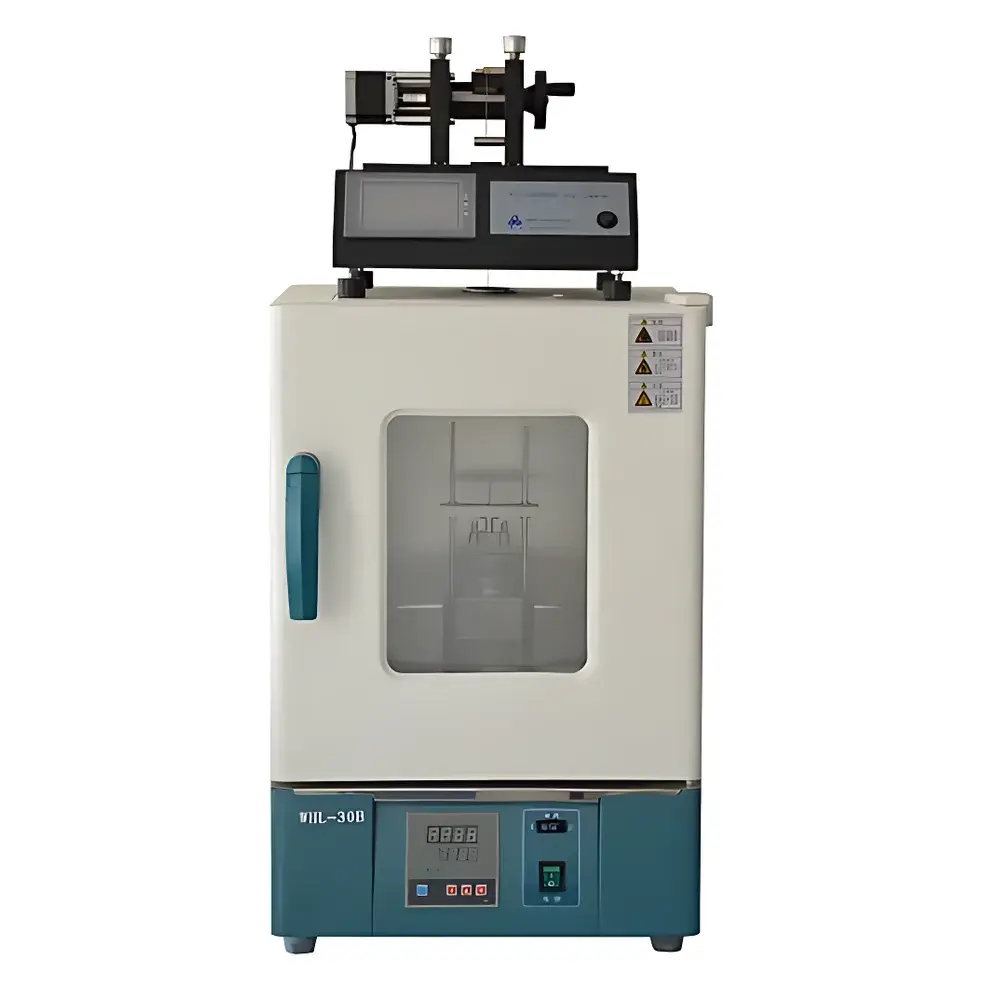
KJ GROUP PTL-MMB02 Millimeter-Scale Temperature-Controlled Dip Coating System
| Brand | KJ GROUP |
|---|---|
| Origin | Liaoning, China |
| Manufacturer Type | Authorized Distributor |
| Country of Origin | China |
| Model | PTL-MMB02 |
| Pricing | Upon Request |
| Dip Speed | 1–200 mm/min |
| Temperature Range (Coating Chamber) | RT to 100 °C |
| Temperature Stability | ±1.5 °C |
| Effective Immersion Length | 60 mm |
| Immersion/Drying Time Setting | 1–999 s |
| Cycle Count | 1–20 cycles |
| Sample Dimensions | 75 mm × 25 mm × 2.5 mm |
| 恒温箱尺寸 | 460 mm × 510 mm × 695 mm |
| Overall Unit Dimensions | 450 mm × 500 mm × 970 mm |
| Power Supply | AC 220 V, 50 Hz, Grounded |
| Ambient Operating Conditions | Altitude ≤1000 m, Ambient Temp. 25 °C ±15 °C, RH 55% ±10% |
Overview
The KJ GROUP PTL-MMB02 Millimeter-Scale Temperature-Controlled Dip Coating System is an engineered solution for precision-controlled vertical dip-coating processes in research and development laboratories. It operates on the principle of controlled withdrawal—immersing a substrate vertically into a liquid precursor solution and withdrawing it at a precisely regulated speed, enabling uniform thin-film deposition via solvent evaporation and capillary-driven meniscus dynamics. Unlike spin coating or spray methods, dip coating offers superior thickness control over large-area or irregularly shaped substrates and is widely used for fabricating sol-gel films, perovskite layers, conductive oxides, antireflective coatings, and functional polymer films. The PTL-MMB02 integrates thermal regulation directly into the coating environment: its built-in temperature-stabilized chamber maintains process conditions from ambient +5 °C up to 100 °C with ±1.5 °C stability, ensuring reproducible film morphology, crystallinity, and drying kinetics across repeated runs.
Key Features
- PLC-based control architecture with intuitive 7-inch capacitive touchscreen interface—no PC required for basic operation
- High-resolution stepper motor drive delivering smooth, jitter-free withdrawal speeds from 1 to 200 mm/min (adjustable in 0.1 mm/min increments)
- Suspended motor mounting system minimizes mechanical vibration transmission to the dip arm, critical for sub-micron thickness uniformity
- Integrated thermostatic chamber with independent PID temperature control; chamber volume optimized for rapid thermal equilibration and minimal air convection disturbance
- Programmable multi-stage cycle logic: independent control of immersion speed, dwell time (1–999 s), withdrawal speed, post-withdrawal drying interval (1–999 s), and total repetition count (1–20 cycles)
- Compact footprint (450 × 500 × 970 mm) designed for benchtop deployment in ISO Class 5–7 cleanrooms or standard analytical labs
- CE-marked and compliant with EN 61000-6-2 (immunity) and EN 61000-6-3 (emission) standards for laboratory instrumentation
Sample Compatibility & Compliance
The PTL-MMB02 accommodates standard slide-sized substrates (75 × 25 × 2.5 mm) using a precision-machined stainless-steel clamping fixture. Custom fixtures can be retrofitted for alternative geometries—including curved, porous, or flexible substrates—without modification to the core motion system. The system supports aqueous, alcoholic, and low-boiling organic solvent-based precursors (e.g., ethanol, isopropanol, chloroform), with material compatibility verified for common sol-gel precursors (TEOS, TMOS), metal alkoxides, and polymer solutions (PVP, PEDOT:PSS). All wetted components—including the sample holder, immersion cup, and dip wire—are chemically inert (316 stainless steel or PTFE-coated) and autoclavable. The unit meets GLP documentation requirements: all process parameters (speed, temperature, timing, cycle number) are timestamped and stored locally in non-volatile memory, supporting audit-ready traceability for ISO/IEC 17025-accredited labs.
Software & Data Management
While standalone operation is fully functional via the onboard HMI, optional USB data export enables CSV-formatted logs of real-time temperature, speed profile, and cycle status for post-processing in MATLAB, Python, or LabVIEW. No proprietary software installation is required. Firmware updates are performed via FAT32-formatted USB stick. The system supports 21 CFR Part 11–compatible electronic signatures when integrated with validated third-party LIMS platforms via Modbus RTU (RS485 interface, optional). Audit trails record operator ID (via manual entry), parameter changes, and emergency stop events with ISO 8601 timestamps—fully aligned with FDA and EU GMP Annex 11 expectations for coating process validation.
Applications
- Sol-gel synthesis of TiO₂, SiO₂, and ZnO antireflective or photocatalytic films
- Perovskite solar cell layer deposition (e.g., MAPbI₃, FAPbBr₃) with controlled nucleation kinetics
- Functional hydrophobic/hydrophilic bilayer fabrication for microfluidic channel surface engineering
- Preparation of gas-sensing metal oxide thin films (WO₃, SnO₂) with tunable grain size via thermal ramping during drying
- Biomedical coating of bioactive glass or chitosan films onto orthopedic implant substrates
- Quality assurance testing of industrial coating formulations under standardized withdrawal protocols (ASTM D1308, ISO 2808 adapted)
FAQ
What is the minimum achievable film thickness repeatability on this system?
Film thickness repeatability depends primarily on solution rheology, ambient humidity, and withdrawal speed stability. Under controlled lab conditions (RH <50%, 23 °C), typical coefficient of variation (CV) for thickness across five consecutive dips is ≤3.5% for 100–500 nm sol-gel films.
Can the system accommodate substrates larger than 75 × 25 mm?
The standard fixture is optimized for 75 × 25 mm slides. Larger rigid substrates (up to 100 × 40 mm) may be used with custom-machined clamps—contact technical support for dimensional specifications and load-bearing verification.
Is nitrogen purging supported inside the temperature chamber?
No built-in gas inlet port is provided. However, the chamber door gasket design allows for external integration of inert gas lines via user-modified feedthroughs—this configuration requires validation of thermal uniformity and safety interlocks.
Does the system log temperature and speed profiles during operation?
Yes. Internal logging records temperature setpoint, actual chamber temperature, programmed withdrawal speed, and cycle stage transitions at 1 Hz resolution. Logs are retained for ≥1000 cycles and exportable via USB.
What maintenance is required for long-term accuracy?
Annual calibration of the PT100 temperature sensor and verification of stepper motor step accuracy using laser displacement interferometry are recommended. Lubrication-free linear guides require no periodic greasing; wipe-down of immersion cup and dip wire with IPA after each solvent type change is mandatory.



