
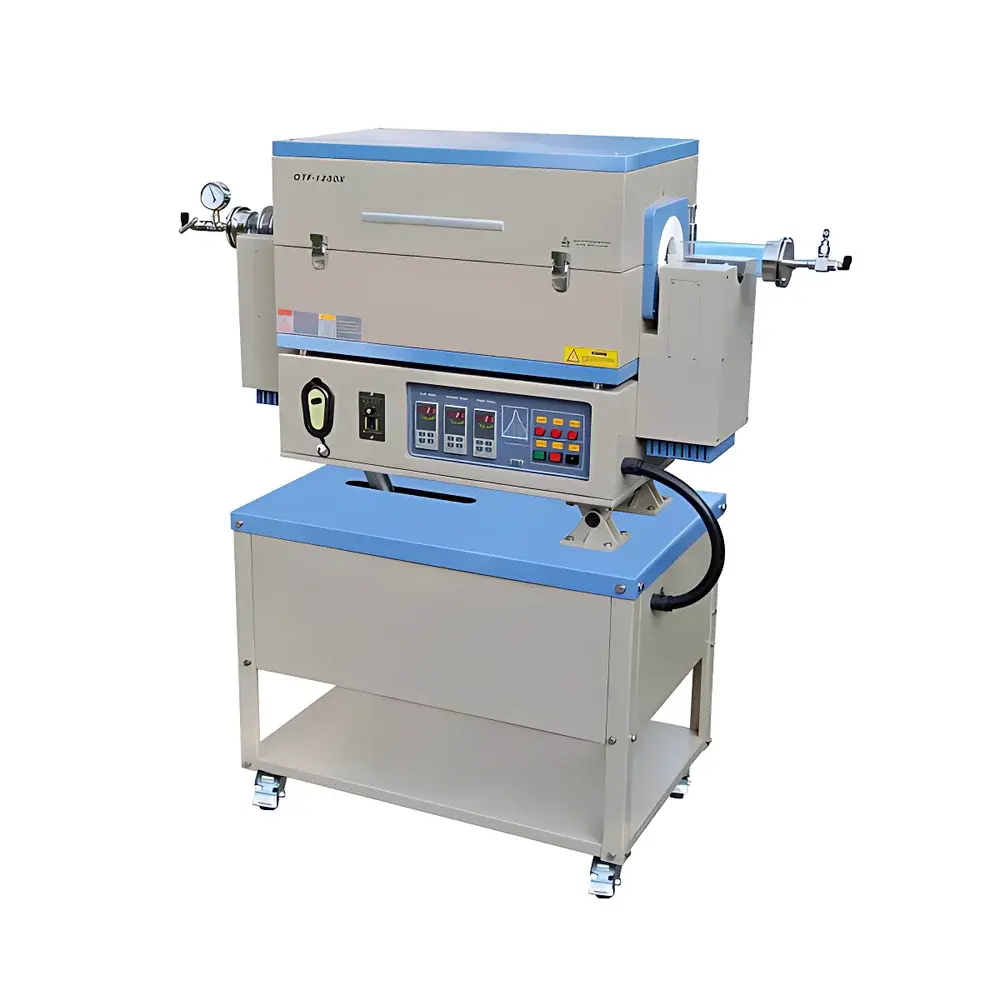
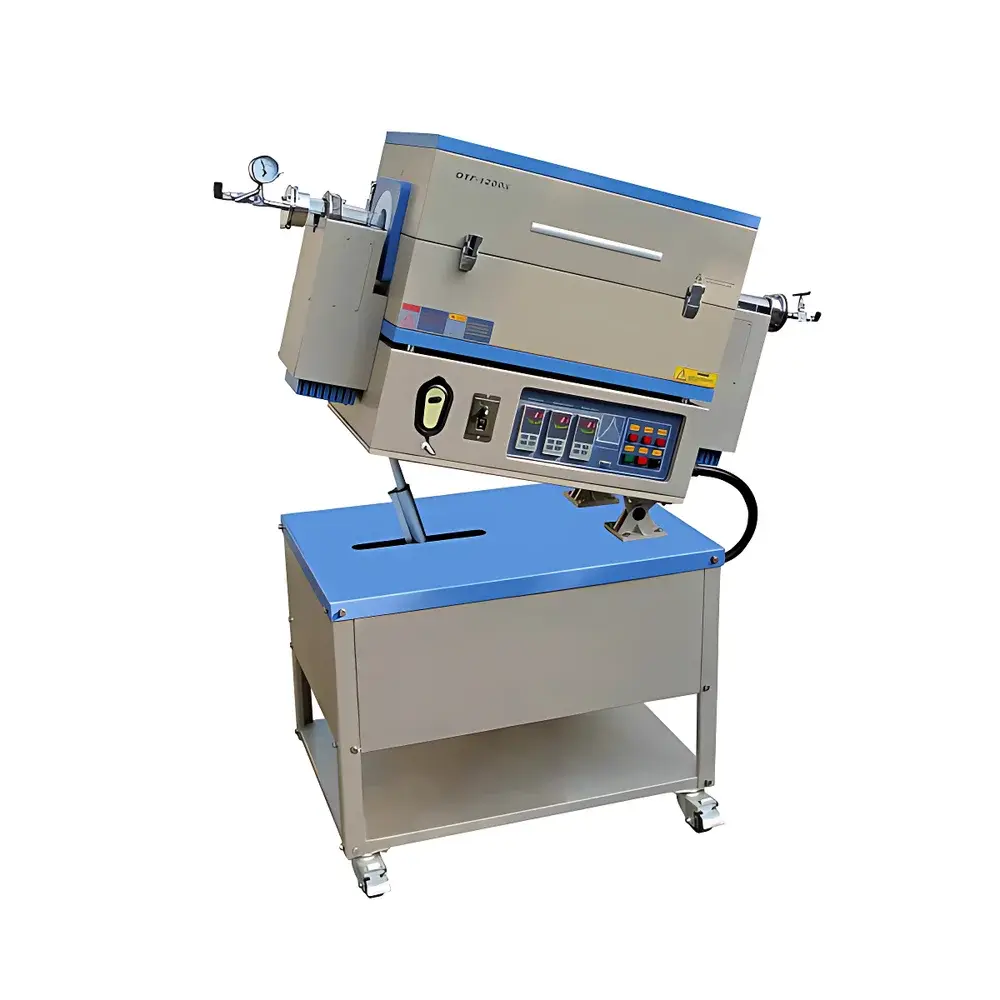
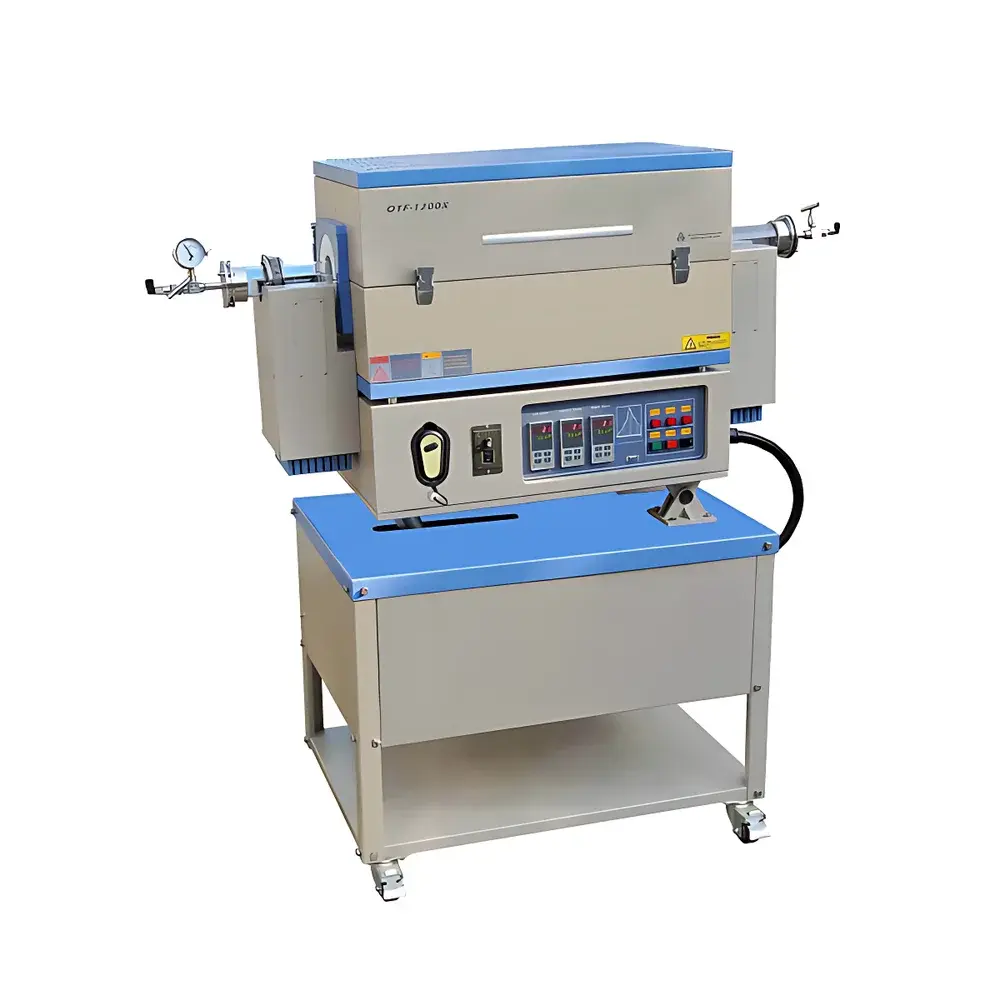
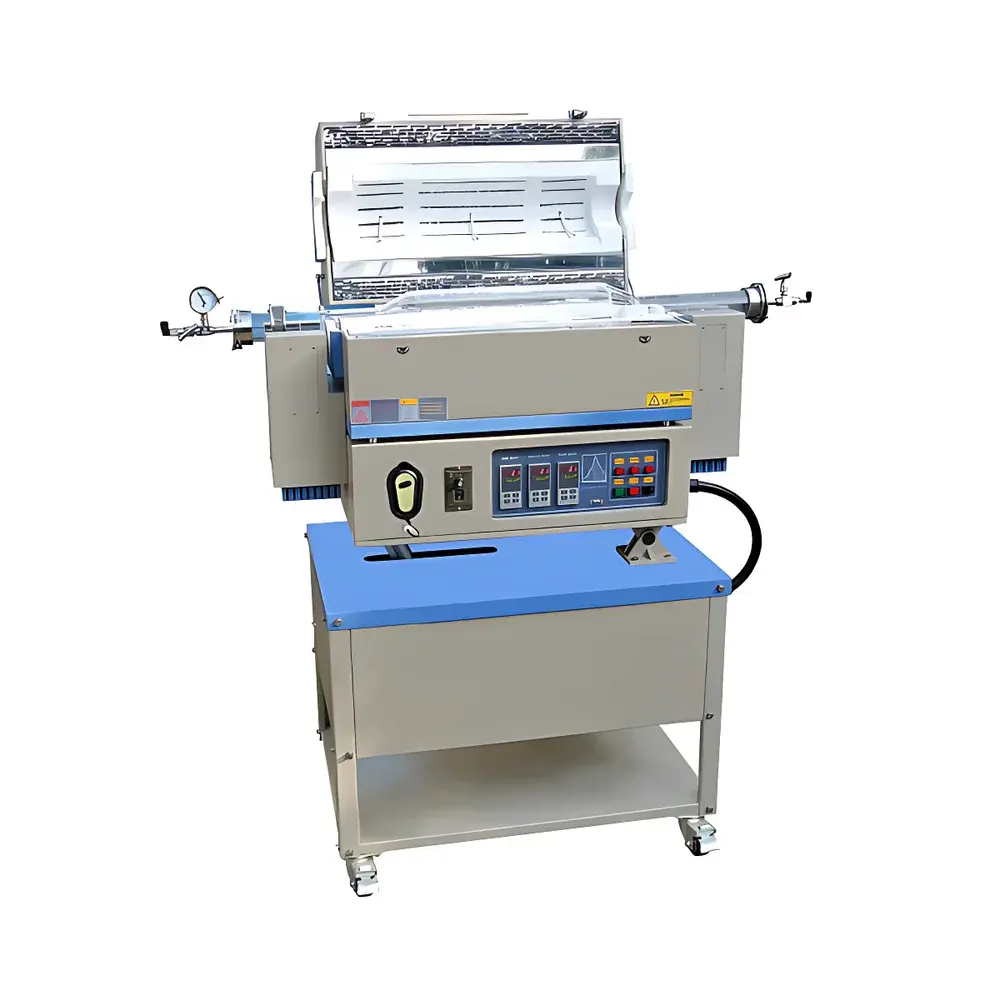
KJ GROUP OTF-1200X-5L-R-III Triple-Zone Tilted Rotating Tube Furnace
| Brand | KJ GROUP |
|---|---|
| Origin | Liaoning, China |
| Manufacturer Type | Authorized Distributor |
| Country of Origin | China |
| Model | OTF-1200X-5L-R-III |
| Power Supply | AC 220 V, 50/60 Hz, 4 kW |
| Max Temperature | 1200 °C (≤1 h), Continuous: 1100 °C |
| Temp Uniformity Zone | 450 mm |
| Heating Zones | Three (Zone I: 150 mm, Zone II: 300 mm, Zone III: 150 mm) |
| Tube Rotation Speed | 0–10 rpm |
| Tilt Angle Range | 0–30° |
| Quartz Tube Dimensions | Total Length 1200 mm |
| Ends | Ø60 mm × 420 mm |
| Center Section | OD Ø130 mm, ID Ø120 mm |
| Vacuum Level | ≤10⁻² torr |
| Control Accuracy | ±1 °C |
| Batch Capacity | 2 kg per cycle |
| Cooling | Dual-layer shell with forced-air cooling |
| Insulation | High-purity alumina fiber |
| Refractory Coating | 1750 °C-rated imported alumina reflective coating |
| Inlet Fitting | 1/4″ Swagelok compression fitting (Ø6.35 mm) |
| Outlet Fitting | 12 mm barbed outlet |
| Dimensions (W×D×H) | 900 × 600 × 1500 mm |
| Net Weight | 130 kg |
Overview
The KJ GROUP OTF-1200X-5L-R-III is a precision-engineered triple-zone tilted rotating tube furnace designed for controlled thermal processing of fine powders under inert, reducing, or reactive atmospheres. Its core architecture integrates simultaneous axial rotation and programmable tilt functionality—enabling dynamic material agitation during heating—to ensure uniform thermal exposure and enhanced solid-state reaction kinetics. The furnace operates on the principle of resistive heating via embedded Kanthal A1 or SiC heating elements, with independent PID-controlled zones allowing precise thermal gradient establishment across the 600 mm total heating length. This configuration supports both isothermal hold and multi-step ramp-soak profiles essential for solid-phase synthesis, calcination, and annealing of advanced functional materials—including layered oxides, olivine-type cathodes (e.g., LiFePO₄), and Ni-rich NMC precursors—where particle homogeneity, stoichiometric fidelity, and phase purity are critical to electrochemical performance.
Key Features
- Dual-shell construction with integrated forced-air cooling system ensures stable external surface temperature (<45 °C at 1100 °C operation) and rapid cooldown capability.
- High-purity alumina fiber insulation (≥1700 °C rating) minimizes thermal loss and improves energy efficiency by >30% compared to conventional refractory brick designs.
- Internally coated furnace chamber featuring 1750 °C-rated imported alumina reflective layer enhances radiant heat distribution and maintains long-term chamber cleanliness—reducing cross-contamination between runs.
- Top-hinged lid mechanism enables unobstructed access to the quartz tube for rapid tube replacement, sample loading, and maintenance—critical in high-throughput lab environments.
- Custom-designed asymmetric quartz tube (OD Ø130 mm / ID Ø120 mm center section; tapered Ø60 mm ends) accommodates up to 2 kg of powder per batch while maintaining structural integrity at elevated temperatures.
- Four fixed-angle lift baffles inside the rotating tube promote continuous tumbling and cascading motion—significantly improving mixing efficiency and eliminating stagnant zones during prolonged dwell periods.
- CE-marked design complies with EN 61000-6-3 (EMC) and EN 61000-6-4 (immunity), ensuring electromagnetic compatibility in shared laboratory infrastructure.
Sample Compatibility & Compliance
The OTF-1200X-5L-R-III supports a broad range of inorganic and composite powder systems, including lithium transition metal oxides, metal-organic frameworks (MOFs), ceramic precursors, and catalyst supports. Its vacuum-tight quartz tube (leak rate <5×10⁻⁶ mbar·L/s) and dual-gas-port configuration enable operation under static inert gas (Ar/N₂), dynamic flowing atmospheres, or low-pressure CVD-compatible conditions (down to 10⁻² torr). The system meets fundamental safety and documentation requirements for GLP-compliant thermal processing workflows. While not inherently 21 CFR Part 11 compliant out-of-the-box, its digital temperature controller supports audit-trail-ready data logging when interfaced with validated third-party software platforms. All materials in contact with process gases conform to ASTM F86 (standard practice for surface preparation of titanium alloys) and ISO 10993-5 (cytotoxicity screening), supporting biocompatible material development protocols.
Software & Data Management
Temperature control is managed via a programmable 32-bit microprocessor-based PID controller with 16-segment ramp-soak capability, real-time deviation alarm, and over-temperature cut-off protection. Optional RS485/Modbus RTU interface allows integration into centralized lab automation systems (e.g., LabVantage, Thermo Fisher SampleManager) for traceable parameter archiving. Raw thermocouple voltage outputs (Type S) are accessible for external calibration verification. Data export is supported in CSV format with timestamps synchronized to internal RTC (real-time clock), enabling correlation with post-process analytical results (XRD, SEM-EDS, ICP-MS). Firmware updates follow IEC 62443-2-4 security guidelines for industrial control systems.
Applications
- Solid-state synthesis of cathode active materials (LiCoO₂, NCA, LNMO) requiring precise oxygen partial pressure control and extended dwell times at 700–900 °C.
- Controlled decomposition of metal acetates/nitrates for nanostructured oxide formation without agglomeration.
- Thermal stabilization of air-sensitive battery precursors prior to electrode slurry formulation.
- Low-temperature carbothermal reduction of metal oxides in graphite-containing atmospheres.
- Multi-step annealing of thin-film precursors deposited on rotating substrates for uniform crystallinity development.
- Process optimization studies for scale-up validation—leveraging identical thermal profiles between lab-scale rotation and pilot rotary kilns.
FAQ
What is the maximum recommended continuous operating temperature?
The furnace is rated for continuous operation at 1100 °C; short-term excursions to 1200 °C are permissible for ≤60 minutes per cycle.
Can the rotation and tilt functions be operated independently?
Yes—rotation speed (0–10 rpm) and tilt angle (0–30°) are fully decoupled and adjustable via separate manual controls or optional PLC interface.
Is the quartz tube replaceable in situ without disassembling the furnace?
Yes—the top-hinged door design permits full removal and reinstallation of the quartz tube without disturbing electrical connections or insulation integrity.
Does the system include vacuum pumping capability?
No—vacuum generation requires an external two-stage rotary vane pump (recommended ultimate vacuum ≤10⁻³ torr); the furnace includes vacuum-rated flanges and sealing hardware.
What maintenance intervals are recommended for optimal thermal stability?
Quarterly inspection of heating element resistance, annual recalibration of Type S thermocouples against NIST-traceable reference, and biannual cleaning of air-cooling ducts and baffle surfaces.



