
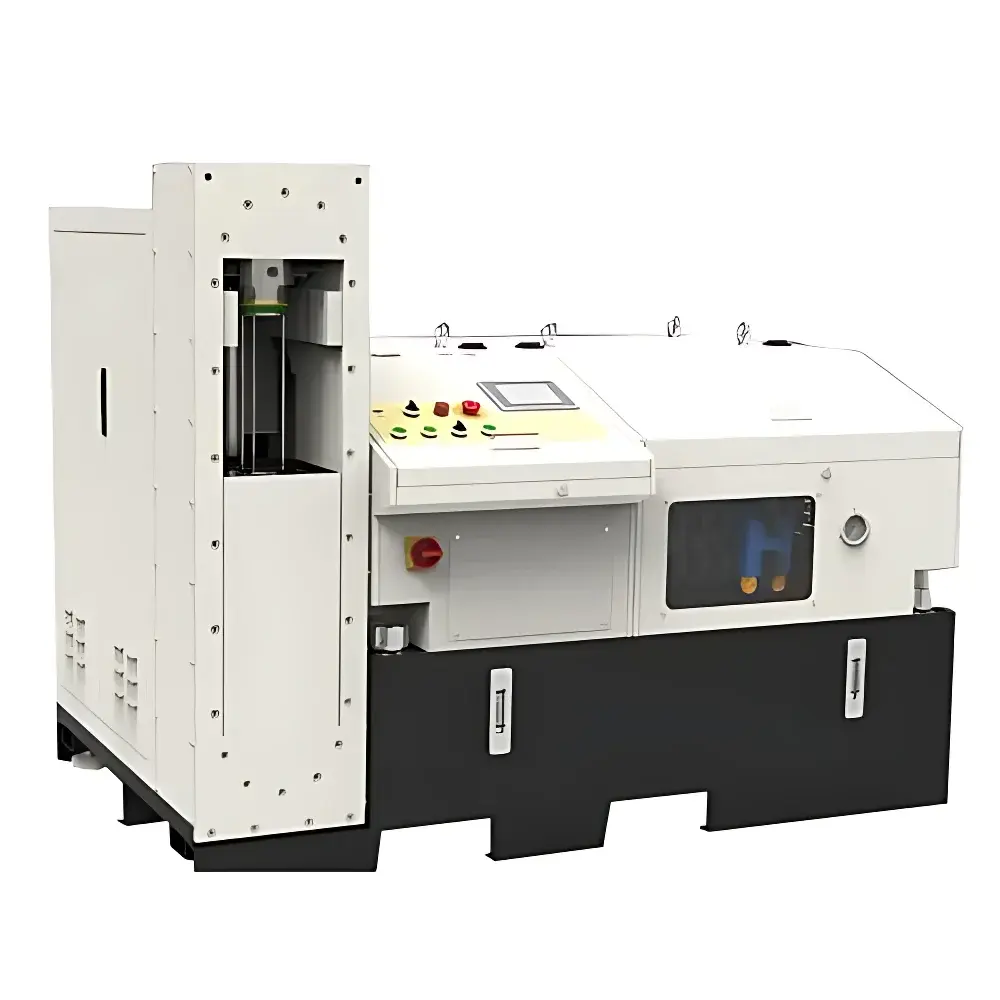
KJ GROUP U-Series Laboratory Cold Isostatic Press
| Brand | KJ GROUP |
|---|---|
| Origin | Liaoning, China |
| Manufacturer Type | Authorized Distributor |
| Country of Origin | China |
| Model | U-Series |
| Pricing | Available Upon Request |
| High-Pressure Chamber ID | 100 mm / 150 mm |
| Effective Chamber Depth | 300 mm |
| Max Operating Pressure | 100–400 MPa |
| Pressure Control Accuracy | High-Precision Programmable Ramp/Soak Profile |
| Pressure Cycling Data Logging | Full Traceability with Timestamped Curve Export |
| Lifting Mechanism | Fully Automated Sample Handling |
| Pressurization Method | Single-Stage Hydraulic Intensification |
| Pressure Ramp Rate | Segment-wise Adjustable (MPa/s) |
| Stored Process Recipes | Multiple User-Defined Protocols |
| Working Fluid | Hydraulic Oil or Water-Based Emulsion |
| Fluid Replenishment | Auto-Refill During Cycle |
| Chamber Construction | Pre-Stressed Steel Wire-Wound Vessel |
| Frame Construction | Pre-Stressed Steel Wire-Wound Monocoque |
| Safety Valves | Redundant Fail-Safe Design |
| HMI | 7-inch Full-Color Touchscreen Interface |
| Data Export | USB 2.0 Port |
| Emergency Functions | Dual-Channel E-Stop + Rapid Depressurization |
| Drive Power | 9 kW |
| Footprint | ≤2.5 m² |
| Height | <1.5 m |
| Overall Dimensions (CIP-100MA) | 1750 × 1190 × 1370 mm |
| Overall Dimensions (CIP-150MA) | 2000 × 1350 × 1500 mm |
| Net Weight (CIP-100MA) | <2.5 t |
| Net Weight (CIP-150MA) | <3.75 t |
| Benchtop Variant Dimensions | 450 × 420 × 1010 mm |
| Benchtop Variant Weight | 200 kg |
Overview
The KJ GROUP U-Series Laboratory Cold Isostatic Press is an engineered solution for high-fidelity densification and shaping of advanced powder-based materials under uniform hydrostatic pressure. Operating on the principle of cold isostatic pressing (CIP), the system transmits pressure isotropically through an incompressible fluid medium—typically hydraulic oil or a certified water–glycol emulsion—into a preformed elastomeric mold containing the green compact. This eliminates directional bias in particle rearrangement and plastic deformation, yielding parts with exceptional density uniformity, minimal internal stress gradients, and near-net-shape dimensional fidelity. Designed specifically for R&D laboratories and pilot-scale manufacturing environments, the U-Series supports rigorous process development in powder metallurgy, structural ceramics, refractory composites, cemented carbides, and multilayer functional ceramics where reproducible microstructural control is critical to final mechanical, thermal, or electrical performance.
Key Features
- Fully automated sample loading and retrieval mechanism eliminates manual handling risks and ensures repeatable positioning within the high-pressure chamber.
- 7-inch full-color touchscreen HMI with intuitive icon-driven navigation enables real-time monitoring of pressure, temperature (optional sensor input), cycle stage, and fault diagnostics.
- Programmable multi-segment pressure profiles—including ramp, hold, and controlled depressurization phases—with resolution down to 0.1 MPa and timing accuracy ±0.5 s per segment.
- Integrated data acquisition system records complete pressure–time curves with timestamped metadata; exportable via USB 2.0 in CSV format for post-cycle analysis or regulatory documentation.
- Pre-stressed steel wire-wound chamber and frame architecture provide structural integrity at pressures up to 400 MPa while minimizing elastic deformation and ensuring long-term calibration stability.
- Redundant safety architecture includes dual-channel emergency stop circuitry, fail-safe depressurization valves, and real-time overpressure cutoff logic compliant with ISO 13850 and EN 60204-1.
- Compact footprint (<2.5 m²) and low vertical profile (<1.5 m) allow installation in standard laboratory spaces without structural reinforcement or dedicated vaulting.
Sample Compatibility & Compliance
The U-Series accommodates a broad range of green bodies formed from metal, ceramic, and composite powders—including stainless steel, tungsten carbide, alumina, silicon nitride, zirconia, and graphite-based compacts. Elastomeric molds (typically silicone or polyurethane) are compatible with both oil and aqueous emulsion media, supporting material-specific compatibility requirements per ASTM B991 and ISO 13355. The system’s pressure traceability, user-accessible audit logs, and password-protected parameter locking align with GLP and GMP documentation expectations. Optional validation packages support IQ/OQ protocols in accordance with FDA 21 CFR Part 11 for regulated pharmaceutical or biomedical device applications involving ceramic implants or sintered components.
Software & Data Management
The embedded control firmware provides deterministic real-time execution of pressure cycles with no external PC dependency. All process parameters—including target pressure, ramp rate, dwell duration, and depressurization slope—are stored as named recipes with version-controlled naming conventions. Each cycle generates a unique identifier linked to operator ID, date/time stamp, and environmental conditions (if external sensors are connected). Raw pressure–time datasets are archived locally and exportable in ASCII-compliant CSV format for integration into LIMS, statistical process control (SPC) platforms, or finite element modeling workflows. Audit trails record all parameter modifications, login/logout events, and emergency interventions—retained for ≥36 months unless manually purged under defined retention policies.
Applications
- Development of high-density sintered components for aerospace turbine blades and wear-resistant tooling.
- Consolidation of nanoscale ceramic powders where conventional uniaxial pressing induces shear-induced anisotropy.
- Manufacturing of large-area piezoelectric ceramic substrates requiring thickness uniformity better than ±0.5%.
- Processing of brittle intermetallic or MAX-phase precursors prior to hot isostatic pressing (HIP) or spark plasma sintering (SPS).
- Qualification of binder systems in metal injection molding (MIM) feedstocks by correlating green strength with CIP pressure history.
- Teaching and certification labs delivering hands-on training in powder processing fundamentals per ASTM E2523 standards.
FAQ
What pressure media are supported, and how do they affect material compatibility?
The U-Series is certified for use with mineral-based hydraulic oils (ISO VG 46) and water–glycol emulsions (e.g., HFC–20). Oil media offer higher viscosity and thermal stability for extended dwell cycles; emulsions are preferred for environmentally sensitive or food-grade-certified ceramics due to lower toxicity and easier cleanup.
Can the system be integrated into an automated production line?
Yes—the unit features dry-contact I/O terminals (24 VDC) and Modbus RTU over RS-485 for PLC-level coordination. Optional Ethernet/IP or PROFINET gateways are available for higher-level MES integration.
Is calibration traceable to national standards?
All pressure transducers are supplied with NIST-traceable calibration certificates (as per ISO/IEC 17025), valid for 12 months under normal operating conditions. On-site recalibration services are available through KJ GROUP’s global service network.
What maintenance intervals are recommended for long-term reliability?
Daily visual inspection of seals and fluid levels; quarterly verification of valve response time and pressure decay rate; annual replacement of high-pressure O-rings and hydraulic filter elements per OEM service bulletin KJ-U-CIP-MNT-2023.



