
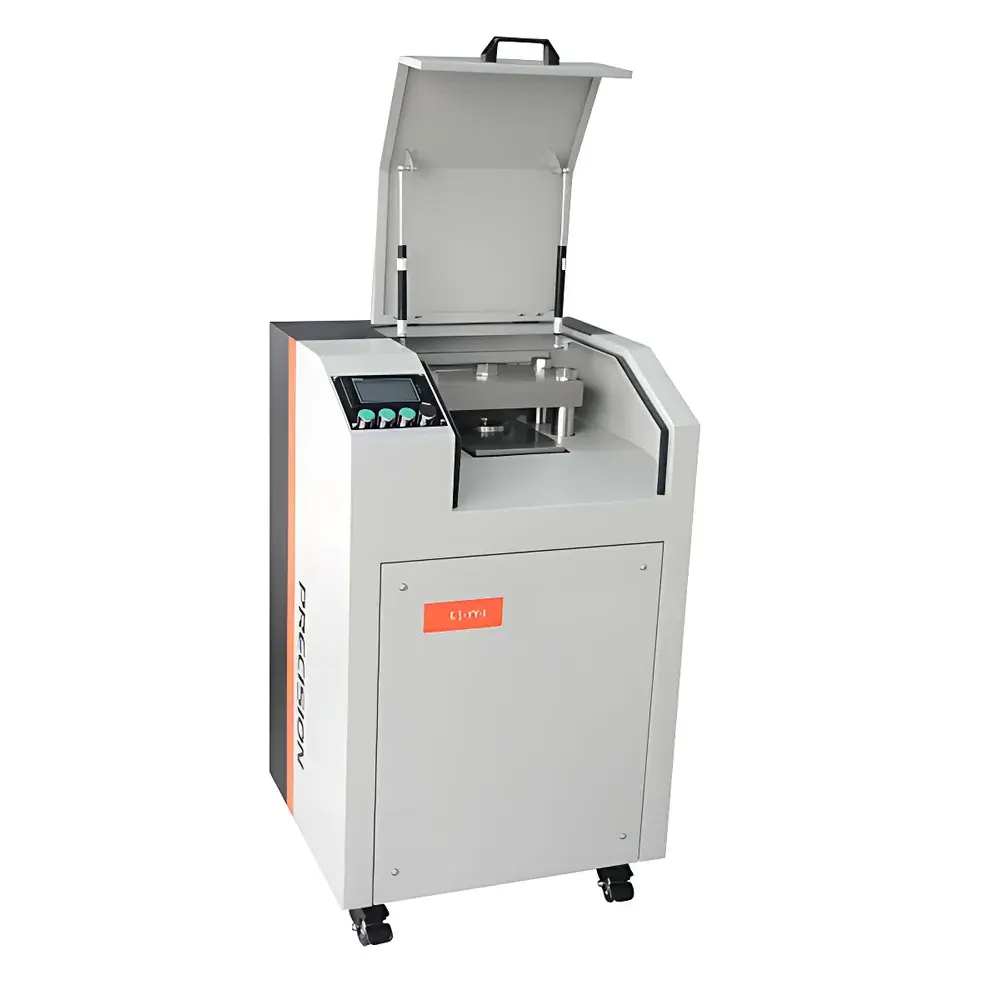
KJ GROUP KJ-YY-1 Hydraulic Pellet Press
| Brand | KJ GROUP |
|---|---|
| Origin | Liaoning, China |
| Manufacturer Type | Authorized Distributor |
| Country of Origin | China |
| Model | KJ-YY-1 |
| Pricing | Upon Request |
| Power Supply | 3-phase 4-wire 380 V AC |
| Rated Power | 1.5 kW |
| Maximum Pressure | 40 metric tons (400 kN) |
| Hold Time Range | 0–999 s |
| Max Piston Stroke | 60 mm |
| Dimensions (W×D×H) | 650 × 650 × 1050 mm |
| Weight | 300 kg |
Overview
The KJ GROUP KJ-YY-1 Hydraulic Pellet Press is an engineered laboratory press system designed specifically for the preparation of homogeneous, high-density pellets used in X-ray fluorescence (XRF) spectroscopy and Fourier-transform infrared (FTIR) spectroscopy. It operates on a closed-loop hydraulic principle, utilizing proportional pressure control to deliver repeatable, traceable compaction forces across a defined stroke range. Unlike manual or pneumatic presses, the KJ-YY-1 integrates real-time pressure feedback via a calibrated pressure transducer and mechanical pressure lock mechanism—ensuring force stability during hold phases critical for matrix uniformity and analytical reproducibility. Its architecture supports both static hold (constant-force maintenance) and dynamic hold (pressure modulation during dwell), enabling method optimization for diverse sample matrices including powdered ores, pharmaceutical excipients, cement clinkers, and polymer composites.
Key Features
- Robust monolithic frame with high geometric rigidity and precision-machined load train—minimizes deflection under 400 kN maximum compressive load.
- Motor-driven hydraulic power unit with sealed oil reservoir and low-noise pump assembly—reduces contamination risk and extends valve service life.
- Touchscreen HMI interface with programmable sequence logic: auto-load → ramp → hold → depressurize → ejection—eliminates operator-dependent variability.
- Front-access horizontal sample loading/unloading path accommodates standard die sets (e.g., steel rings, borate fusion cups, aluminum cups, LDPE dies, plastic collars) without vertical overhead clearance constraints.
- Proportional solenoid valve module with integrated pressure regulation—delivers ±0.5% full-scale repeatability across the 0–400 kN operating range.
- Real-time pressure monitoring with multi-point logging capability (pre-, mid-, and post-hold values) and adjustable hold duration (0–999 seconds).
- Locking casters with brake mechanism—facilitates safe relocation within shared lab environments while maintaining positional stability during operation.
Sample Compatibility & Compliance
The KJ-YY-1 supports standardized pellet geometries required by ASTM E1361 (XRF pellet preparation), ISO 20057 (FTIR KBr disc fabrication), and USP (pharmaceutical tablet hardness correlation studies). It accepts industry-standard die assemblies conforming to ASTM D7580 (powder compaction tooling dimensions) and is routinely validated in GLP-compliant labs for routine QC workflows in cement, metallurgy, and mining QA/QC departments. The fully enclosed hydraulic circuit meets IP54 environmental protection standards and complies with CE machinery directive 2006/42/EC for industrial equipment safety.
Software & Data Management
The embedded controller logs timestamped pressure profiles, hold durations, and cycle completion status to internal non-volatile memory. Export functionality supports CSV-formatted data dumps via USB port for integration into LIMS or ELN platforms. Audit trail features include operator ID tagging (via optional network login), parameter change history, and electronic signature support—aligning with FDA 21 CFR Part 11 requirements when deployed in regulated environments. No cloud connectivity or proprietary software installation is required; all configuration and diagnostics are accessible directly through the local HMI.
Applications
- XRF quantitative analysis of geological samples (soils, sediments, ores) requiring ≥10-ton compaction for minimized particle-size effects.
- FTIR transmission measurements using KBr or CsI pellets—optimized pressure ramp rates prevent crystallite fracture and ensure optical homogeneity.
- Pharmaceutical blend uniformity testing where tablet tensile strength correlates with compaction pressure history.
- Cement and slag characterization per EN 196-1, where green density and porosity influence subsequent hydration kinetics.
- Research-scale ceramic green body formation prior to sintering—enabling controlled porosity gradients via segmented pressure profiles.
FAQ
What types of dies are compatible with the KJ-YY-1?
Standard 32 mm, 40 mm, and 50 mm diameter dies—including steel ring molds, borate fusion crucibles, aluminum sample cups, low-density polyethylene (LDPE) dies, and custom-machined plastic collars—are mechanically supported.
Is the KJ-YY-1 suitable for GMP-regulated laboratories?
Yes—when configured with user access controls, electronic audit trails, and calibrated pressure transducer certification, it satisfies key elements of Annex 11 and 21 CFR Part 11 for instrument qualification in pharmaceutical and medical device manufacturing settings.
Does the system require external cooling or compressed air?
No—hydraulic oil temperature is managed passively via finned reservoir design; no auxiliary cooling or pneumatic supply is needed for standard operation.
Can pressure calibration be performed in-house?
Yes—the built-in pressure transducer supports two-point field calibration using NIST-traceable deadweight testers; procedure documentation is included in the technical manual.
What maintenance intervals are recommended?
Hydraulic oil replacement every 2,000 operating hours or biannually (whichever occurs first); filter element replacement every 500 hours; annual verification of pressure transducer linearity and hold-time accuracy.



