
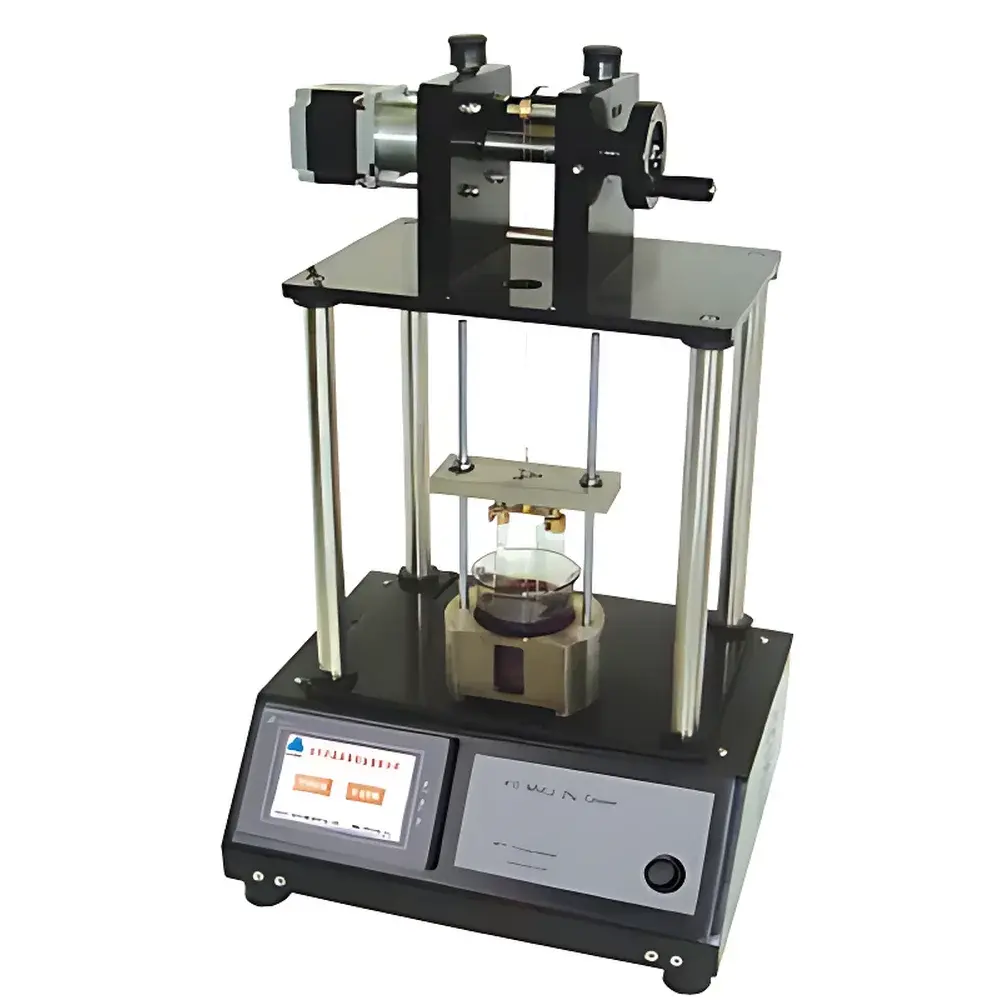
KJ GROUP PTL-MM02 Programmable Dip-Coating Machine
| Brand | KJ GROUP |
|---|---|
| Origin | Liaoning, China |
| Manufacturer Type | Authorized Distributor |
| Country of Origin | China |
| Model | PTL-MM02 |
| Price | Upon Request |
| Touchscreen Interface | 7-inch Color TFT LCD |
| CE Certified | Yes |
| Control System | Industrial PLC |
| Drive Motor | High-Precision Stepper Motor with Suspended Mounting for Vibration Damping |
| Power Supply | AC 220 V, 50 Hz, Grounded |
| Rated Power | 50 W |
| Operating Environment | Altitude < 1000 m |
| Dimensions (W×D×H) | 320 × 260 × 560 mm |
| Net Weight | 17 kg |
| Sample Holder Dimensions | 75 × 25 × 2.5 mm |
| Immersion Length | 60 mm |
| Withdrawal Speed Range | 1–200 mm/min (adjustable in 0.1 mm/min increments) |
| Immersion/Drying Time Range | 1–999 s (programmable per cycle) |
| Number of Cycles | 1–20 (fully programmable sequence) |
| Standard Accessories | (1) Sample Clamp Set, (2) Coating Beaker (100 mL), (3) Three Stainless-Steel Withdrawal Wires |
Overview
The KJ GROUP PTL-MM02 Programmable Dip-Coating Machine is an entry-level, precision-engineered laboratory instrument designed for controlled vertical dip-coating deposition of thin films via the immersion–withdrawal method. Based on classical sol-gel and colloidal coating principles, the system operates by vertically submerging a substrate into a liquid precursor solution—such as metal alkoxide sols, polymer dispersions, or nanoparticle suspensions—and withdrawing it at a precisely regulated linear velocity. Film thickness is governed primarily by withdrawal speed, solution viscosity, surface tension, and evaporation kinetics during emergence—enabling reproducible, layer-by-layer fabrication of uniform coatings ranging from nanometers to several micrometers in thickness. Engineered for academic research, materials development, and QC screening, the PTL-MM02 delivers high repeatability under ambient or optionally integrated thermal environments.
Key Features
- Industrial-grade PLC control architecture ensures deterministic timing, robust error handling, and long-term operational stability across repeated coating cycles.
- 7-inch full-color TFT touchscreen interface provides intuitive navigation, real-time parameter visualization, and on-device recipe storage for up to 20 user-defined protocols.
- Suspended stepper motor design minimizes mechanical vibration transmission to the withdrawal wire and substrate—critical for suppressing meniscus instability and achieving edge-uniform films.
- High-resolution speed control (0.1 mm/min increment) across a wide range (1–200 mm/min) supports both slow, diffusion-limited deposition and rapid industrial prototyping.
- Programmable multi-cycle operation enables automated sequential dipping, dwell, withdrawal, and inter-cycle drying—facilitating graded multilayer architectures or self-assembled monolayer stacking.
- Compact footprint (320 × 260 × 560 mm) and low power consumption (50 W) allow seamless integration into fume hoods, gloveboxes, or shared lab benches without dedicated utility infrastructure.
Sample Compatibility & Compliance
The PTL-MM02 accommodates rigid planar substrates up to 75 × 25 × 2.5 mm—including silicon wafers, glass slides, ITO-coated PET, stainless steel coupons, and ceramic tiles. Its 60 mm effective immersion length supports standardized sample geometry while minimizing solution volume requirements (as low as 15 mL in the included 100 mL beaker). The system complies with EU Machinery Directive 2006/42/EC and carries CE marking for safe operation within laboratory environments. It meets general electrical safety requirements per IEC 61010-1 and electromagnetic compatibility standards EN 61326-1. While not intrinsically rated for hazardous atmospheres, it may be operated inside nitrogen-purged enclosures or temperature-controlled chambers (e.g., optional integrated dry box) to support moisture-sensitive precursors or thermal annealing-coupled deposition.
Software & Data Management
The embedded control firmware supports full audit trail functionality: all parameter changes, start/stop timestamps, cycle completion logs, and emergency stops are recorded internally with date/time stamps. Data export is available via USB flash drive in CSV format for traceability and post-processing in MATLAB, Python, or Excel. Though no external PC software is bundled, the machine’s RS-232 serial port enables integration with LabVIEW-based automation frameworks or centralized LIMS systems—supporting GLP-aligned workflows where electronic records must satisfy 21 CFR Part 11 requirements (when paired with validated third-party software and user access controls). Parameter locking and operator-level password protection prevent unauthorized modifications during routine use.
Applications
- Sol-gel synthesis of TiO₂, SiO₂, ZnO, and SnO₂ antireflective, photocatalytic, or gas-sensing thin films.
- Preparation of perovskite precursor layers for optoelectronic device prototyping (e.g., solar cells, LEDs).
- Deposition of conductive polymer films (e.g., PEDOT:PSS) for flexible electrode development.
- Controlled assembly of Langmuir–Blodgett-type monolayers using amphiphilic molecules.
- Functional coating of biosensor substrates with enzyme-immobilized hydrogels or affinity ligands.
- Teaching laboratories: hands-on demonstration of colloidal stability, capillary rise, Marangoni effects, and evaporation-driven self-organization.
FAQ
What is the minimum film thickness achievable with the PTL-MM02?
Film thickness depends on solution rheology and withdrawal parameters—not instrument resolution. Typical reproducible thicknesses range from ~50 nm (for low-viscosity sols at 1 mm/min) to >5 µm (for viscous polymer solutions at 200 mm/min). Calibration requires ellipsometry or profilometry.
Can the PTL-MM02 operate inside a nitrogen glovebox?
Yes—the unit has no internal air vents or active cooling fans. Its compact dimensions and external power input allow direct placement inside standard gloveboxes (minimum internal height ≥600 mm required).
Is the withdrawal wire material specified?
Standard delivery includes three 0.2 mm diameter stainless-steel wires (AISI 316). Custom tungsten or Pt-Ir wires are available upon request for corrosive or high-temperature applications.
Does the system support variable-speed withdrawal profiles (e.g., acceleration/deceleration)?
No—the PTL-MM02 executes constant-velocity withdrawal per cycle. For non-linear speed profiles, users should consider the KJ GROUP PTL-MS series with servo-driven motion control.
How often does the stepper motor require maintenance?
Under normal lab use (<2 hrs/day), the sealed stepper motor requires no scheduled maintenance over a 5-year service life. Periodic visual inspection of wire alignment and clamp torque is recommended every 6 months.



