
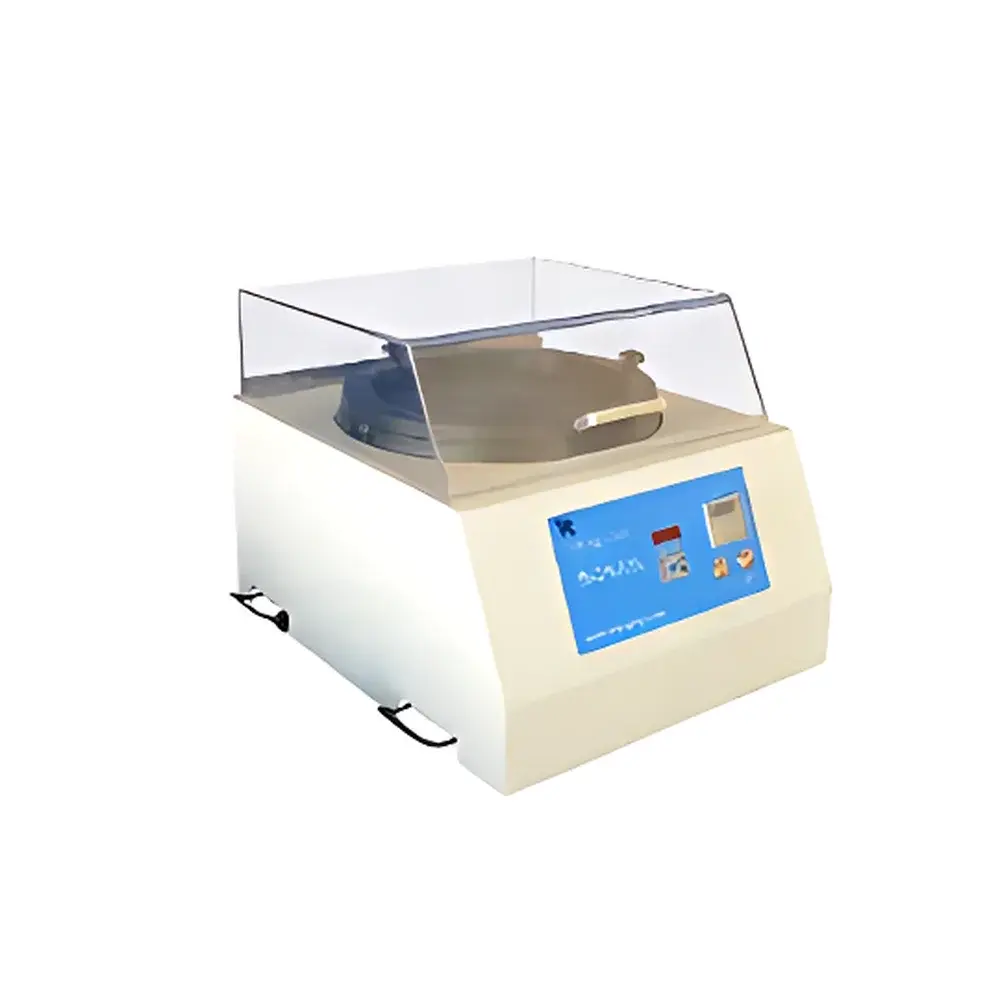
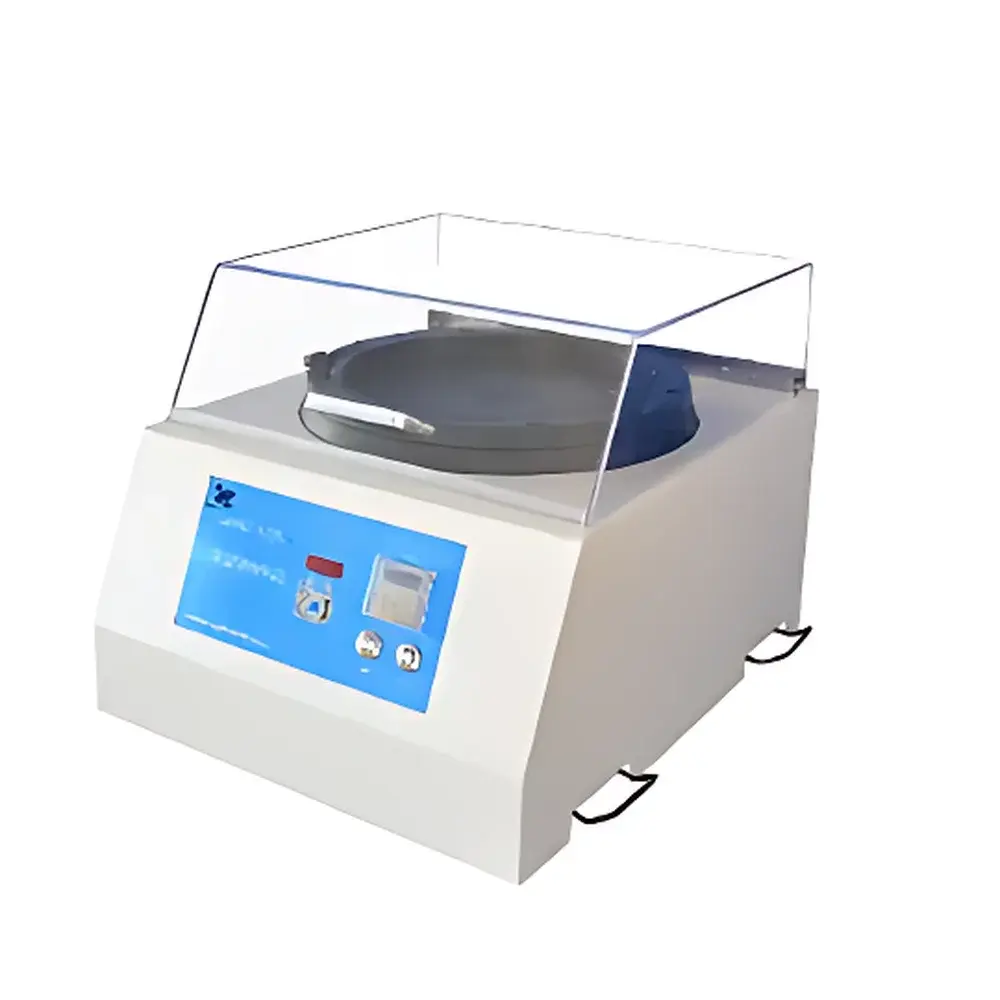
KJ GROUP UNIPOL-1200Z Vibratory Polishing Machine
| Brand | KJ GROUP |
|---|---|
| Origin | Liaoning, China |
| Model | UNIPOL-1200Z |
| Dimensions (L×W×D) | 660 × 530 × 430 mm |
| Platen Count | 1 |
| Platen Diameter | 304.8 mm |
| Frequency Range | 0–240 Hz |
| Maximum Timer Setting | 9999 min |
| Input Voltage | AC 110/220 V, 50/60 Hz |
| Motor Power | 550 W |
| Weight | 135 kg |
| Operating Environment | ≤1000 m altitude, 10–40 °C, 45–65 %RH |
| Water Supply Required | Yes |
| Ventilation Required | Yes |
| Workbench Minimum Size | 700 × 800 × 700 mm (W×D×H) |
Overview
The KJ GROUP UNIPOL-1200Z Vibratory Polishing Machine is a precision-engineered laboratory instrument designed for automated, high-reproducibility surface finishing of metallographic, geological, and ceramic specimens prior to electron microscopy analysis—including SEM, EBSD, and TEM sample preparation. Unlike rotary or lapping-based systems, the UNIPOL-1200Z employs controlled vibratory motion in a horizontal orbital plane, generating uniform micro-abrasive action across the specimen surface without rotational shear stress. This principle minimizes edge rounding, relief artifacts, and subsurface deformation—critical for crystallographic orientation mapping and quantitative microstructural characterization. The machine operates within a sealed, transparent polycarbonate dust shield, ensuring operator safety and contamination control while maintaining optical access for process monitoring.
Key Features
- Digitally controlled variable-frequency drive (0–240 Hz) with real-time LCD display of frequency, elapsed time, and remaining runtime—enabling precise optimization of polishing kinetics for diverse material classes (e.g., aluminum alloys, stainless steels, silicon carbide, quartz).
- Full automation capability: programmable timer up to 9999 minutes supports unattended overnight operation, reducing manual intervention and enhancing inter-operator consistency in routine QA/QC workflows.
- Robust fiberglass-reinforced polymer housing with chemical-resistant coating—engineered to withstand prolonged exposure to aqueous slurries, acidic etchants, and organic solvents commonly used in metallurgical preparation.
- Single 304.8 mm (12-inch) vibration platen with concentric mounting geometry ensures balanced load distribution and minimal mechanical resonance across the operational frequency range.
- Modular specimen holder system compatible with standard mounting diameters: 1″, 1.25″, 1.5″, 2″, 32 mm, and 50 mm; custom adapters available for non-standard geometries including irregularly shaped rock chips or large-section geological thin sections.
- Integrated water delivery port and drainage channeling—designed for continuous coolant flow during extended polishing cycles to maintain thermal stability and prevent slurry drying on the pad surface.
Sample Compatibility & Compliance
The UNIPOL-1200Z accommodates both mounted (epoxy/resin-embedded) and unmounted specimens up to 150 mm in maximum dimension. Its low-shear vibratory mechanism preserves phase integrity in multiphase composites, brittle intermetallics, and soft polymers—making it suitable for ASTM E3-22 (Standard Guide for Preparation of Metallographic Specimens) and ISO 14577-1:2022 (Metallic materials — Instrumented indentation test) compliant sample conditioning. The system’s sealed enclosure meets IEC 61000-6-3 emission limits for laboratory electromagnetic environments. While not certified to FDA 21 CFR Part 11, its digital timer log and parameter lockout functions support GLP-aligned documentation practices when integrated into validated SOPs.
Software & Data Management
The UNIPOL-1200Z operates via embedded firmware with no external PC dependency. All operational parameters—including frequency setpoint, duration, and start/stop timestamps—are retained in non-volatile memory and displayed on the front-panel LCD. No proprietary software is required; however, users may export run logs manually via timestamped visual recording or integrate the device into facility-wide LIMS through optional RS-232 or analog 0–10 V output modules (sold separately). Audit trail generation is supported by user-defined labeling of each polishing cycle using alphanumeric ID tags entered via membrane keypad.
Applications
- Preparation of distortion-free, scratch-free surfaces for EBSD pattern indexing in aluminum, titanium, and nickel-based superalloys.
- Routine polishing of polished-thin sections for petrographic analysis under polarized light microscopy (PLM) and cathodoluminescence (CL) imaging.
- Final-stage finishing of sintered ceramics (e.g., ZrO₂, Al₂O₃) prior to nanoindentation or scratch testing per ISO 14577 and ASTM C1327.
- Surface planarization of semiconductor wafers and MEMS substrates where rotational asymmetry must be avoided.
- Batch processing of quality control samples in foundry and aerospace manufacturing environments adhering to AS9100 Rev D requirements for traceable surface preparation.
FAQ
What types of polishing consumables are compatible with the UNIPOL-1200Z?
The system accepts standard 304.8 mm diameter polishing pads—including napped cloth (e.g., TexMet), synthetic polymer (e.g., MicroCloth), and rigid polyurethane matrices—as well as colloidal silica (e.g., 50 nm SiO₂), alumina (e.g., 80 nm Al₂O₃), and diamond suspensions (0.25–6 µm). Pad thickness must not exceed 6 mm to maintain optimal vibration coupling.
Is the machine suitable for hazardous slurry chemistries such as HF-based etchants?
No. The UNIPOL-1200Z is rated for aqueous and mild organic slurries only. Hydrofluoric acid, concentrated nitric acid, or chlorinated solvents are incompatible with the platen seal and housing materials. Always consult the Material Safety Data Sheet (MSDS) of any slurry prior to use.
Can multiple specimens be processed simultaneously?
Yes—up to six 1.25-inch mounted specimens or three 2-inch specimens may be loaded concurrently using the supplied multi-position holders, provided total mass does not exceed 8 kg to preserve frequency stability and amplitude linearity.
Does the unit require compressed air or vacuum connections?
No. The UNIPOL-1200Z is electrically powered only; no pneumatic or vacuum infrastructure is needed. A dedicated GFCI-protected outlet and stable water supply are mandatory.
What maintenance intervals are recommended for long-term reliability?
Inspect vibration isolation feet and platen mounting bolts quarterly; clean the internal slurry tray and drain channel after every 20 operating hours; replace the main drive belt every 12 months or 2000 operational hours—whichever occurs first.



