
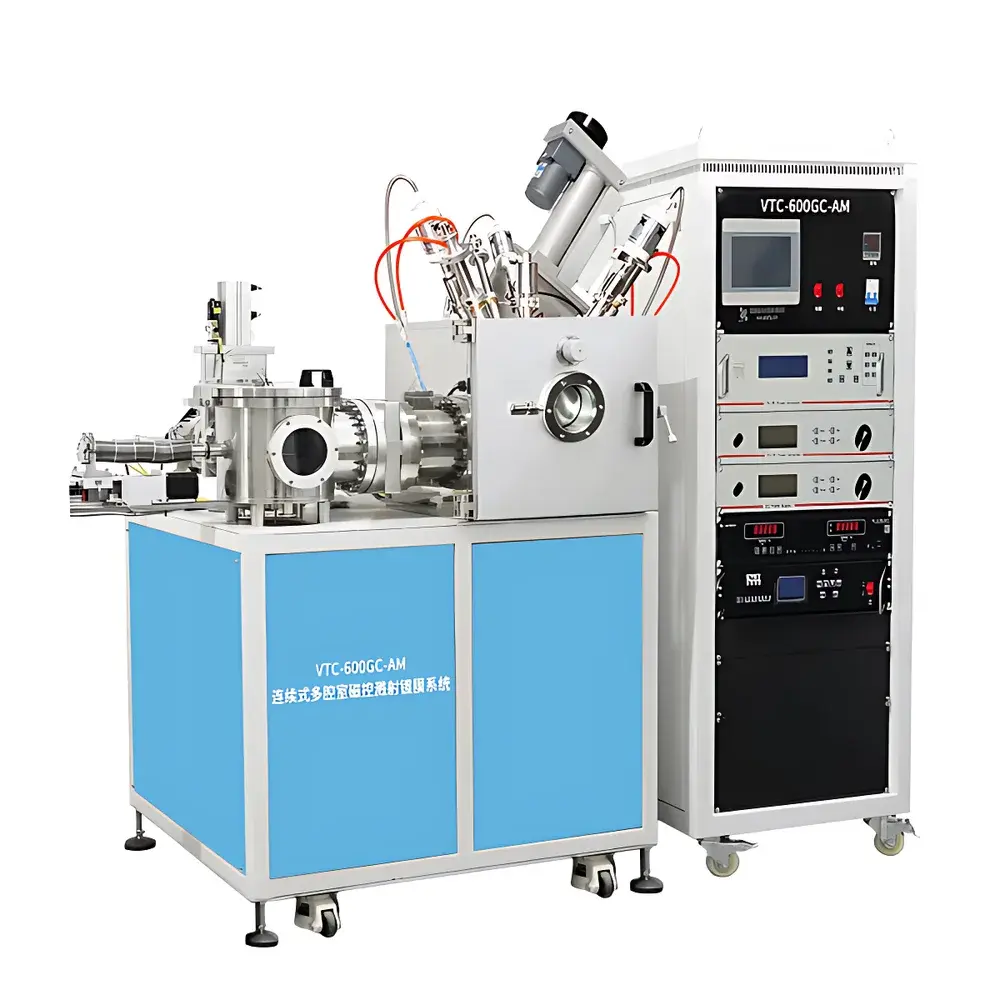
KJ GROUP VTC-600GC-AM Continuous Multi-Chamber Magnetron Sputtering Deposition System
| Brand | KJ GROUP |
|---|---|
| Origin | Liaoning, China |
| Manufacturer Type | Direct Manufacturer |
| Country of Origin | China |
| Model | VTC-600GC-AM |
| Vacuum Base Pressure | 6.0 × 10⁻⁵ Pa |
| Leak Rate | ≤0.5 Pa/h |
| Pump-Down Time (Atm → 5.0 × 10⁻³ Pa) | ~5 min |
| Vacuum System | Dual-stage (Mechanical Pump + Turbomolecular Pump) |
| Substrate Holder Diameter | φ140 mm |
| Substrate Temperature Range | Ambient to 500 °C (±1 °C control accuracy) |
| Substrate Rotation Speed | 5–20 rpm |
| Gas Inlet Channels | 2 (Mass Flow Controllers for Ar and N₂) |
| Target-to-Substrate Angle | 34° |
| Number of Target Positions | 3 (120° spacing, customizable) |
| Target Cooling | Water-cooled |
| Target Diameter | 2″ (φ50.8 mm), Thickness: 0.1–5 mm |
| Optional Features | RF Power Supply (for insulating targets), DC Power Supply (for conductive targets), Substrate Bias Module |
Overview
The KJ GROUP VTC-600GC-AM Continuous Multi-Chamber Magnetron Sputtering Deposition System is an engineered solution for high-reproducibility thin-film synthesis in academic and industrial R&D laboratories. Designed around a dual-chamber architecture—comprising a central transfer chamber and one or more magnetron sputtering chambers—the system enables sequential, non-breaking vacuum processing across multiple deposition zones. Its core operation relies on magnetron sputtering physics: energetic argon ions, accelerated within a magnetic confinement field near the target surface, dislodge atoms from solid cathode materials (metals, oxides, nitrides, or dielectrics), which then condense as uniform, stoichiometric thin films on heated, rotating substrates. The integrated linear motion stage allows precise, programmable shuttle movement of the substrate carrier between chambers, supporting true multi-step fabrication protocols—including bilayer, gradient, or combinatorial film stacks—without air exposure or manual handling. This architecture meets critical requirements for oxygen-sensitive systems such as solid-state electrolytes (e.g., LLZO, LATP), OLED charge transport layers (e.g., MoO₃, NiOₓ), and ferroelectric oxides (e.g., PZT, BTO), where interfacial contamination or oxidation must be strictly avoided.
Key Features
- Modular dual-chamber configuration with independent vacuum integrity: transfer chamber and sputtering chamber maintain separate pressure control and diagnostic access.
- Computer-controlled linear shuttle mechanism with position feedback and repeatable origin homing—enabling sub-millimeter positioning accuracy and synchronized motion profiles.
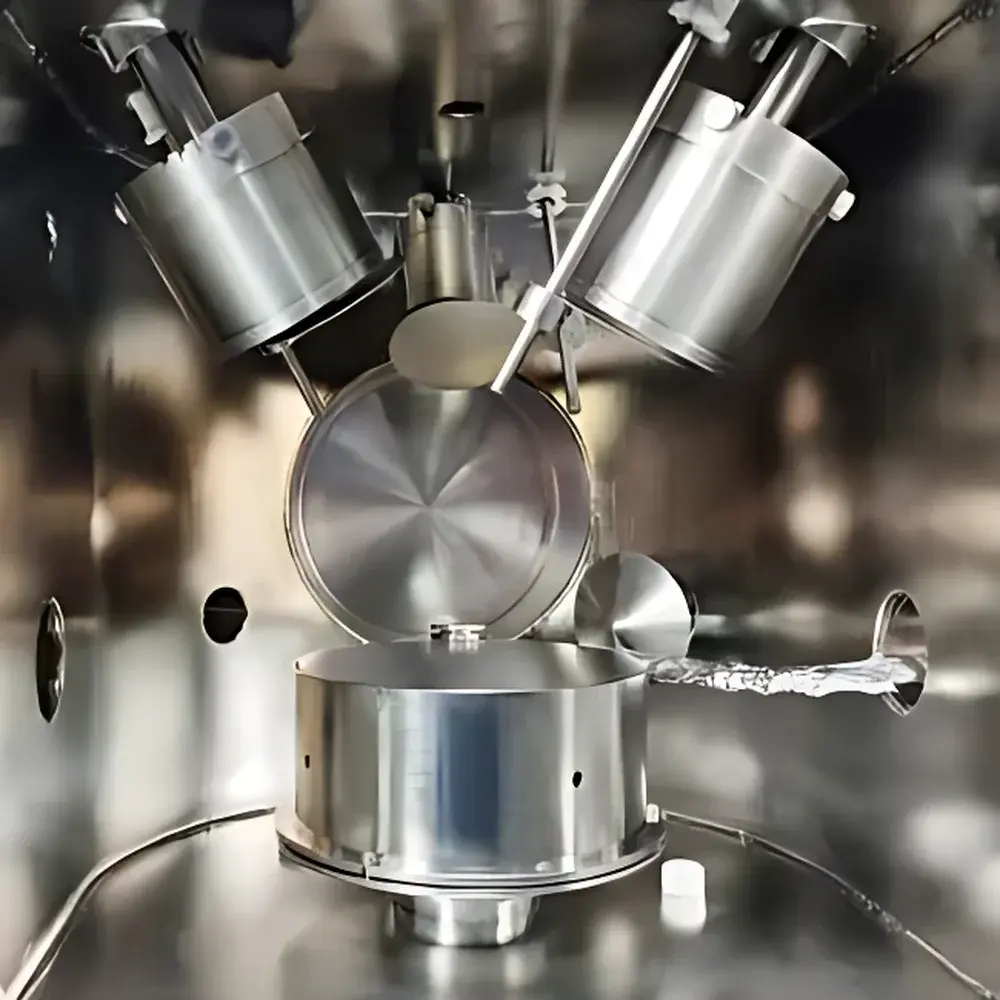
- Three-axis configurable magnetron array (standard 3-target, 120° layout; expandable up to 6 positions) with adjustable target-substrate geometry (34° incidence angle optimized for step coverage and deposition rate uniformity).
- Water-cooled 2-inch (φ50.8 mm) target mounts compatible with standard planar magnetrons; supports both DC sputtering (conductive targets: metals, alloys, doped oxides) and RF sputtering (insulating targets: Al₂O₃, SiO₂, LiNbO₃, polymers like PTFE precursors).
- Heated, rotationally driven substrate stage (φ140 mm, ambient–500 °C, ±1 °C stability) with optional DC/RF bias capability for ion-assisted densification and stress control.
- Dual-gas mass flow control (Ar/N₂) with digital setpoint regulation and real-time monitoring—essential for reactive sputtering of nitrides (e.g., TiN, AlN) and oxides (e.g., ITO, ZnO).
- Front-loading desktop footprint (W×D×H ≈ 1200 × 850 × 1700 mm) with rear-mounted vacuum pumping train—minimizing lab space requirements while maintaining service accessibility.
Sample Compatibility & Compliance
The VTC-600GC-AM accommodates wafers, coupons, and custom substrates up to φ140 mm, including silicon, quartz, glass, flexible polymer foils (e.g., PET, PI), and ceramic discs. Its low base pressure (<6 × 10⁻⁵ Pa) and low leak rate (≤0.5 Pa/h) ensure minimal residual hydrocarbon and water vapor partial pressures—critical for reproducible growth of stoichiometric metal oxides and low-defect semiconductor heterostructures. All vacuum components comply with ISO 286-2 (geometric tolerancing) and ASTM E595 (outgassing testing for space-grade hardware). The system’s modular electrical architecture supports integration into GLP-compliant environments: power supplies include RS-485/Modbus RTU interfaces for centralized logging, and optional audit-trail-enabled software modules align with FDA 21 CFR Part 11 data integrity requirements for regulated R&D workflows.
Software & Data Management
Operation is managed via a Windows-based HMI with intuitive tabbed navigation for vacuum sequencing, gas flow calibration, temperature ramping, shutter timing, and motion profiling. Real-time plotting displays pressure curves, power delivery (DC/RF forward/reflected), substrate temperature, and rotational speed. All process parameters are timestamped and exportable in CSV/Excel format. Optional LabVIEW or Python API support enables integration with external metrology tools (e.g., in-situ ellipsometers or quartz crystal microbalances) and automated recipe libraries. System logs retain full operational history—including pump-down cycles, vent events, and error codes—for traceability during method validation or peer-reviewed publication preparation.
Applications
- Solid-state battery research: sequential deposition of Li-conducting electrolyte layers (e.g., LiPON, Li₃PO₄) and cathode interphases (e.g., LiCoO₂/LiFePO₄) without interlayer oxidation.
- OLED and perovskite optoelectronics: fabrication of hole injection (NiOₓ, MoO₃), electron transport (ZnO, TiO₂), and transparent electrode (ITO, AZO) stacks under controlled reactive atmospheres.
- Ferroelectric and multiferroic devices: growth of epitaxial PZT, BFO, or YMnO₃ films requiring precise oxygen partial pressure and substrate heating.
- Hard coating development: TiN, CrN, and DLC-like carbon films on tooling substrates using bias-assisted sputtering.
- Combinatorial materials science: spatially resolved co-sputtering from multiple targets to generate composition-spread libraries for rapid screening.
FAQ
Can the VTC-600GC-AM perform reactive sputtering with oxygen or other reactive gases?
Yes—the dual-channel MFC system supports O₂, CO₂, or NH₃ addition when paired with optional corrosion-resistant gas lines and plasma-compatible flow sensors. Reactive deposition protocols are fully programmable within the control software.
Is remote monitoring or automation possible?
The system includes Ethernet and RS-485 ports for SCADA integration. Optional OPC UA server licensing enables connection to enterprise MES or LabVantage platforms.
What vacuum certifications are provided?
Each unit ships with a factory-generated vacuum performance report, including base pressure verification, leak test results (helium mass spectrometry), and pump-down time validation—traceable to NIST-calibrated gauges.
How is film thickness monitored during deposition?
While the base configuration does not include in-situ thickness monitoring, the system features standardized flanges (CF35/CF63) for integrating quartz crystal microbalances (QCM) or optical monitors (e.g., spectroscopic ellipsometry viewports) as user-installed options.
Does KJ GROUP provide installation and training support internationally?
Yes—turnkey commissioning, on-site operator training, and application-specific protocol development are available globally through authorized technical partners, with documentation supplied in English and compliance-ready SOP templates.



