
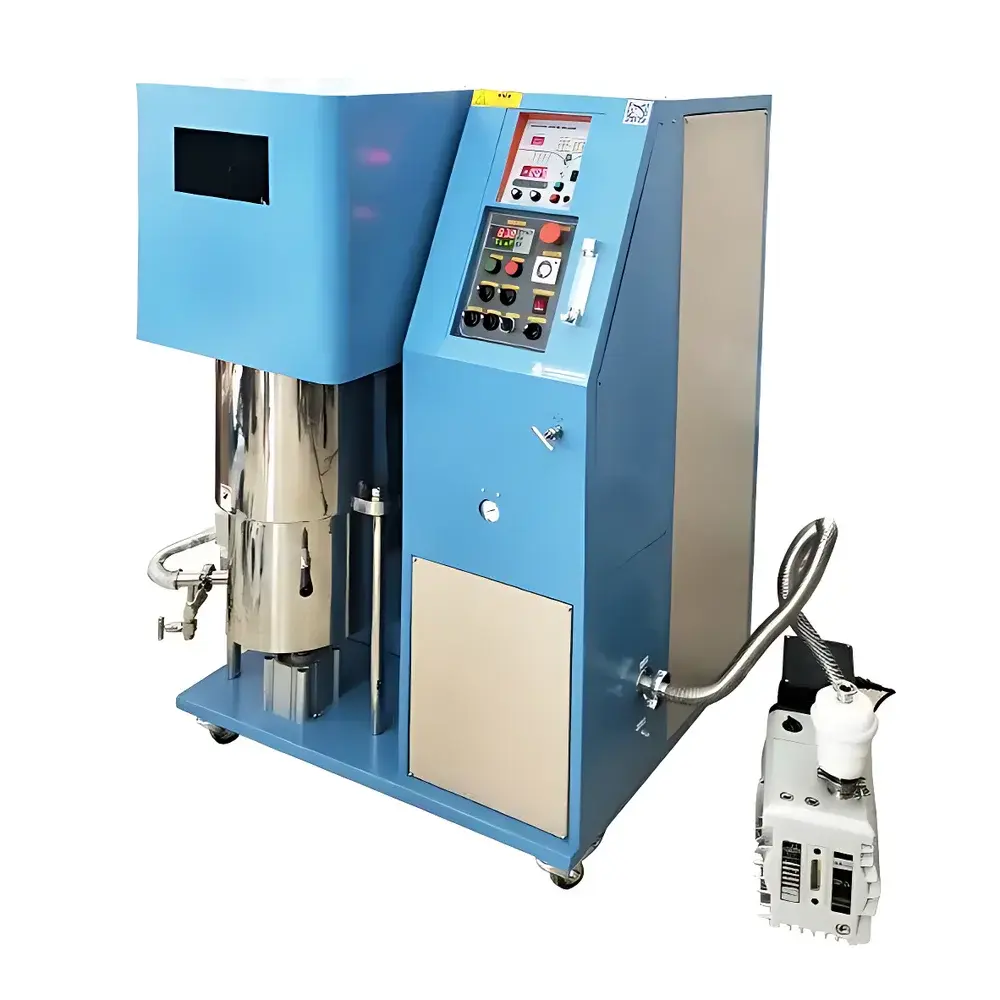
KJ GROUP IMCS-1500RC Atmosphere-Protected Continuous Casting Furnace with Induction Heating (up to 1500 °C)
| Brand | KJ GROUP |
|---|---|
| Origin | Liaoning, China |
| Manufacturer Type | Authorized Distributor |
| Country of Origin | China |
| Model | IMCS-1500RC |
| Pricing | Upon Quotation |
| Maximum Operating Temperature | 1500 °C |
| Temperature Control Method | PID |
| Temperature Uniformity | ±2 °C |
| Thermocouple Type | S-type |
| Vacuum System | Dual-stage rotary vane pump |
| Ultimate Vacuum | 1 bar (abs) |
| Atmosphere Flow Rate | 5 L/min |
| Optional Water Chiller Flow Rate | 16 L/min |
| Overall Dimensions (W×D×H) | 1120 mm × 840 mm × 1560 mm |
| Net Weight | 195 kg |
| Crucible Material | Graphite |
| Casting Forms | Rods, Tubes, and Flat Sheets |
| Secondary Feeding Unit | Optional (custom-configurable) |
Overview
The KJ GROUP IMCS-1500RC is an industrial-grade, atmosphere-protected continuous casting furnace engineered for high-temperature metallurgical processing under controlled inert or reducing gas environments. Utilizing high-frequency induction heating, the system achieves precise thermal management up to 1500 °C within a sealed graphite crucible assembly, enabling reproducible melting, homogenization, and directional solidification of reactive and refractory alloys—including Ni-based superalloys, Ti alloys, Cu–Cr–Zr systems, and specialty steels. Unlike batch-type furnaces, the IMCS-1500RC integrates a mechanically synchronized withdrawal mechanism that permits continuous solidification of molten metal into uniform cross-sectional profiles—primarily rods, tubes, and thin sheets—while maintaining tight thermal gradients across the solidification front. This architecture supports research into microstructure evolution, segregation behavior, and thermomechanical property development in near-net-shape castings, making it suitable for both R&D laboratories and pilot-scale production environments.
Key Features
- Induction-heated graphite crucible system with integrated melt containment and controlled withdrawal drive for stable continuous casting.
- Hermetically sealed chamber compatible with vacuum (down to 1 bar absolute) and regulated inert/reducing atmospheres (Ar, N₂, H₂/N₂ mixtures) at flow rates up to 5 L/min.
- PID-based temperature control using calibrated S-type thermocouples, delivering thermal stability within ±2 °C across the full operating range (room temperature to 1500 °C).
- Modular design supporting optional secondary feeding units for multi-stage alloying or compositional gradient casting—configurable per user-defined metallurgical requirements.
- Standardized mounting interface for integration with external water-cooling circuits; optional chiller unit provides 16 L/min flow capacity for sustained high-power operation.
- Robust mechanical frame with reinforced insulation layers and safety interlocks compliant with IEC 61000-6-2 (EMC immunity) and IEC 61000-6-4 (EMC emission) standards.
Sample Compatibility & Compliance
The IMCS-1500RC accommodates a broad spectrum of metallic feedstocks—including master alloys, pre-alloyed ingots, and granulated scrap—in standard graphite crucibles (diameters ranging from 30 mm to 80 mm, depth ≥150 mm). Casting geometry is determined by the die configuration mounted at the base of the crucible; rod diameters from 3 mm to 25 mm, tube OD/ID ratios from 1.5:1 to 4:1, and sheet thicknesses between 0.5 mm and 3 mm are routinely achieved. All internal wetted surfaces are constructed from high-purity graphite (ASTM D7028 grade), minimizing contamination during high-temperature exposure. The system meets structural and operational requirements referenced in ASTM E8/E8M (tensile testing of metallic materials), ISO 15510 (nickel and nickel alloys—chemical composition), and supports GLP-compliant documentation workflows when paired with validated data logging hardware.
Software & Data Management
Temperature setpoints, ramp/soak profiles, vacuum pressure trends, and atmosphere flow logs are recorded via a dedicated industrial PLC-based controller with RS485/Modbus RTU output. Optional Ethernet-enabled data acquisition modules support time-stamped CSV export and real-time SCADA integration (e.g., Ignition, Siemens WinCC). Audit trails include operator ID, timestamp, parameter change history, and alarm event logs—fully traceable for FDA 21 CFR Part 11 compliance when deployed in regulated GMP environments. Firmware updates are delivered through secure USB interfaces with cryptographic signature verification.
Applications
- Development of metastable phases in rapidly solidified Al–Fe–V–Si alloys for aerospace applications.
- Processing of oxygen-free copper and Cu–Ag composites for high-conductivity busbar fabrication.
- Continuous casting trials of Zr-based bulk metallic glasses under Ar/H₂ mixtures to suppress oxide nucleation.
- Thermal simulation of direct-chill (DC) casting processes for aluminum extrusion billets.
- In-situ study of solute partitioning kinetics during unidirectional solidification of Ni–Al–Mo ternaries.
- Prototyping of functionally graded materials via sequential feedstock introduction using the optional secondary feeder.
FAQ
What types of protective atmospheres are supported?
The furnace accepts argon, nitrogen, hydrogen–nitrogen blends (e.g., 5% H₂ in N₂), and forming gas (5% H₂ in Ar); all require external gas supply lines with mass flow controllers.
Can the system operate under dynamic vacuum conditions during casting?
Yes—the dual-stage rotary vane pump enables active vacuum maintenance (<1 bar abs) throughout melting and withdrawal, though atmospheric or positive-pressure inert gas operation is recommended for most reactive metals.
Is the graphite crucible replaceable, and what is its typical service life?
Crucibles are consumable components; expected lifetime ranges from 20–50 melts depending on alloy chemistry, peak temperature, and thermal cycling frequency—documentation includes replacement protocols and dimensional tolerances.
Does the system meet CE or UL certification requirements?
The base configuration complies with CE marking directives (2014/35/EU Low Voltage Directive and 2014/30/EU EMC Directive); UL 61010-1 listing is available upon request for North American installations.
What level of technical support is provided post-installation?
KJ GROUP offers remote diagnostics, on-site commissioning (optional), annual calibration verification services, and access to metallurgical application engineering support for process optimization.
Related Products



