
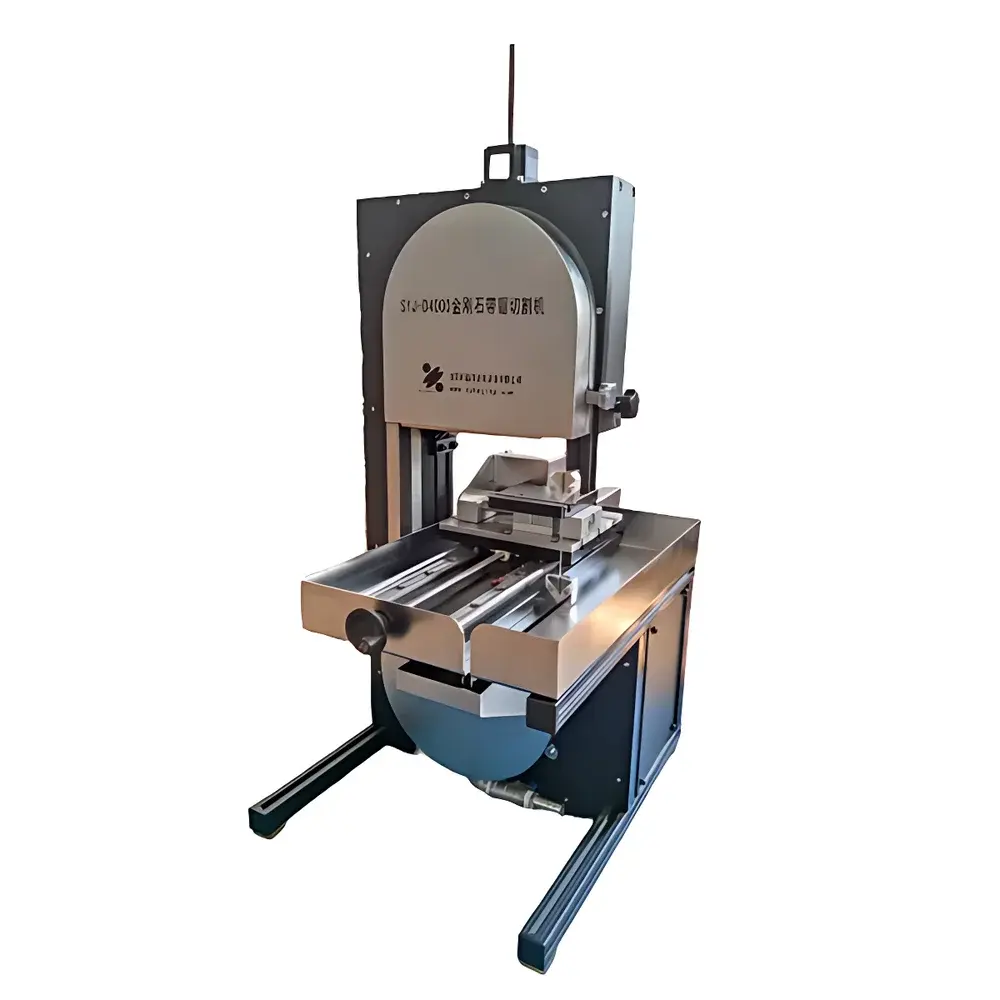
KJ GROUP SYJ-D4000 Diamond Band Saw Cutting Machine
| Brand | KJ GROUP |
|---|---|
| Origin | Liaoning, China |
| Manufacturer Type | Direct Manufacturer |
| Instrument Category | Domestic |
| Model | SYJ-D4000 |
| Pricing | Upon Request |
| Instrument Type | Precision Cutting Machine |
| Blade Linear Speed | >600 m/min |
| Max. Cutting Thickness | 100 mm |
| Min. Manual Curved-Cut Radius | 10 mm |
| Max. Manual Span Distance | 320 mm |
| Kerf Width | <1.2 mm |
| X-Axis Travel Range | ≥140 mm |
| X-Axis Feed Resolution | 0.01 mm |
| Y-Axis Travel Range | ≥140 mm |
| Cut Count Setting Range | 1–99 cycles |
| Feed Rate Range | 0.01–40 mm/min |
| Dimensions (W×D×H) | 410 × 580 × 950 mm |
Overview
The KJ GROUP SYJ-D4000 Diamond Band Saw Cutting Machine is a compact, high-precision band saw system engineered for controlled sectioning of brittle, heterogeneous, and composite materials in research laboratories and specialized preparation facilities. It operates on the principle of continuous diamond-impregnated blade motion—where abrasive diamond particles embedded in a flexible steel band cut via mechanical abrasion under precisely regulated feed force and linear velocity. Unlike rotary or reciprocating saws, this system minimizes thermal stress, microcracking, and delamination, making it particularly suitable for delicate biological specimens, mineralogical samples, and engineered composites where structural integrity and surface fidelity are critical. Its dual-mode operation—manual trajectory control and programmable automated feed—enables both exploratory sample evaluation and repeatable, protocol-driven sectioning workflows.
Key Features
- Dual-operation mode: switch seamlessly between manual joystick-controlled cutting and motorized, parameter-defined automatic feed for reproducible sectioning sequences.
- High-speed diamond band drive: blade linear velocity exceeds 600 m/min, ensuring efficient material removal while maintaining low kerf loss (<1.2 mm) and minimal subsurface damage.
- Fine-resolution positioning: X- and Y-axis travel ranges ≥140 mm each, with X-axis feed resolution of 0.01 mm—supporting precise alignment of anatomical landmarks or microstructural features prior to cut initiation.
- Curvilinear capability: minimum manual curve radius of 10 mm enables contour-following cuts for irregularly shaped specimens such as dental arches, fossilized bone fragments, or custom-shaped ceramic substrates.
- Configurable cycle programming: up to 99 sequential cuts can be defined with independent feed rate (0.01–40 mm/min), dwell time, and stroke depth—essential for serial sectioning protocols in histomorphometry and 3D reconstruction studies.
- Rigid cast-aluminum frame and vibration-damped base structure ensure mechanical stability during extended operation, reducing positional drift and improving dimensional repeatability across multi-hour runs.
Sample Compatibility & Compliance
The SYJ-D4000 accommodates a broad spectrum of hard-to-cut materials including optical glass, sintered ceramics, natural stone (marble, granite, jade), concrete composites, and polymer-ceramic hybrids. In life sciences, it supports preparation of undecalcified bone sections, dental implants with surrounding osseointegrated tissue, vascular stents embedded in calcified arterial segments, and plastinated human/animal organ blocks—without requiring pre-decalcification or cryo-embedding. All cutting procedures comply with standard laboratory safety practices per ISO 13857 (safety distances) and IEC 61000-6-2 (electromagnetic immunity). While not certified for GMP production environments, its repeatable feed control, traceable parameter logging, and mechanical interlocks align with GLP documentation requirements for preclinical histopathology labs conducting ASTM E112 (grain size analysis) or ISO 10993-12 (biological evaluation of medical devices) sample preparation.
Software & Data Management
The SYJ-D4000 utilizes an embedded microcontroller-based interface with tactile keypad and LCD display for real-time parameter entry and status monitoring. No external PC dependency is required for basic operation; however, optional RS-232 or USB-to-serial connectivity allows integration with lab information management systems (LIMS) for audit-trail generation. Each cutting cycle logs timestamp, feed rate, total strokes, and final position—data exportable in CSV format for QA/QC review. The system does not incorporate FDA 21 CFR Part 11-compliant electronic signatures, but all manual entries are time-stamped and non-editable post-execution, satisfying basic GLP traceability expectations for academic and contract research organizations.
Applications
- Preparation of undecalcified bone and dental tissue sections for histomorphometric analysis (e.g., osteocyte lacunar density, cement line quantification).
- Sectioning of cardiovascular stent–tissue complexes for corrosion interface evaluation and neointimal thickness measurement.
- Cutting of fossilized vertebrate remains and paleontological matrix blocks for synchrotron tomography alignment and thin-section microscopy.
- Dimensionally accurate slicing of technical ceramics and optical substrates for interferometric flatness testing and coating adhesion assessment.
- Serial sectioning of plastinated anatomical specimens for digital atlas development and surgical simulation training modules.
- Controlled segmentation of automotive elastomeric seals and thermoplastic composites for failure mode analysis and aging studies.
FAQ
What types of diamond blades are compatible with the SYJ-D4000?
The machine accepts standard 0.35–0.45 mm thick diamond-coated band blades with 12–18 mm width and 2,500–3,200 mm loop length. Blade selection must match material hardness and desired surface finish—e.g., fine-grit resin-bonded blades for biomineralized tissues, metal-bonded blades for reinforced concrete.
Can the SYJ-D4000 perform water-cooled cutting?
Yes—integrated coolant nozzle and reservoir support continuous aqueous or ethanol-based coolant delivery to suppress dust, dissipate frictional heat, and extend blade service life. Coolant flow rate is manually adjustable.
Is alignment calibration required before each use?
A one-time mechanical zero-point calibration is performed during installation. Subsequent daily verification involves checking X/Y homing repeatability using a calibrated gauge block—typical deviation remains within ±0.02 mm over 100 cycles.
Does the system support angled or beveled cuts?
No—the SYJ-D4000 performs only orthogonal (90°) vertical cuts relative to the sample stage plane. For angular sectioning, specimens must be mounted on custom-machined jigs or rotated fixtures.
What maintenance intervals are recommended?
Belt tension and guide wheel wear should be inspected every 200 operating hours; coolant filter replacement is advised every 50 hours under continuous use; main drive bearings require re-lubrication annually per manufacturer specifications.



