
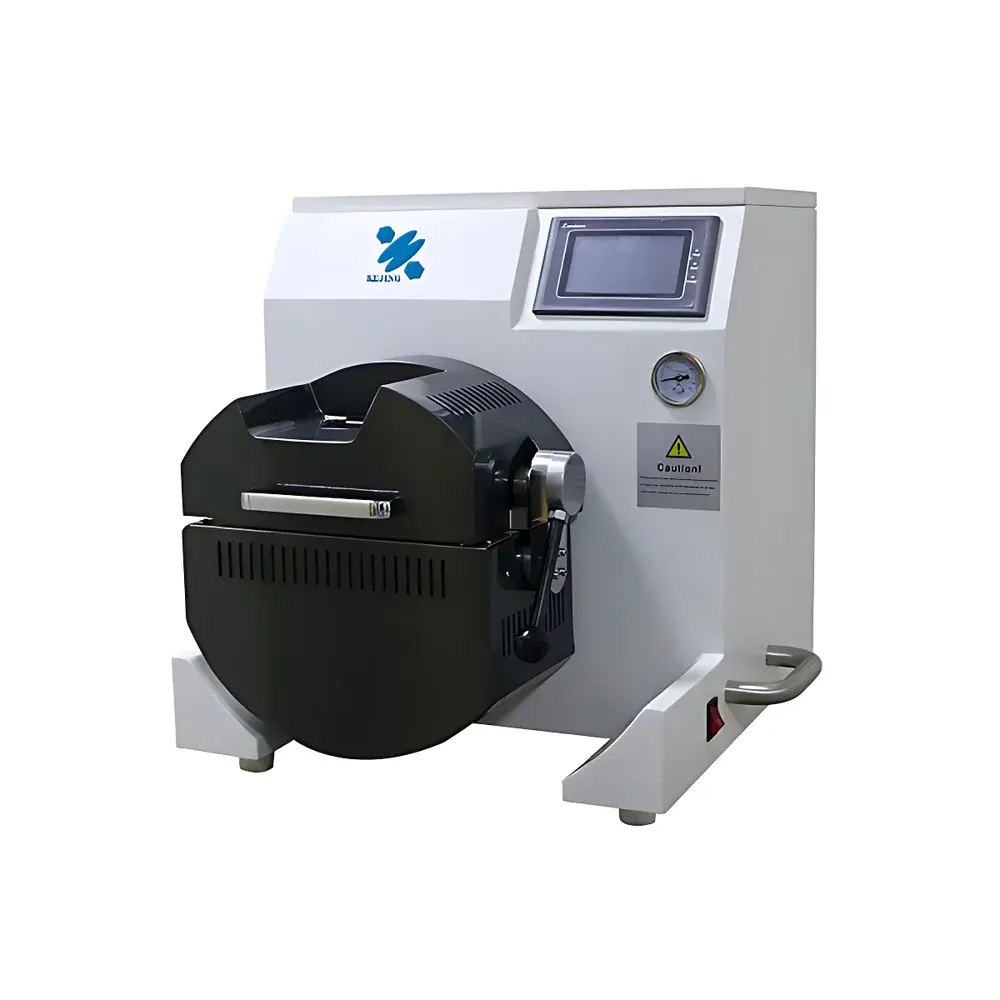
KJ GROUP VIMC-150 Vacuum Induction Melting and Centrifugal Casting Furnace
| Brand | KJ GROUP |
|---|---|
| Origin | Liaoning, China |
| Manufacturer Type | Authorized Distributor |
| Country of Origin | China |
| Model | VIMC-150 |
| Price | Upon Request |
| Power Supply | 220 V AC, 4.5 kW |
| Max Temperature | 2600 °C |
| Heating Method | Medium-Frequency Induction |
| Crucible Capacity | 150 g (Au equivalent) |
| Melting Time | ≤2 min |
| Vacuum Level | ≤−0.1 MPa (10⁻³ mbar typical) |
| Pressure Range | Up to 3.5 MPa (Ar) |
| Gas Atmosphere | High-Purity Argon (optional N₂ or He) |
| Crucible Material | Fused Quartz |
| Cooling System | Integrated Water-Cooling Circuit |
| Control System | Siemens S7-1200 PLC with PID Digital Temperature Regulation |
| Automation | Fully Automated Vacuum-Induced Inversion & Pressure-Assisted Casting |
| Safety | Multi-Stage Interlock Alarms (Overtemp, Overpressure, Coolant Flow Loss, Vacuum Failure) |
Overview
The KJ GROUP VIMC-150 Vacuum Induction Melting and Centrifugal Casting Furnace is an integrated metallurgical system engineered for high-precision, oxide-free casting of reactive and refractory metals under controlled inert or vacuum atmospheres. It combines medium-frequency induction heating with synchronized vacuum evacuation, gas pressurization, and programmable centrifugal inversion—enabling reproducible production of dense, pore-free castings in laboratory and small-batch industrial settings. Designed for applications where surface integrity, microstructural homogeneity, and compositional fidelity are critical—including dental prosthetics, fine jewelry prototyping, precious metal recycling, and academic metallurgy research—the VIMC-150 operates on the principle of electromagnetic induction melting followed by gravity-assisted or pressure-driven mold filling under sub-atmospheric conditions. Its maximum operating temperature of 2600 °C supports full liquefaction of platinum-group metals (Pt, Pd), titanium alloys, gold, silver, copper, and select stainless steels, while the fused quartz crucible ensures minimal contamination and thermal shock resistance.
Key Features
- Precision digital PID temperature control (Siemens S7-1200 PLC platform) with ±2 °C stability across the full 200–2600 °C range, enabling repeatable thermal profiles for alloy-specific solidus/liquidus targeting.
- 5 kW adjustable medium-frequency induction power supply delivering rapid, localized heating—achieving complete melt of 150 g Au-equivalent charge in ≤2 minutes with no electrode contact or slag formation.
- Integrated vacuum and pressure management: dual-stage mechanical vacuum pump achieves ≤−0.1 MPa base pressure; high-pressure argon delivery up to 3.5 MPa enables directional solidification and porosity suppression during mold filling.
- Automated inversion mechanism with programmable tilt angle and timing, synchronized with vacuum break and gas pressurization to ensure laminar, oxide-free metal transfer into investment molds.
- Comprehensive safety interlock architecture: real-time monitoring of coolant flow rate, chamber overtemperature, pressure excursion, vacuum integrity, and door status—triggering immediate shutdown and audible/visual alerts per IEC 61508 SIL 2 requirements.
- Compact footprint (540 × 530 × 495 mm) with casters and modular water-cooling interface, facilitating integration into ISO Class 5–7 cleanrooms or shared lab environments without dedicated HVAC modifications.
Sample Compatibility & Compliance
The VIMC-150 accommodates a defined range of high-value, oxidation-sensitive metals and alloys, including but not limited to: 24K gold, K-gold (e.g., 14K, 18K), sterling silver (925), platinum (Pt-10Ir), palladium (Pd-5Cu), commercially pure titanium (Grade 2), and low-carbon copper alloys. All casting processes comply with ASTM F2899–23 (Standard Practice for Vacuum Casting of Dental Alloys) and ISO 22674:2023 (Dentistry — Metallic Materials for Fixed and Removable Restorations). The fused quartz crucible meets USP extractables criteria for metallic impurity limits (<1 ppb Ni, Cr, Fe), supporting GLP-compliant material certification workflows. Vacuum and pressure subsystems conform to PED 2014/68/EU Category II design standards.
Software & Data Management
The furnace integrates with KJ GROUP’s proprietary CAST-LOG™ software suite (v3.2), providing full traceability of each casting cycle: timestamped temperature ramp curves, vacuum decay logs, pressure hold durations, inversion sequence timing, and alarm event history. All operational data are stored locally on an encrypted SD card and exportable as CSV or PDF reports compliant with FDA 21 CFR Part 11 requirements—including electronic signatures, audit trails, and user-level access controls (admin/operator/guest roles). Optional OPC UA server enables seamless integration into MES platforms such as Siemens Opcenter or Rockwell FactoryTalk.
Applications
- Dental laboratories: Fabrication of crowns, bridges, and implant frameworks from Co-Cr, Ti-6Al-4V, and noble alloys with minimized internal porosity and improved marginal fit.
- Jewelry R&D: Rapid iteration of custom alloy compositions (e.g., rose gold variants, Pt-Pd blends) with precise stoichiometric control and repeatable microstructure development.
- University metallurgy programs: Hands-on instruction in vacuum metallurgy principles, phase diagram validation, and solidification kinetics under controlled nucleation conditions.
- Precious metal refiners: Small-batch assay and ingot production with certified mass balance reporting and residual oxygen content <10 ppm (verified via LECO ONH analyzers).
- Microcasting facilities: Production of turbine blade replicas, MEMS-compatible metal microstructures, and sensor housings requiring dimensional accuracy within ±0.05 mm and surface roughness Ra <1.6 µm.
FAQ
What types of molds are compatible with the VIMC-150?
Investment (lost-wax) ceramic shells, graphite molds, and silica-based refractory molds—pre-baked to ≥800 °C under argon to eliminate residual organics and moisture.
Can the system be validated for GMP manufacturing?
Yes. IQ/OQ documentation packages are available upon request, including sensor calibration certificates (NIST-traceable thermocouples, capacitance manometers), pressure decay test records, and vacuum leak rate verification per ASTM E493.
Is remote monitoring supported?
Via optional Ethernet/Wi-Fi module: real-time parameter streaming, SMS/email alerts for process deviations, and secure web-based dashboard access using TLS 1.3 encryption.
What maintenance intervals are recommended?
Vacuum pump oil change every 500 operating hours; quartz crucible inspection after 20 melts; water-cooling filter replacement quarterly; full PLC firmware update annually.
Does the system support custom atmosphere blending (e.g., Ar + H₂)?
Yes—when equipped with the optional MFC-controlled dual-gas manifold (up to 3 gases), enabling reducing atmospheres for oxide-sensitive alloys like Ni-based superalloys.



