
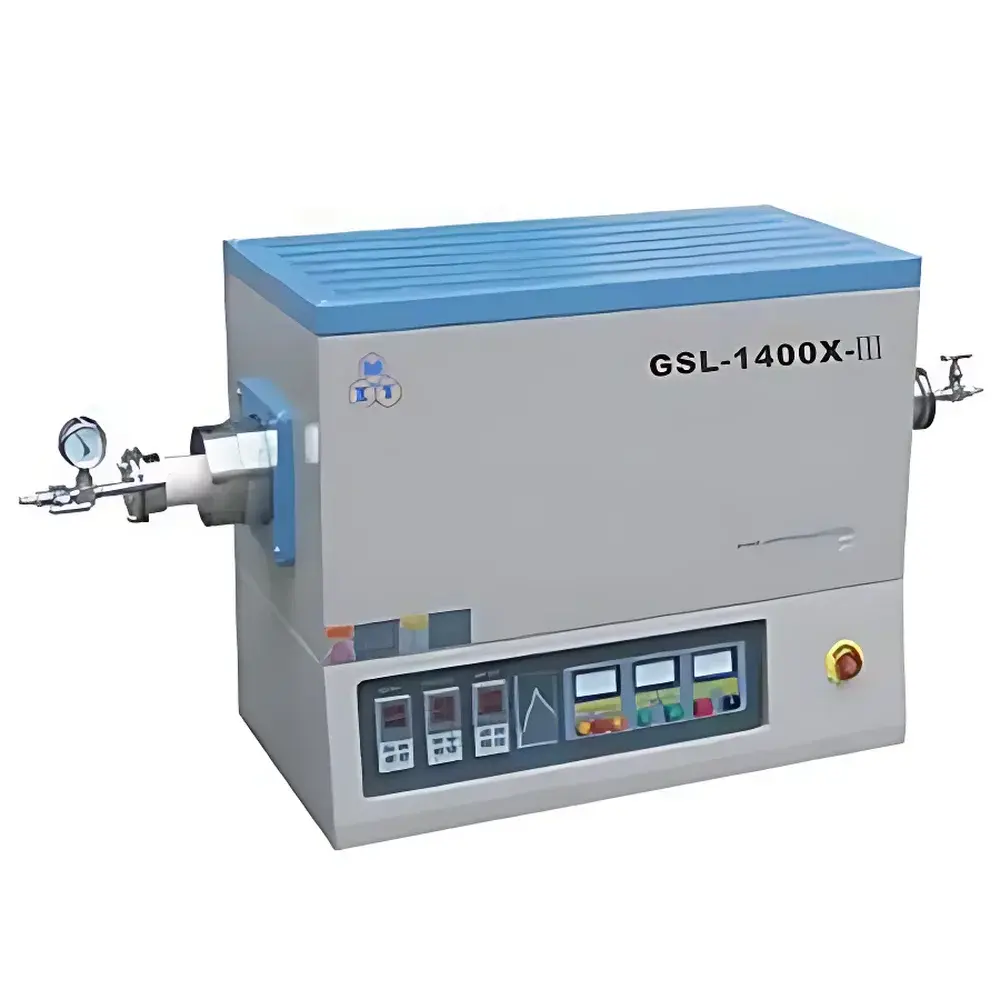
GSL-1400X-III Triple-Zone Vacuum & Atmosphere Tube Furnace (KJ GROUP / Shenyang Kejing)
| Brand | KJ GROUP / Shenyang Kejing |
|---|---|
| Origin | Liaoning, China |
| Manufacturer Type | Authorized Distributor |
| Region of Origin | Domestic (China) |
| Model | GSL-1400X-III |
| Pricing | Upon Request |
| Power Supply | AC 220 V, 50/60 Hz, 4 kW |
| Maximum Temperature | 1400 °C (continuous at 1300 °C) |
| Heating Element | Silicon Carbide Rods |
| Thermocouple Type | S-type Platinum-Rhodium |
| Uniform Temperature Zone | 120 mm |
| Tube Dimensions | Φ60 × 1000 mm or Φ80 × 1000 mm (Al₂O₃) |
| Chamber Lining | High-Purity Alumina Fiber (Vacuum-Formed) |
| Control Accuracy | ±1 °C |
| Vacuum Compatibility | Yes (with optional high-vacuum system) |
| Atmosphere Capability | Inert, reducing, oxidizing, or vacuum |
| Certifications | CE-compliant |
| Overall Dimensions | 860 × 470 × 720 mm |
| Net Weight | 120 kg |
Overview
The GSL-1400X-III Triple-Zone Vacuum & Atmosphere Tube Furnace is an engineered thermal processing platform designed for precise, repeatable high-temperature synthesis and heat treatment under controlled gaseous environments or vacuum conditions. Built upon a robust dual-layer stainless steel housing with high-purity alumina fiber insulation (vacuum-formed for structural integrity and low thermal conductivity), the furnace employs silicon carbide (SiC) heating elements and S-type platinum-rhodium thermocouples to achieve stable operation up to 1400 °C — with continuous rated performance at 1300 °C. Its triple independent heating zones enable axial temperature gradient control across the 1000 mm-long alumina tube, supporting uniform thermal profiles or deliberate thermal ramps essential for processes such as chemical vapor deposition (CVD), solid-state reaction kinetics, ceramic sintering, and thin-film annealing. The furnace integrates a flanged quartz or alumina tube system with metal-sealed flanges, allowing seamless transition between inert gas purging, reactive atmosphere introduction, and vacuum evacuation down to 10⁻² mbar (when equipped with optional two-stage rotary vane pump or high-vacuum turbomolecular system).
Key Features
- Triple-zone independent PID temperature control with 708P programmable controller, enabling synchronized or decoupled zone regulation for tailored thermal profiles.
- High-density silicon carbide heating rods fabricated via vacuum extrusion, ensuring mechanical stability and long-term resistance to thermal cycling degradation.
- High-purity α-alumina fiber furnace chamber, formed by vacuum adsorption for consistent density, low heat storage, and excellent thermal shock resistance.
- Standard Φ60 mm × 1000 mm or Φ80 mm × 1000 mm high-purity alumina (99.7% Al₂O₃) tube; compatible with quartz alternatives for lower-temperature applications.
- CE-certified electrical architecture with grounded AC 220 V, 50/60 Hz input and integrated over-temperature protection circuitry.
- Stainless steel vacuum flange assembly with Viton or high-temperature silicone O-rings (6 included), supporting rapid atmosphere exchange and leak-tight vacuum hold.
Sample Compatibility & Compliance
The GSL-1400X-III accommodates a broad range of sample geometries and containment systems, including alumina and quartz crucibles, boat fixtures, and substrate holders for wafer-scale processing. Its 120 mm effective isothermal zone ensures reproducible thermal exposure for materials testing per ASTM C1171 (refractory ceramics), ISO 1887 (thermal stability of inorganic materials), and IEC 60068-2-11 (environmental testing: dry heat). The furnace’s design supports GLP-aligned workflows when paired with optional PC-based data logging (21 CFR Part 11-compliant software available), audit-trail-enabled temperature recording, and calibrated thermocouple traceability to NIST standards. Vacuum and gas-handling configurations comply with ISO 27462 for laboratory equipment safety and EN 61000-6-3 for electromagnetic compatibility.
Software & Data Management
An optional RS485/USB communication module enables integration with KJ GROUP’s proprietary furnace control software, providing real-time temperature monitoring, multi-step ramp-soak programming, and automated data export in CSV or Excel format. The software supports user-defined alarm thresholds, event-triggered logging, and timestamped thermal history archives — all structured for traceability in regulated environments. When configured with optional digital vacuum gauges or mass flow controllers, the system permits closed-loop atmosphere management, with pressure and gas composition logs synchronized to temperature profiles. All firmware adheres to IEC 62443 cybersecurity baseline requirements for industrial control systems.
Applications
- Pre-sintering and final densification of electronic ceramics (e.g., BaTiO₃, PZT, LTCC substrates).
- CVD precursor decomposition and thin-film growth on Si, SiC, or metallic substrates.
- Controlled-atmosphere annealing of battery cathode materials (NMC, LFP) and solid electrolytes.
- Thermal gravimetric analysis (TGA) coupling via custom inlet/outlet ports for evolved gas analysis.
- Low-pressure chemical synthesis, carbothermic reduction, and nitridation of refractory powders.
- High-temperature calibration of thermocouples and reference materials per ISO/IEC 17025 protocols.
FAQ
What vacuum level can the GSL-1400X-III achieve with standard configuration?
The base configuration includes a mechanical vacuum connection but no pump; with an optional two-stage rotary vane pump, typical base pressure reaches 1×10⁻² mbar. For ultra-high vacuum (UHV) applications, a turbomolecular pumping station (optional) achieves ≤5×10⁻⁶ mbar.
Can the furnace operate under hydrogen or ammonia atmospheres?
Yes — provided appropriate gas-handling hardware (stainless steel lines, leak-tested fittings, and explosion-proof ventilation) is installed per CGA G-1 and NFPA 55 guidelines. Hydrogen use requires additional safety interlocks and purge cycles.
Is the alumina tube included with thermal insulation?
Yes — one high-purity alumina tube (Φ60×1000 mm or Φ80×1000 mm) and four matching end plugs are supplied as standard. Optional quartz tubes and custom-length alumina variants are available.
Does the 708P controller support Ethernet or Modbus communication?
The standard 708P unit features RS485 Modbus RTU output. Ethernet gateway modules and OPC UA drivers are available as add-on accessories for SCADA integration.
What maintenance intervals are recommended for silicon carbide heating elements?
Under continuous operation at ≤1300 °C with proper atmosphere control, SiC rods typically maintain calibration for 1,500–2,000 hours. Visual inspection and resistance measurement every 500 hours are advised to detect incipient degradation.



