
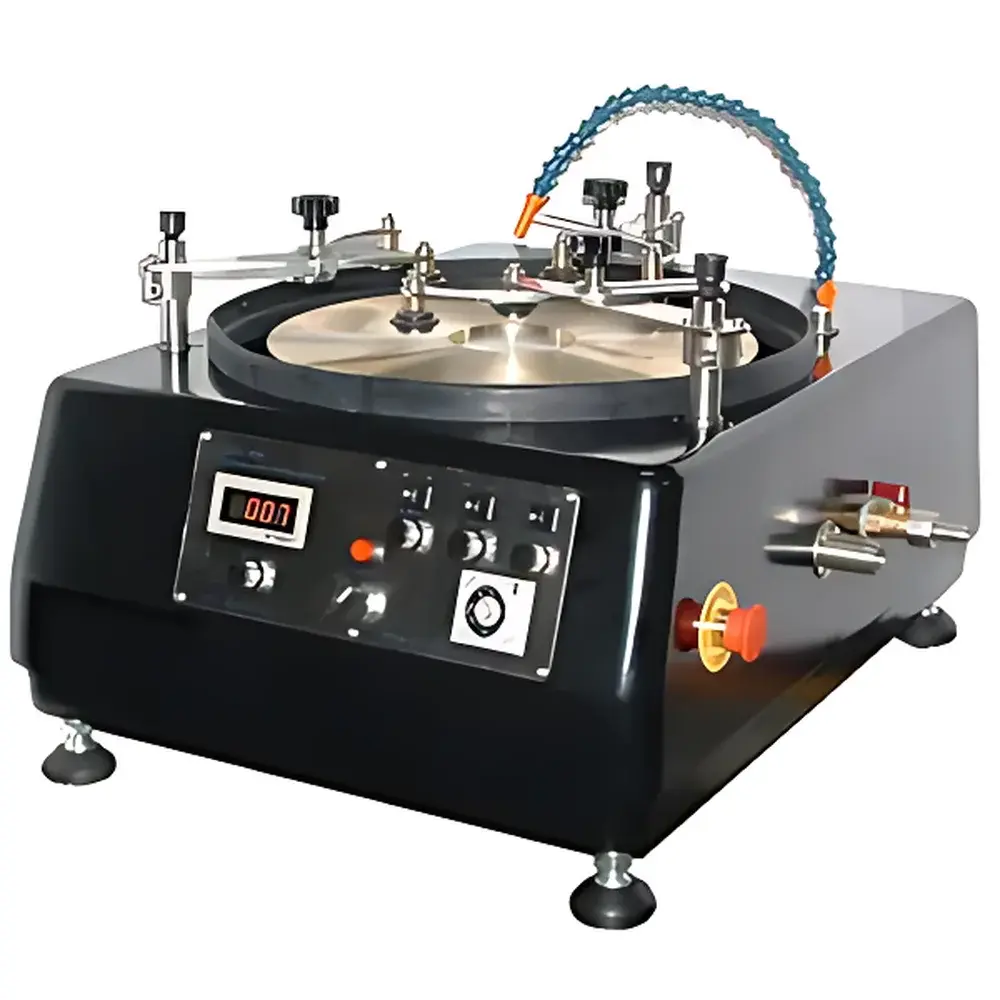
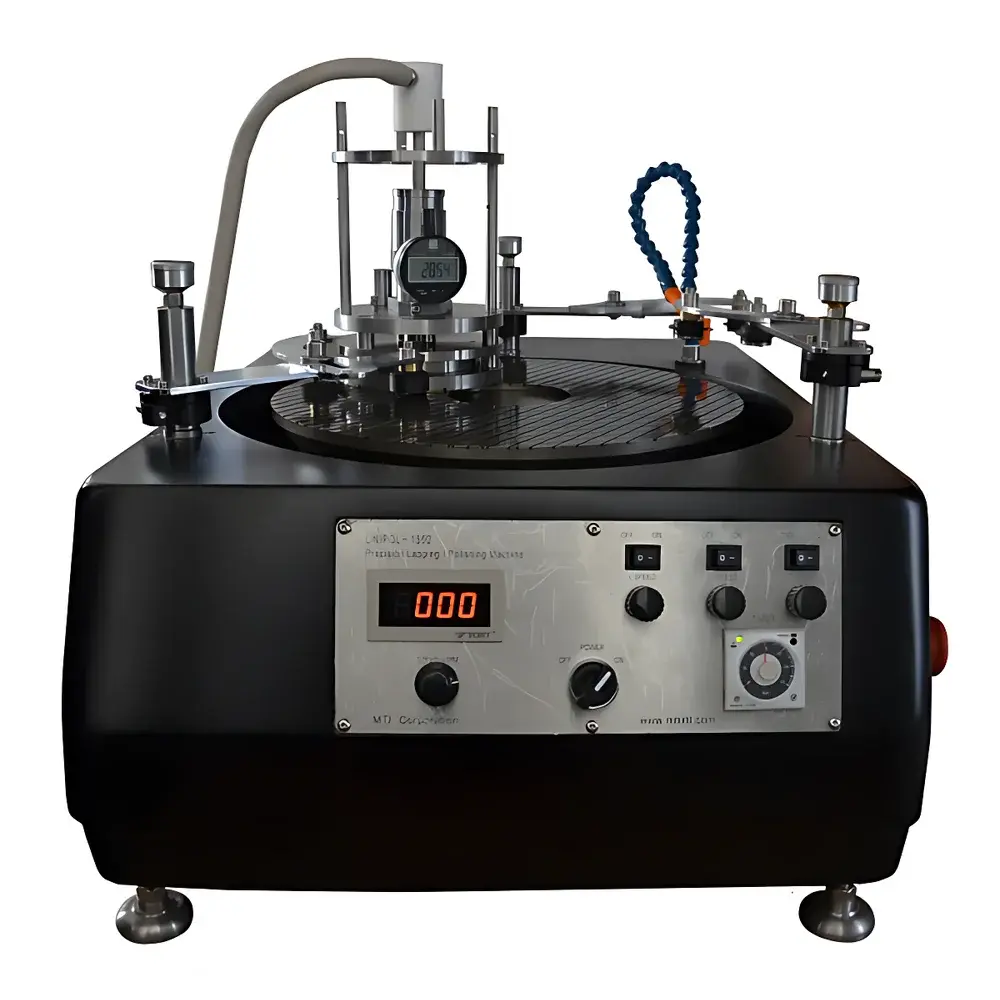
KJ GROUP UNIPOL-1502 Automated Precision Grinding and Polishing System
| Brand | KJ GROUP |
|---|---|
| Origin | Liaoning, China |
| Model | UNIPOL-1502 |
| Dimensions (L×W×D) | 720 mm × 580 mm × 380 mm |
| Number of Grinding/Polishing Stations | 3 |
| Platen Diameter | Ø381 mm |
| Rotational Speed Range | 10–125 rpm |
| Runout at Platen Edge | ≤0.01 mm over 332 mm |
| Surface Flatness | <0.0025 mm per 25 mm × 25 mm area |
| Oscillation Frequency | 0–9 cycles/min |
| Power Supply | 110/220 V AC, 50 Hz |
| Power Consumption | 410 W |
| Weight | 90 kg |
| Timer Range | 0–300 h |
Overview
The KJ GROUP UNIPOL-1502 Automated Precision Grinding and Polishing System is a laboratory-grade, multi-station mechanical sample preparation instrument engineered for high-accuracy planar surface finishing of hard and brittle materials. It operates on the principle of controlled abrasive contact between rotating platens and specimen-mounted carriers, combined with synchronized orbital motion and oscillatory arm movement to eliminate preferential wear patterns and ensure uniform material removal across the entire sample surface. Unlike conventional single-axis grinders, the UNIPOL-1502 integrates three independent processing stations—two of which execute programmable lateral oscillation—enabling simultaneous grinding and polishing of up to three specimens while maintaining micron-level flatness and edge integrity. Its design prioritizes reproducibility in cross-sectional analysis, wafer metrology, metallurgical specimen preparation, and optical component fabrication where surface topography, parallelism, and edge preservation are critical to downstream characterization (e.g., SEM, XRD, ellipsometry, or interferometric inspection).
Key Features
- Triple-station configuration with two oscillating arms (0–9 cycles/min) and one fixed station, supporting concurrent processing of up to three specimens ≤Ø110 mm or ≤110 mm diagonal square samples.
- High-precision Ø381 mm platen with surface flatness <0.0025 mm per 25 mm × 25 mm zone and radial runout ≤0.01 mm over 332 mm diameter—certified per ISO 10791-6 geometric accuracy standards for grinding equipment.
- Infinitely variable rotational speed control (10–125 rpm) with digital tachometer display for real-time spindle monitoring and process repeatability.
- Integrated timer with 0–300 hour range supports unattended operation for extended coarse grinding, fine lapping, or final polishing sequences under defined time constraints.
- Magnetic retention system for rapid attachment/detachment of abrasive pads (e.g., polyurethane, synthetic leather, suede), diamond-impregnated resin discs, or standard grit-backed sandpaper—eliminating adhesive residues and enabling quick media changes without tools.
- Stainless steel carrier blocks machined to ≤0.005 mm parallelism and ≤0.003 mm flatness per ANSI B46.1 surface texture specifications, ensuring minimal edge rounding and maximal specimen planarity post-processing.
Sample Compatibility & Compliance
The UNIPOL-1502 accommodates diverse material classes including single-crystal semiconductors (Si, Ge, ZnSe, ZnS), technical ceramics (Al2O3, SiC, ZrO2), sintered metals, geological thin sections, PCB substrates, infrared optics, refractory composites, and hardened alloys. Its mechanical architecture complies with IEC 61000-6-2 (EMC immunity) and IEC 61000-6-4 (EMC emissions) for laboratory environments. When operated with optional GPC-100A precision control unit, the system supports GLP-compliant workflows through audit-trail-enabled parameter logging (speed, time, oscillation frequency, coolant flow rate) aligned with FDA 21 CFR Part 11 data integrity requirements. All structural components meet ISO 9001-certified manufacturing protocols; platen flatness verification reports are available upon request.
Software & Data Management
While the base UNIPOL-1502 operates via front-panel controls, integration with the optional GPC-100A Precision Grinding and Polishing Controller enables PC-based protocol management, multi-step recipe storage (up to 99 programs), and real-time parameter synchronization across stations. The controller logs timestamped operational data—including actual RPM, elapsed time, oscillation count, and external sensor inputs (e.g., flow rate from SKZD-4 auto-dosage system)—in CSV format for traceability. Exported datasets conform to ASTM E1558-22 guidelines for reporting mechanical polishing parameters in metallurgical testing. No proprietary software installation is required; data export is compatible with common LIMS platforms and statistical process control (SPC) tools.
Applications
- Preparation of TEM/SEM cross-sections requiring sub-micron thickness uniformity and minimal beveling.
- Wafer-level planarization of ≤110 mm semiconductor substrates prior to epitaxial growth or lithographic patterning.
- Production of geologic thin sections with consistent 30 µm thickness and optical clarity for petrographic microscopy.
- Surface conditioning of infrared-transmitting windows (e.g., ZnS, Ge) to meet MIL-PRF-13830B scratch-dig specifications.
- Routine metallographic specimen preparation per ASTM E3-22 and ISO 15510 standards for grain structure analysis.
- Batch processing of ceramic matrix composites used in aerospace thermal protection systems, where interfacial integrity must remain undisturbed during surface refinement.
FAQ
What types of abrasives are compatible with the UNIPOL-1502?
Magnetic-backed diamond discs (e.g., resin-bonded 15–3 µm), silicon carbide or aluminum oxide sandpaper (P80–P2000), and polymer-based polishing pads (polyurethane, synthetic leather) can be mounted directly onto the platen using the integrated magnetic chuck.
Can the system operate without external coolant supply?
Yes—the base configuration supports dry grinding with bonded abrasives; however, wet operation using an optional SKZD-4 auto-dosing system or YJXZ-12 recirculating pump is recommended for heat-sensitive or dust-prone materials to prevent thermal damage and improve particle suspension.
Is the UNIPOL-1502 suitable for ISO/IEC 17025-accredited laboratories?
When paired with GPC-100A and calibrated using NIST-traceable reference standards (e.g., certified flatness gauges), the system meets measurement uncertainty requirements for accredited metallographic preparation per ISO/IEC 17025:2017 Clause 7.8.2.
What maintenance intervals are recommended for long-term reliability?
Platen surface flatness should be verified annually using optical interferometry; bearing lubrication is required every 2,000 operating hours; and magnetic chuck cleaning is advised after each abrasive change to preserve holding force.
Does the system support vacuum chucking for non-magnetic specimens?
No—vacuum chucks are not included, but custom adapter plates compatible with third-party vacuum carriers can be mechanically interfaced via the standard M6 threaded mounting pattern on the carrier block base.
Related Products



