
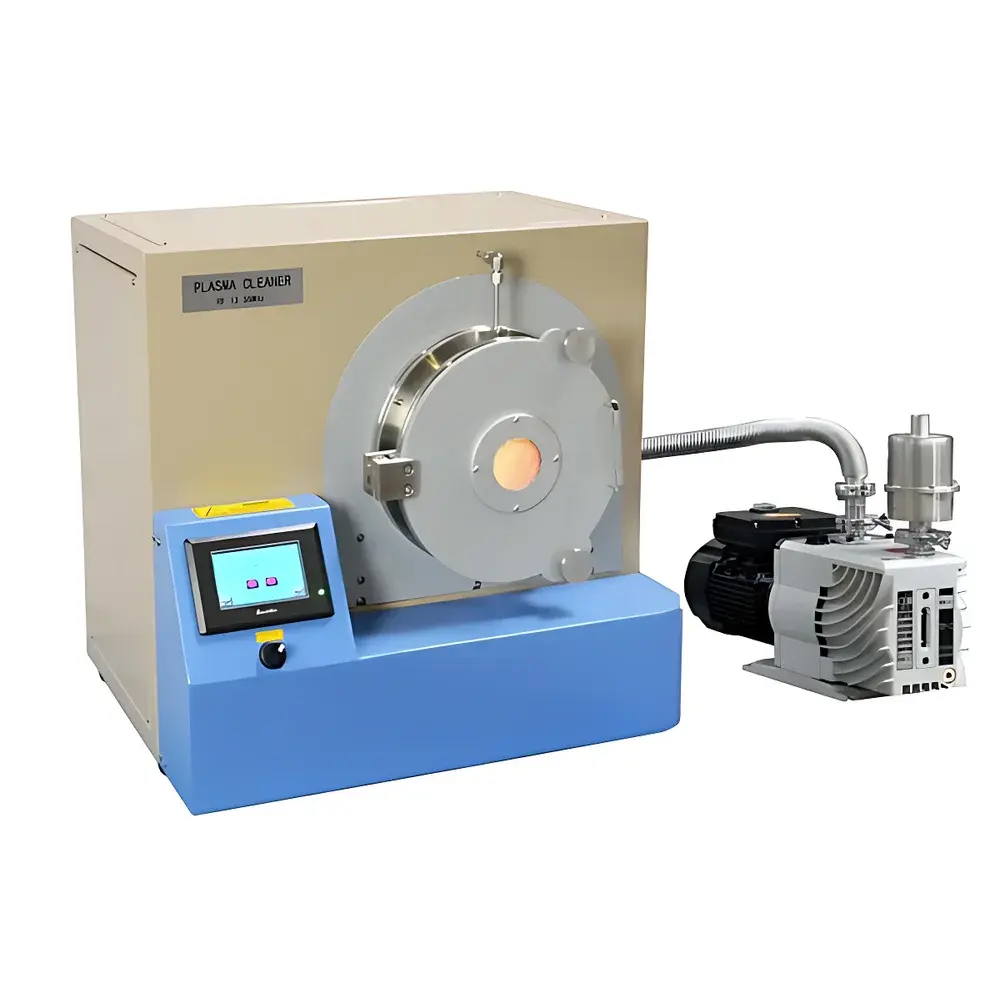
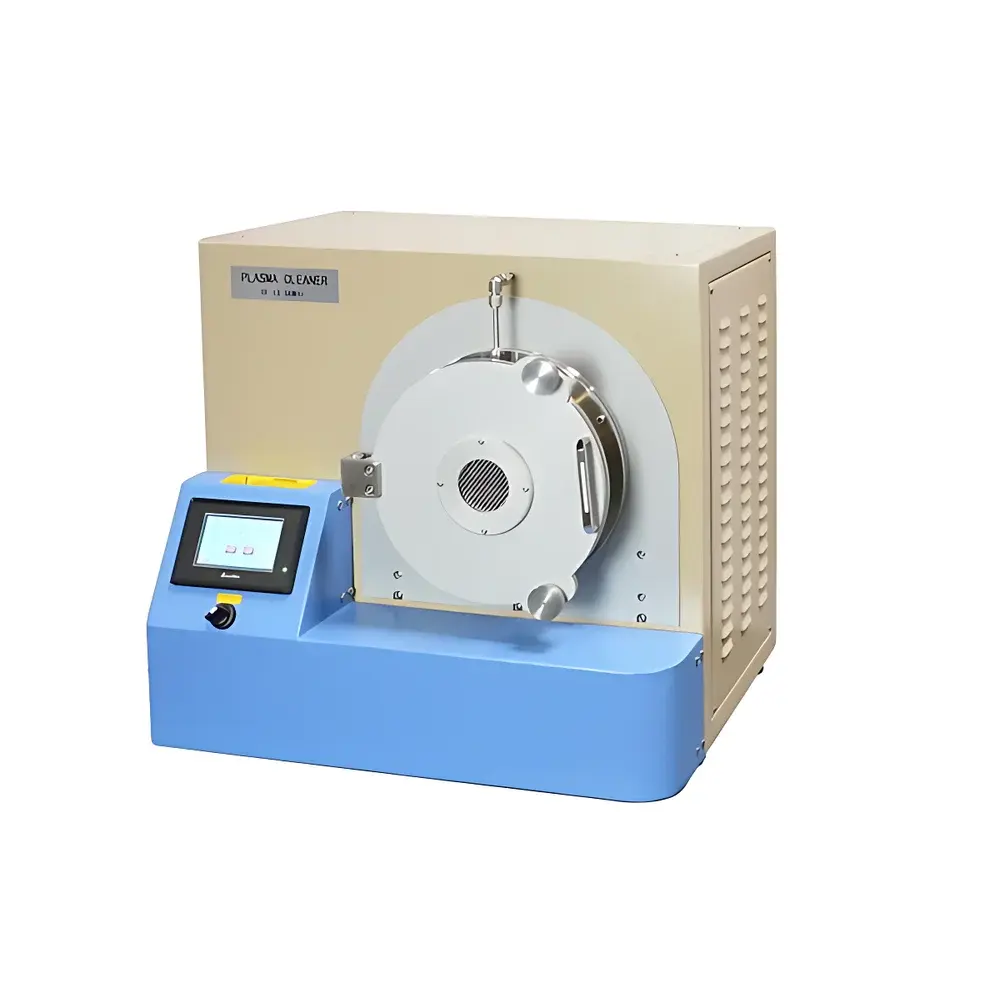
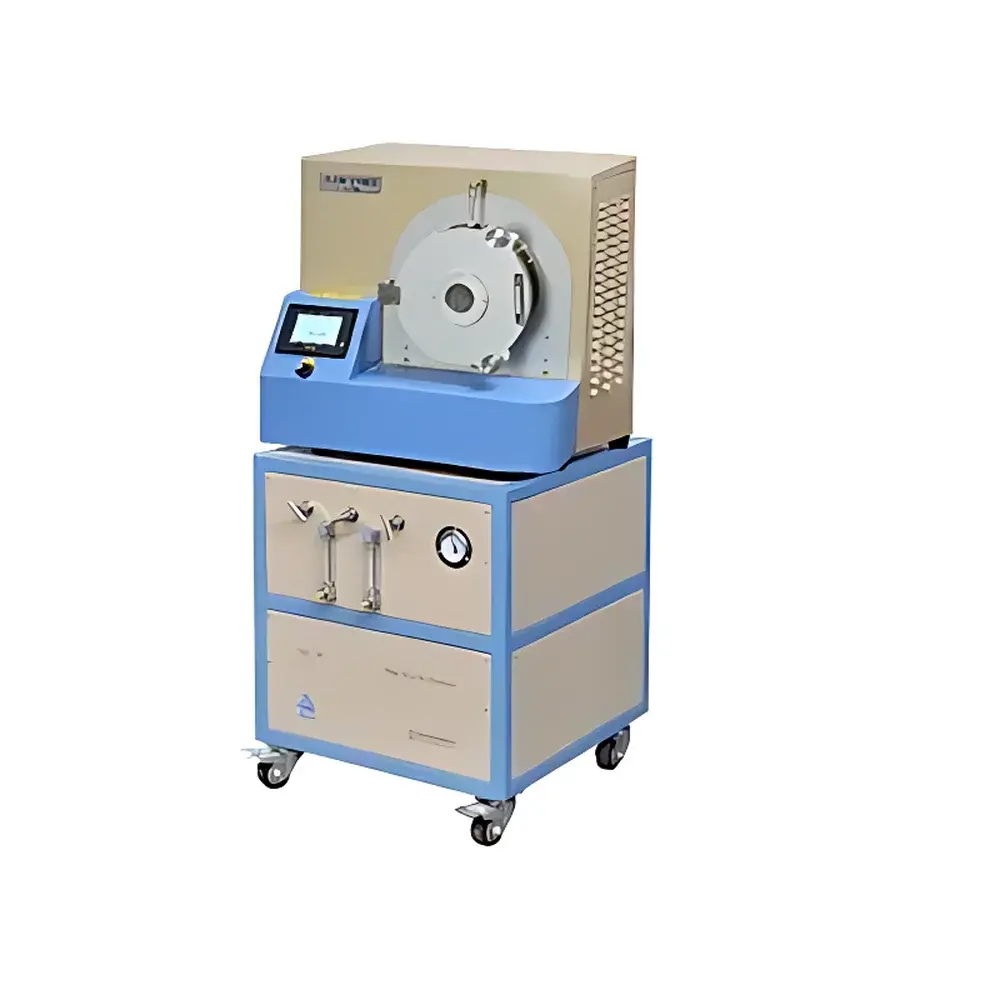
KJ GROUP PCE-8 Plasma Cleaner
| Brand | KJ GROUP |
|---|---|
| Model | PCE-8 |
| Type | Benchtop RF Plasma Surface Treater |
| RF Frequency | 13.56 MHz |
| Max RF Power | 100 W (continuously adjustable) |
| Plasma Chamber | High-purity quartz tube, Ø8.2" ID × 12" L (Ø208 mm × 305 mm), aluminum folding flange with Ø60 mm viewport |
| Ultimate Vacuum | 50 mtorr |
| Pumping System | Direct-coupled dual-stage rotary vane pump (240 L/min) |
| Gas Compatibility | N₂, O₂, Ar, H₂, air, and custom gas mixtures |
| Mass Flow Control | 0–500 sccm (digital MFC integrated) |
| Control Interface | 6" color touchscreen (power, time, gas flow, pump activation) |
| Dimensions (W×D×H) | 620 × 450 × 600 mm |
| Total Power Consumption | <600 W |
| Input Voltage | AC 220 V |
Overview
The KJ GROUP PCE-8 Plasma Cleaner is a benchtop radiofrequency (RF) plasma surface treatment system engineered for precision cleaning, surface activation, and mild etching of substrates in research and pilot-scale fabrication environments. Operating at the industrial standard frequency of 13.56 MHz, the system generates low-pressure, non-thermal plasma within a high-purity quartz chamber (Ø208 mm internal diameter × 305 mm length), enabling uniform and controllable interaction between reactive species (e.g., atomic oxygen, metastable argon, hydroxyl radicals) and sample surfaces. Unlike atmospheric plasma systems, the PCE-8’s vacuum-based architecture—achieving an ultimate pressure of 50 mtorr—ensures reproducible plasma ignition, minimal thermal load on temperature-sensitive substrates (e.g., polymers, organic thin films, or pre-deposited metal layers), and compatibility with oxygen-free processing using inert gases such as argon. Its design supports critical pre-deposition treatments—including native oxide removal from Si, GaAs, or sapphire wafers prior to epitaxial growth—as well as hydrophilicity enhancement of PDMS, PET, or glass slides for microfluidic bonding or biosensor functionalization.
Key Features
- High-stability 13.56 MHz RF generator with continuous 0–100 W power regulation, optimized for stable glow discharge across variable gas compositions and pressures
- Quartz plasma chamber with aluminum folding flange and integrated Ø60 mm borosilicate viewport for real-time visual monitoring of plasma uniformity and glow characteristics
- Integrated digital mass flow controller (0–500 sccm range) for precise, repeatable gas dosing—essential for process transferability and DOE-based optimization
- Direct-coupled dual-stage rotary vane vacuum pump (240 L/min pumping speed) with oil mist filtration, enabling rapid evacuation (<90 s to 100 mtorr) and stable base pressure control
- 6-inch full-color capacitive touchscreen HMI with intuitive parameter mapping: RF power setpoint, treatment duration (1 s–99 min), gas flow rate, pump enable/disable, and safety interlock status
- Modular vacuum interface compliant with KF25 standards, supporting optional accessories including multi-channel gas mixing systems (floating-ball or proton-type), auxiliary RF sources (300 W/600 W), and substrate carriers (2″–6″ quartz boats)
Sample Compatibility & Compliance
The PCE-8 accommodates rigid and flexible substrates up to 6″ in diameter—including silicon wafers, fused silica optics, ceramic substrates, metallic foils, and polymer films—without requiring custom fixtures. Its low-power, low-temperature plasma regime avoids substrate warping, carbonization, or ion bombardment damage common in high-energy plasma systems. The chamber geometry and electrode configuration support homogeneous treatment across >95% of the central 4″ area (verified via XPS depth profiling and water contact angle mapping). From a regulatory standpoint, the system operates within ISO 14644-1 Class 8 cleanroom-compatible electrical and emission limits. While not certified to IEC 61000-6-3 (EMC) or UL 61010-1 out-of-the-box, its RF shielding and grounded chassis design facilitate integration into GLP-compliant laboratories conducting ASTM F2102 (surface cleanliness verification) or SEMI F20 (plasma process validation) workflows.
Software & Data Management
The PCE-8 operates via embedded firmware with no external PC dependency; all process parameters are stored locally in non-volatile memory with timestamped logging (up to 1,000 cycles). The touchscreen interface provides immediate access to historical run logs—including RF power trace, final vacuum level, total gas consumption, and elapsed treatment time—for audit-ready documentation. For laboratories requiring electronic records compliance, optional RS-232 or USB-to-serial connectivity enables integration with LabArchives, ELN platforms, or custom SCADA systems. Though the base unit does not include 21 CFR Part 11–compliant user authentication or electronic signature functionality, its deterministic control architecture supports retrofitted audit-trail modules meeting GMP Annex 11 requirements when deployed in regulated QC/QA settings.
Applications
- Pretreatment of III–V and II–VI semiconductor substrates to remove adventitious carbon and native oxides prior to MBE or MOCVD epitaxy
- Surface activation of polymeric microfluidic chips (e.g., PMMA, COC) to improve plasma bonding strength and reduce delamination failure rates
- Removal of photoresist residues and organic contaminants from TEM grids and AFM calibration samples
- Tuning surface energy of biomedical scaffolds (e.g., PLLA, PCL) to modulate protein adsorption kinetics and cell adhesion behavior
- Controlled functionalization of graphene and TMD monolayers via oxygen-plasma-induced defect engineering for sensor development
- Decontamination of optical components (lenses, mirrors) without solvent exposure or mechanical abrasion
FAQ
What gases are compatible with the PCE-8, and how do they affect surface chemistry?
The system supports N₂, O₂, Ar, H₂, synthetic air, and pre-mixed gas blends. Oxygen plasma promotes hydrophilicity and organic removal via oxidation; argon enables physical sputtering and surface roughening; hydrogen plasma reduces metal oxides; nitrogen introduces amine functionalities. Gas selection must align with substrate thermal stability and target surface functionality.
Can the PCE-8 be used for plasma etching, or is it limited to cleaning?
At 100 W, the PCE-8 delivers mild isotropic etching suitable for polymer ashing and thin-film desorption. For aggressive directional etching (e.g., SiO₂ or SiNₓ), optional 300 W or 600 W RF upgrades are available—though chamber geometry limits aspect-ratio capability compared to dedicated RIE tools.
Is the quartz chamber resistant to halogen-based chemistries (e.g., CF₄, SF₆)?
No. The standard high-purity fused quartz chamber is incompatible with fluorine- or chlorine-containing plasmas, which cause rapid etching of SiO₂. Halogen processes require alumina or Y₂O₃-coated chambers, not supplied with the base PCE-8 configuration.
How is process repeatability ensured across multiple users or shifts?
All parameters are saved as named protocols with password-protected editing. The MFC’s calibrated flow output and RF power feedback loop maintain ±3% deviation across 100+ consecutive runs under identical settings, as verified per ISO/IEC 17025–accredited inter-laboratory studies.
Does the system include vacuum gauge calibration certification?
The built-in Pirani/capacitance manometer is factory-calibrated against NIST-traceable standards. A calibration certificate (valid for 12 months) is provided with shipment; annual recalibration is recommended for GLP/GMP applications.



