
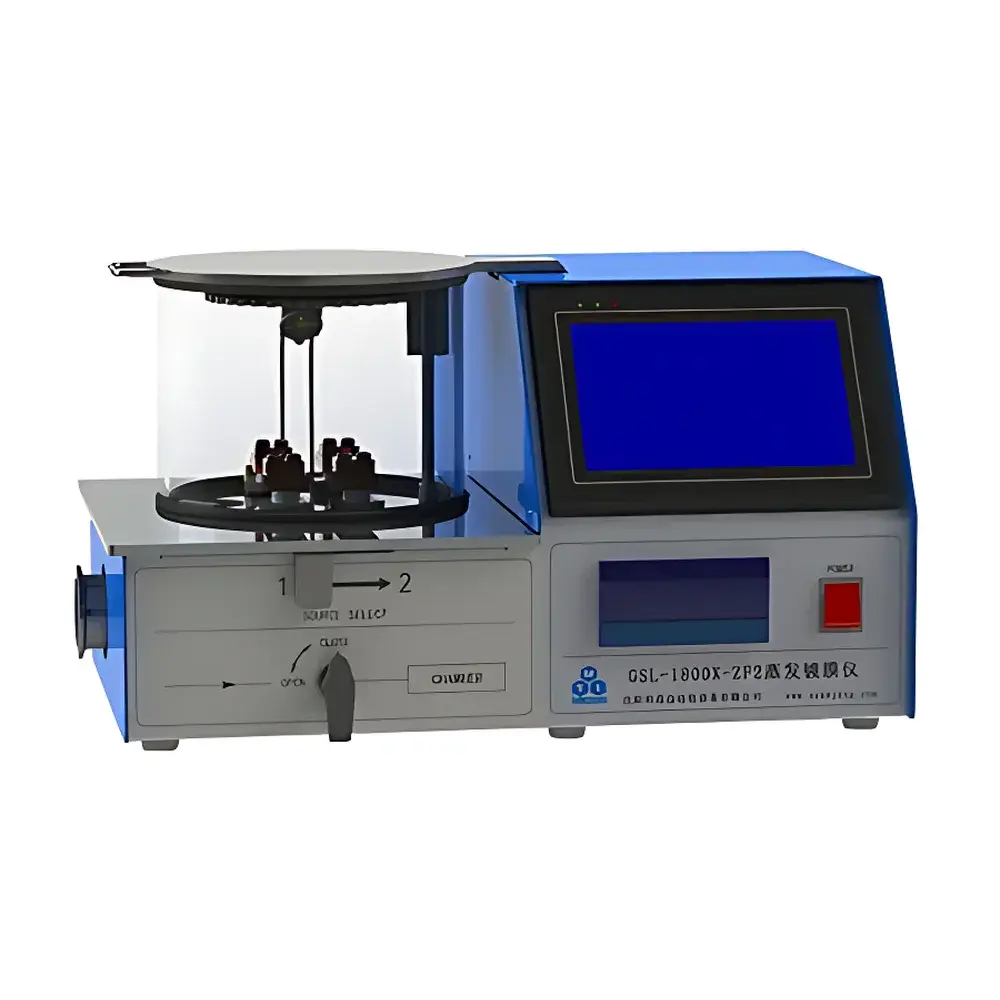
KJ GROUP GSL-1800X-ZF2 High-Vacuum Thermal Evaporation Coater
| Brand | KJ GROUP |
|---|---|
| Origin | Liaoning, China |
| Model | GSL-1800X-ZF2 |
| Power Supply | AC 220 V, 50 Hz |
| Maximum Operating Temperature | 1800 °C (via tungsten or molybdenum boat) |
| Base Pressure | ≤5 × 10⁻⁴ Pa (with optional turbomolecular pump) |
| Chamber Diameter | Ø300 mm |
| Chamber Height | 360 mm |
| Substrate Holder | Ø50 mm, rotary and optional heated (up to 500 °C) |
| Evaporation Sources | Dual resistive-heating boats (W/Mo) + optional e-beam crucible |
| Vacuum Interface | KF25 flanges |
| Compliance | CE certified |
| Dimensions (W×D×H) | 360 mm × 350 mm × 360 mm |
| Weight | 50 kg |
Overview
The KJ GROUP GSL-1800X-ZF2 is a high-vacuum thermal evaporation coater engineered for precise, repeatable thin-film deposition in academic and industrial R&D laboratories. Unlike sputtering systems that rely on plasma-driven momentum transfer, this instrument operates on resistive thermal evaporation—where solid source materials (e.g., Au, Al, Cr, Ni, Ti, SiO₂, MgF₂) are heated under high vacuum to generate directional vapor fluxes that condense uniformly onto substrates. The system achieves base pressures down to 5 × 10⁻⁴ Pa using a standard 120 L/min rotary vane pump, with optional turbomolecular pumping enabling sub-10⁻⁵ Pa conditions required for low-defect oxide or organic semiconductor deposition. Its compact footprint (360 × 350 × 360 mm) and modular KF25 vacuum interface support rapid integration into existing cleanroom or glovebox workflows. Designed for reproducibility rather than throughput, the GSL-1800X-ZF2 delivers controlled film thicknesses from 1 nm to several hundred nanometers—verified via integrated quartz crystal microbalance (QCM) sensor with ±0.1 nm resolution and real-time deposition rate feedback.
Key Features
- Dual independent resistive evaporation sources (tungsten or molybdenum boats), each rated for continuous operation up to 1800 °C, enabling co-evaporation or sequential multi-layer deposition.
- Rotary substrate holder (Ø50 mm) with optional resistive heating module (PID-controlled, 50–500 °C), facilitating substrate temperature-dependent nucleation studies and stress management in metal/oxide stacks.
- Integrated quartz crystal monitor (QCM) with digital controller, providing real-time thickness measurement, deposition rate calculation, and endpoint detection with <1% relative error over 10–500 nm range.
- CE-certified PLC-based control system featuring a 4.3″ capacitive touchscreen HMI, supporting programmable deposition sequences, vacuum interlock logic, and parameter logging (time-stamped pressure, current, temperature, thickness).
- KF25-standard vacuum architecture with quick-clamp flanges and stainless-steel bellows compatibility—enabling straightforward maintenance, pump exchange, or integration with load-lock modules or residual gas analyzers (RGA).
- No external cooling water or compressed air required; operates within ambient lab conditions (25 ± 15 °C, 55 ± 10% RH, <1000 m elevation) with standard grounded AC220V/50Hz supply.
Sample Compatibility & Compliance
The GSL-1800X-ZF2 accommodates rigid planar substrates up to Ø50 mm—including silicon wafers, glass slides, ITO-coated PET, ceramic tiles, and TEM grids—mounted directly onto the thermally isolated stage. It is not suitable for volatile organics, low-melting polymers (>150 °C deformation threshold), or substrates with high outgassing rates (e.g., untreated plastics). All metallic evaporation sources (Au, Ag, Al, Cr, Ni, Pt) and dielectric materials (SiO₂, Al₂O₃, TiO₂, MgF₂) compatible with thermal stability >800 °C may be deposited. The system complies with EU Machinery Directive 2006/42/EC and Electromagnetic Compatibility Directive 2014/30/EU, evidenced by CE marking. Vacuum chamber materials (304 stainless steel, oxygen-free copper gaskets) meet ASTM F880 specifications for ultra-high-purity applications. While not pre-configured for GLP/GMP environments, its audit-ready parameter logging supports 21 CFR Part 11–aligned data integrity protocols when paired with validated third-party software.
Software & Data Management
Control firmware runs on an embedded ARM Cortex-M7 platform with deterministic real-time scheduling. The HMI stores up to 100 user-defined recipes (each containing vacuum ramp profiles, power ramping slopes, QCM setpoints, and dwell times) with password-protected access levels (Operator / Engineer / Admin). All operational events—including pump-down duration, final base pressure, peak evaporation current, final thickness, and timestamped alarms—are written to non-volatile flash memory and exportable via USB 2.0 as CSV files. No proprietary cloud service or vendor-hosted license is required; raw log files are human-readable and compatible with MATLAB, Python (pandas), or LabVIEW for statistical process control (SPC) analysis. Optional RS485 Modbus RTU interface enables integration into centralized facility SCADA systems.
Applications
- Preparation of electron microscopy contrast layers (e.g., 5–10 nm Au/Pd coatings on biological specimens).
- Fabrication of electrode stacks for perovskite solar cells (ITO/SnO₂/perovskite/Au) and OLED test structures (ITO/NPB/Alq₃/LiF/Al).
- Deposition of anti-reflective (MgF₂) or high-reflective (Al + SiO₂) optical coatings on laser cavity mirrors and spectrometer components.
- Process development of transparent conductive oxides (e.g., ITO, AZO) for flexible electronics R&D.
- Baseline calibration of thin-film stress measurement tools using controlled Ti/W bilayer deposition.
- Teaching labs: Demonstrating Knudsen effusion, mean free path effects, and shadow-mask lithography principles.
FAQ
Can the GSL-1800X-ZF2 deposit aluminum oxide (Al₂O₃) via thermal evaporation?
Yes—when using high-purity Al₂O₃ pellets loaded into a tungsten boat and operated under ≤10⁻⁴ Pa base pressure, though deposition rates will be lower than for metals due to higher sublimation enthalpy.
Is e-beam evaporation supported as a factory option?
No—the GSL-1800X-ZF2 is configured exclusively for resistive thermal evaporation; however, its chamber flange layout allows retrofitted e-beam gun integration by qualified vacuum engineers using KF25-compatible feedthroughs.
What vacuum pump oil maintenance schedule is recommended?
With typical usage (2–3 depositions/week), rotary vane pump oil should be replaced every 3 months or after 200 hours of cumulative operation, per manufacturer guidelines for VP-100 grade oil.
Does the system include vacuum gauge calibration certificates?
Standard configuration includes a Pirani/cold cathode combo gauge with factory calibration traceable to NIST standards; full calibration documentation is provided upon request at time of order.
Can the QCM sensor be recalibrated in-house?
Yes—the QCM controller supports user-initiated zero-point and sensitivity calibration using certified reference films (e.g., evaporated gold layers of known thickness measured by ellipsometry).
Related Products



