
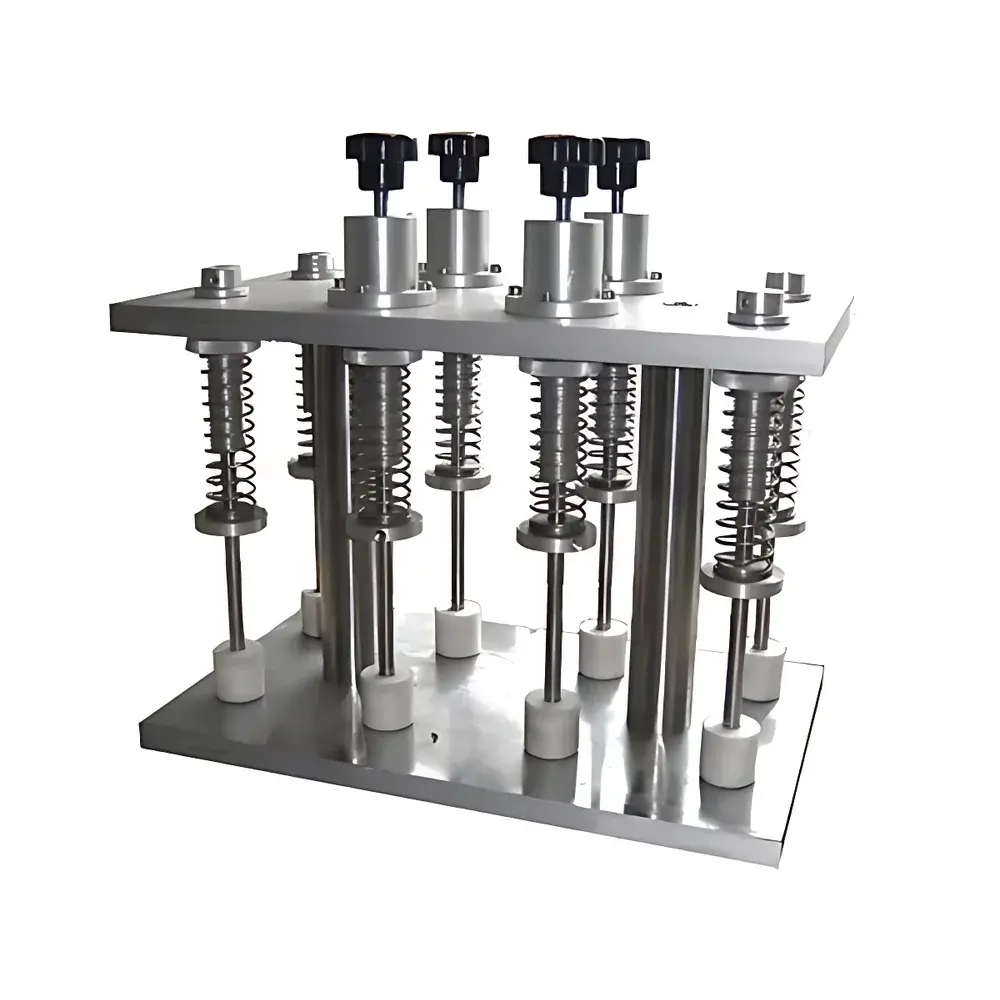
KJ GROUP YT-08 Sample Lamination Press
| Brand | KJ GROUP |
|---|---|
| Origin | Liaoning, China |
| Manufacturer Type | Authorized Distributor |
| Country of Origin | China |
| Model | YT-08 |
| Pricing | Available Upon Request |
| Max Sample Size | 2″ × 3″ (50.8 mm × 76.2 mm) |
| Pressure Source | Mechanical Spring Loading |
| Power Requirement | None |
| Operating Altitude | ≤1000 m |
| Ambient Temperature | 25°C ±15°C |
| Relative Humidity | 55% RH ±10% RH |
| Footprint | 400 mm × 300 mm × 700 mm (W×D×H) |
| Ventilation | Required |
Overview
The KJ GROUP YT-08 Sample Lamination Press is a manually operated, spring-loaded mechanical device engineered for precise, repeatable lamination of thin-sectioned specimens—particularly in optical microscopy, metallurgical sample preparation, and thin-film materials characterization workflows. Unlike hydraulic or pneumatic laminators, the YT-08 relies on calibrated mechanical spring force to apply controlled, uniform compressive load across the specimen surface. This passive, electricity-free design ensures intrinsic stability, zero electromagnetic interference, and full compatibility with glovebox or inert-atmosphere environments. The press is optimized for applications requiring bubble-free adhesion between fragile samples (e.g., polymer films, semiconductor wafers, geological thin sections, or biological tissue slices) and glass or quartz substrates. Its fixed maximum compression limit—dictated by the physical yield point of the integrated helical spring—provides inherent overpressure protection and eliminates operator-induced variability in final bond integrity.
Key Features
- Mechanically actuated, spring-based pressure system with no electrical, pneumatic, or hydraulic dependencies—ideal for cleanrooms, explosion-proof labs, and field-deployable setups.
- Adjustable clamping force via calibrated spring preload; force remains constant beyond the spring’s elastic limit, ensuring reproducible interfacial stress during adhesive curing.
- Multi-position sample stage accommodates up to four standard 2″ × 3″ (50.8 mm × 76.2 mm) specimens simultaneously—maximizing throughput without cross-contamination.
- Aluminum alloy frame with anodized finish provides dimensional stability, corrosion resistance, and low thermal expansion under ambient lab conditions.
- Integrated alignment guide rails and precision-ground platens ensure parallelism within ±5 µm across the entire contact area, critical for uniform adhesive thickness distribution.
- Compact footprint (400 mm × 300 mm × 700 mm) enables integration into limited-space prep stations, including fume hoods where ventilation is required for solvent-based adhesives.
Sample Compatibility & Compliance
The YT-08 supports rigid and semi-rigid specimens ≤2 mm in thickness—including epoxy-embedded metallographic mounts, polymer film laminates, ceramic substrates, and glass-on-glass assemblies. It is compatible with common mounting media such as thermosetting epoxies (e.g., Epofix®, Araldite®), UV-curable resins, and low-viscosity cyanoacrylates. While the device itself carries no active regulatory certification, its mechanical design aligns with GLP-compliant sample preparation practices per ISO/IEC 17025:2017 Annex A.3 (sample handling and conditioning). When used with validated adhesives and documented pressure application protocols, the YT-08 contributes to traceable, auditable sample preparation workflows compliant with ASTM E3–22 (Standard Guide for Preparation of Metallographic Specimens) and ISO 14577–1:2022 (Metallic materials — Instrumented indentation test).
Software & Data Management
The YT-08 operates entirely without embedded electronics or digital interfaces. As a purely mechanical tool, it requires no firmware, drivers, or software installation. However, its use is fully compatible with laboratory information management systems (LIMS) and electronic lab notebooks (ELN) when integrated into standardized SOPs. Operators may log pressure application parameters—including spring adjustment setting, dwell time, ambient temperature/humidity, and adhesive batch number—directly into audit-trail-enabled platforms supporting 21 CFR Part 11 compliance. No calibration certificate is issued with the unit; users are advised to verify platen parallelism annually using certified optical flats and interferometric measurement per ISO 10110–7.
Applications
- Preparation of optically transparent thin sections for polarized light microscopy (PLM) and scanning electron microscopy (SEM) backscattered electron imaging.
- Lamination of flexible printed circuit (FPC) substrates prior to cross-sectional polishing.
- Mounting of brittle mineralogical specimens onto glass slides for petrographic analysis.
- Consolidation of layered 2D material stacks (e.g., graphene/h-BN heterostructures) under controlled interfacial stress before transfer.
- Quality control of adhesive bond line thickness in microelectronics packaging R&D.
- Standardized sample conditioning in interlaboratory round-robin studies governed by ASTM D4169 or ISO 11607–1.
FAQ
Does the YT-08 require electrical power or compressed air?
No. It is a fully manual, spring-driven device with zero energy input requirements.
What is the maximum achievable compressive force?
The nominal peak force is determined by the spring’s material properties and compression geometry; typical output ranges from 150 N to 350 N depending on preload setting—exact values must be verified per batch using a calibrated load cell.
Can the YT-08 be used with vacuum-assisted degassing?
Yes—its open-frame architecture allows placement inside vacuum desiccators or chamber-based degassing systems to enhance bubble removal prior to final lamination.
Is the platen surface flatness certified?
Flatness is maintained at ≤2 µm over 100 mm per ISO 10110–7; however, end users are responsible for periodic verification using metrology-grade reference surfaces.
How often should the spring mechanism be serviced or replaced?
Under normal usage (±3% versus baseline calibration.
Related Products



