
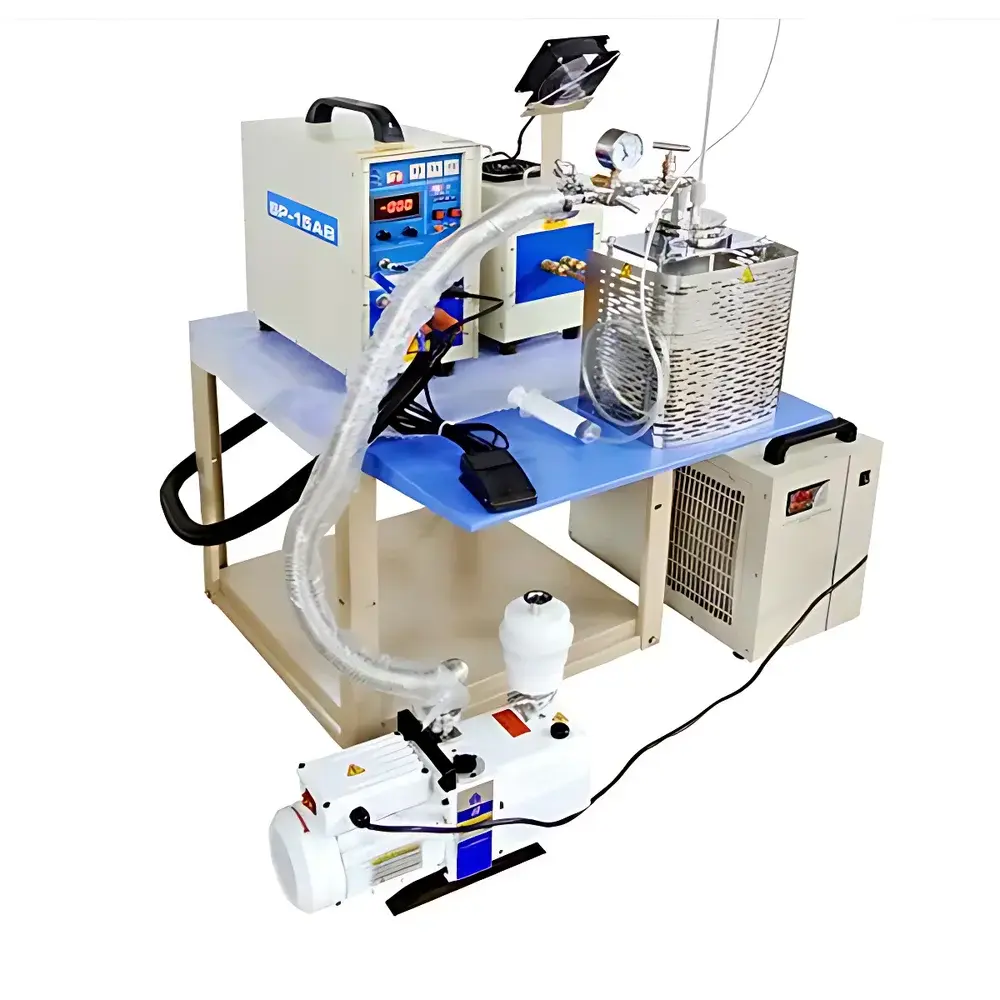
KJ GROUP SP-15VSC Top-Loading Vacuum Suction Casting Induction Melting Furnace
| Brand | KJ GROUP |
|---|---|
| Origin | Liaoning, China |
| Manufacturer Type | Authorized Distributor |
| Origin Category | Domestic (China) |
| Model | SP-15VSC |
| Pricing | Upon Request |
| Input Voltage | 220 V AC, 50/60 Hz, single-phase |
| Max Operating Current | 40 A |
| Max Oscillation Power | 15 kW |
| Max Input Power | 7 kW |
| Output Frequency Range | 30–80 Hz (adjustable) |
| Duty Cycle | 80% |
| Induction Coil Dimensions | 70 mm OD × 65 mm ID × 80 mm H |
| Programmable Timings | Heating (1–99 s), Holding (1–99 s), Cooling (1–99 s) |
| Cooling | Rear-mounted fan + external chiller (16 L/min flow, 2–35 °C range, 6 L stainless steel tank) |
| Safety Protections | Automatic water-pressure interlock, overtemperature cutoff, over-power shutdown |
| Vacuum System | Dual-stage rotary vane pump (156 L/min, ultimate vacuum ≤10⁻⁴ Torr, 208–240 V AC, 4 kW) |
| Vacuum Chamber | Semi-open quartz tube (7 mm OD × 4 mm ID × 500 mm L), mounted via KF25 flange with high-temp silicone O-ring seal, integrated vacuum gauge & dual needle valves |
| Suction Casting Capability | Produces 3–5 mm diameter alloy rods up to 150 mm in length via manual piston-driven suction |
| Maximum Casting Temperature | <1200 °C (to prevent quartz degradation) |
| Crucible | 1.5″ OD × 1.25″ ID × 3.75″ deep graphite crucible (30 mm OD × 24 mm ID × 26 mm H) |
| Refractory Liner | 5 mm alumina-based insulating liner (base support, crucible sleeve, and lid included) |
| Observation Port | Φ12 mm viewport on top flange |
| Pressure Relief | Integrated safety valve (max operating pressure ≤0.02 MPa) |
| Overall Footprint | Induction unit: 800 × 600 × 1000 mm |
| Chiller | 460 × 475 × 762 mm |
| Mobile platform | 600 × 800 mm |
| Net Weight | 135 kg |
Overview
The KJ GROUP SP-15VSC Top-Loading Vacuum Suction Casting Induction Melting Furnace is a precision-engineered system designed for controlled synthesis and rapid solidification of small-diameter metallic alloys under inert or reduced-pressure conditions. It integrates high-frequency induction heating (30–80 Hz) with a top-mounted mechanical vacuum suction mechanism to enable directional, pressure-assisted casting directly into vertically oriented quartz tubing. This configuration leverages the principle of capillary-driven melt transport under transient negative pressure—generated manually via calibrated piston actuation—to achieve rapid quenching rates (on the order of 10²–10³ K/s) in constrained geometries. The system is MET-certified for electrical safety compliance and engineered specifically for laboratory-scale preparation of homogeneous, low-porosity alloy rods (3–5 mm Ø, up to 150 mm long), minimizing shrinkage cavities, dendritic segregation, and gas entrapment common in conventional gravity-casting methods.
Key Features
- 15 kW high-efficiency induction power supply with adjustable frequency (30–80 Hz) and programmable thermal cycles (heating/holding/cooling, each 1–99 s)
- Top-loading vacuum suction module with manual piston actuator, enabling reproducible melt draw-up into quartz capillaries without electromagnetic interference
- Dual-stage rotary vane vacuum pump (156 L/min) achieving base pressure ≤10⁻⁴ Torr; integrated vacuum gauge and dual needle valves for precise pressure regulation
- High-purity semi-open quartz tube (7 mm OD × 4 mm ID × 500 mm L) sealed via KF25 stainless steel flange with high-temperature silicone O-ring and self-tightening design
- Alumina refractory liner (5 mm thickness) fully encapsulating a standard 30 mm OD graphite crucible; optional BN crucibles available for reactive or high-vapor-pressure alloys
- Real-time melt observation through Φ12 mm borosilicate viewport on top flange; compatible with pyrometric monitoring
- Comprehensive safety architecture: automatic water-flow interlock, overtemperature cut-off (<1200 °C operational limit enforced), over-power protection, and pressure-relief valve (≤0.02 MPa max)
- Modular cooling system: recirculating chiller (16 L/min flow, 2–35 °C setpoint, 6 L stainless steel reservoir) with corrosion-resistant fluid compatibility
Sample Compatibility & Compliance
The SP-15VSC supports a broad range of conductive metallic feedstocks—including Fe-, Co-, Ni-, Cu-, Al-, Mg-, and Zr-based alloys—provided melting points remain below 1200 °C to preserve quartz integrity. Its vacuum-tight chamber (validated per ISO 2859-1 sampling standards) ensures oxygen partial pressures <10⁻³ Pa during casting, critical for oxidation-sensitive compositions. The system meets MET certification requirements for Class I, Division 1 electrical safety and conforms to IEC 61000-6-3 (EMC emission limits). All programmable thermal profiles are timestamped and logged with audit-trail capability, supporting GLP-compliant documentation workflows. While not FDA 21 CFR Part 11–certified out-of-box, its digital interface permits integration with validated third-party data acquisition platforms for regulated environments.
Software & Data Management
The furnace operates via front-panel digital controller with non-volatile memory for storing ≥20 user-defined thermal programs. Each program records real-time parameters—including coil current, output frequency, elapsed time, and chiller temperature—at 1 Hz resolution. Data export is supported via USB port (CSV format), enabling traceable post-processing in MATLAB, Python (Pandas), or LabVIEW. Optional RS-485 Modbus RTU interface allows centralized supervision in multi-furnace labs. No proprietary software installation is required; raw logs include UTC timestamps, operator ID fields, and cycle completion flags—facilitating ISO/IEC 17025 calibration recordkeeping.
Applications
- Rapid prototyping of bulk metallic glass precursors (e.g., Zr-Cu-Ni-Al, Pd-Cu-Ni-P) requiring high cooling rates to suppress crystallization
- Preparation of microstructure-uniform master alloys for subsequent arc-melting or spark plasma sintering
- Investigation of solidification kinetics in constrained geometries (e.g., grain refinement studies under forced convection)
- Synthesis of compositionally graded rods via sequential suction casting with intermediate alloy additions
- Teaching laboratories: demonstration of nucleation under undercooling, Marangoni flow effects, and vacuum metallurgy fundamentals
FAQ
What is the maximum allowable casting temperature for this system?
The quartz tube limits continuous operation to <1200 °C. Exceeding this threshold risks devitrification, cracking, or collapse of the capillary—compromising both safety and dimensional fidelity.
Can the system be used with reactive metals such as titanium or magnesium?
Yes—provided a nitrogen or argon purge is maintained during loading/unloading and the vacuum pump is equipped with a hydrocarbon trap. BN crucibles (optional) are recommended for extended Mg handling.
Is automated suction control available?
Not standard; the current design employs manual piston actuation for precise, operator-controlled draw speed. However, the vacuum line includes a solenoid valve port for future OEM automation integration.
How often does the quartz tube require replacement?
Under typical usage (≤100 cycles at ≤1100 °C), expected service life exceeds 500 hours. Visual inspection for clouding or microcracks is advised before each use.
Does the chiller require deionized water?
No—industrial glycol-water coolant (20–30% concentration) is strongly recommended to inhibit scaling and corrosion; tap water is not suitable for long-term operation.



