
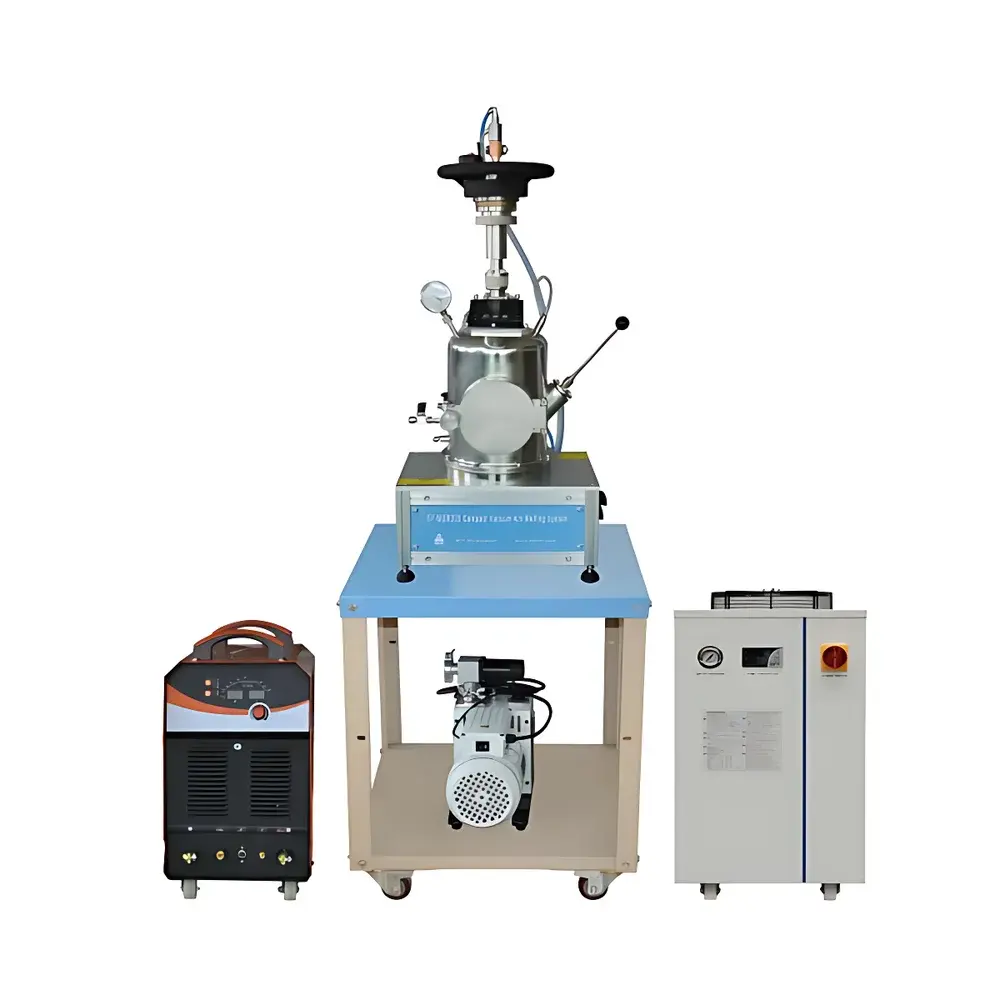
KJ GROUP SP-MSM200 Non-Consumable Small-Scale Arc Melting Furnace
| Brand | KJ GROUP |
|---|---|
| Origin | Liaoning, China |
| Manufacturer Type | Authorized Distributor |
| Country of Origin | China |
| Model | SP-MSM200 |
| Pricing | Upon Request |
| Vacuum Chamber | Ø200 mm × 300 mm |
| Arc Ignition | High-Frequency Start |
| Output Current Range | 20–630 A |
| Electrode | Ø6 mm Tungsten (W), Non-Consumable |
| Max. Melting Temperature | 3500 °C |
| Cooling | Integrated Recirculating Chiller (Deionized Water) |
| Gas Atmosphere | High-Purity Argon (≥99.99%) |
| Standard Vacuum | –0.1 MPa (with Rotary Vane Pump) |
| Optional High Vacuum | 5.0 × 10⁻³ Pa (with Molecular Pump & Capacitance Manometer) |
| Crucible Configuration | 4 positions — three Ø25 mm hemispherical crucibles (20 g stainless steel capacity each), one Ø70 × 15 mm crucible (200 g stainless steel capacity) |
| Furnace Dimensions (L×W×H) | 900 × 600 × 1800 mm |
| Net Weight | 120 kg |
| Power Supply | AC 380 V, 50 Hz, 63 A circuit breaker required |
| Total Power Consumption | <30 kW |
Overview
The KJ GROUP SP-MSM200 Non-Consumable Small-Scale Arc Melting Furnace is a compact, high-precision laboratory furnace engineered for controlled atmospheric melting of metallic elements and alloys under inert gas shielding. Unlike consumable-electrode arc furnaces, the SP-MSM200 employs a non-consumable tungsten electrode (Ø6 mm) with high-frequency ignition to generate stable, localized plasma arcs—enabling repeatable, contamination-free melting without electrode erosion or elemental introduction. Its sealed vacuum chamber (Ø200 mm × 300 mm) supports rapid evacuation and backfilling with ultra-high-purity argon (≥99.99%), maintaining oxygen and nitrogen levels below 1 ppm during operation. Designed for research-grade reproducibility, the furnace integrates water-cooled copper crucibles, a fully enclosed water-cooled vacuum chamber, and a rigid mechanical arm for in-situ sample flipping—allowing multiple remelting cycles without breaking atmosphere integrity. This architecture meets the stringent thermal and compositional control requirements of metallurgical R&D, particularly for refractory alloys, intermetallics, high-entropy alloys (HEAs), and reactive metal systems.
Key Features
- Non-consumable tungsten electrode system ensures long-term arc stability and eliminates electrode-derived impurities.
- Integrated mechanical flipping arm enables precise 180° inversion of solidified ingots inside the sealed chamber—critical for homogenization and segregation reduction across successive melts.
- Four-position crucible tray accommodates up to seven samples per run (using optional multi-cup inserts), with physical isolation between crucibles to prevent cross-contamination.
- Large-diameter front access door (Ø120 mm) and dual quartz observation windows permit unobstructed visual monitoring of arc initiation, melt pool dynamics, and solidification behavior.
- Modular cooling architecture: all critical components—including chamber walls, copper crucibles, and electrode holder—are actively water-cooled via a closed-loop chiller (KJ-5300, supplied), using deionized water to prevent scaling and ensure thermal consistency.
- Manual height adjustment via ergonomic steering-wheel mechanism provides fine positional control over electrode-to-sample distance, optimizing arc coupling and energy transfer efficiency.
- Compact footprint (0.54 m² floor space) and vertical design make it suitable for standard fume-hood-integrated lab environments or dedicated metallurgy workstations.
Sample Compatibility & Compliance
The SP-MSM200 supports melting of a broad spectrum of conductive metallic systems, including but not limited to Fe-, Ni-, Co-, Ti-, Al-, Cu-, and Zr-based alloys, as well as refractory metals such as Mo, Nb, Ta, and W. Its maximum operating temperature of 3500 °C enables processing of ultra-high-melting-point materials without crucible degradation. Crucible geometry is configurable: standard configuration includes three hemispherical Ø25 mm crucibles (20 g stainless steel equivalent) and one cylindrical Ø70 × 15 mm crucible (200 g capacity), with custom crucible dimensions available upon request. The system complies with general laboratory safety standards for high-current DC arc equipment (IEC 61000-6-4, IEC 61000-6-2) and supports GLP-compliant operation when integrated with optional vacuum monitoring (EQ-PCG-554 digital capacitance manometer) and audit-trail-capable process logging software (available via third-party integration). Argon gas delivery meets ISO 8573-1 Class 2 purity requirements for particulate and moisture content.
Software & Data Management
While the SP-MSM200 operates via analog/manual interface for core functions (current setpoint, gas flow regulation, chamber pressure monitoring), it features standardized electrical and pneumatic I/O ports (0–10 V analog outputs, dry-contact relays) for integration into centralized lab automation platforms. Optional vacuum gauges (e.g., EQ-PCG-554) provide RS485/Modbus RTU output for real-time pressure logging. When paired with external data acquisition systems, users can record time-stamped sequences of arc current, chamber pressure, cooling water temperature, and gas flow rate—enabling full traceability per ASTM E29-23 guidelines for experimental repeatability. All hardware interfaces conform to CE electromagnetic compatibility directives, and grounding provisions meet IEC 61000-6-3 requirements for industrial environments.
Applications
- Rapid prototyping of novel alloy compositions in academic and industrial metallurgy labs.
- Homogenization and purification of master alloys prior to casting or additive manufacturing feedstock preparation.
- Small-batch synthesis of intermetallic compounds and high-entropy alloys requiring precise stoichiometric control and minimal oxidation.
- Preparation of calibration standards for XRF, SEM-EDS, and spark-OES analysis.
- Investigation of solidification microstructures under controlled thermal gradients (when coupled with post-melt quenching modules).
- Teaching applications in materials science curricula, demonstrating arc physics, phase equilibria, and reactive metal handling protocols.
FAQ
What vacuum level is achievable with the standard configuration?
The base system includes a VRD-series rotary vane pump capable of reaching –0.1 MPa (≈1 mbar). For high-vacuum applications, the GZK-103D molecular pump option achieves ≤5.0 × 10⁻³ Pa, compatible with residual gas analysis.
Can the furnace be used under hydrogen or nitrogen atmospheres?
No. The SP-MSM200 is certified and optimized exclusively for inert gas operation (Ar or He). Reactive or reducing atmospheres pose fire/explosion hazards and risk tungsten electrode embrittlement.
Is remote operation or automated recipe control supported?
The standard unit does not include embedded PLC or touchscreen HMI. However, its analog I/O and relay outputs support integration with LabVIEW, Python-based SCADA, or commercial MES platforms for semi-automated batch execution.
What maintenance is required for the tungsten electrode?
Under normal use, the Ø6 mm tungsten electrode requires periodic tip dressing (grinding to a sharp conical profile) every 20–30 melts. No replacement is needed unless physical damage or severe pitting occurs.
Does the system meet FDA 21 CFR Part 11 requirements for electronic records?
Out-of-the-box, no—data logging is external. However, when interfaced with validated third-party acquisition software featuring electronic signatures, audit trails, and role-based access control, full Part 11 compliance can be achieved within a qualified QMS framework.



