
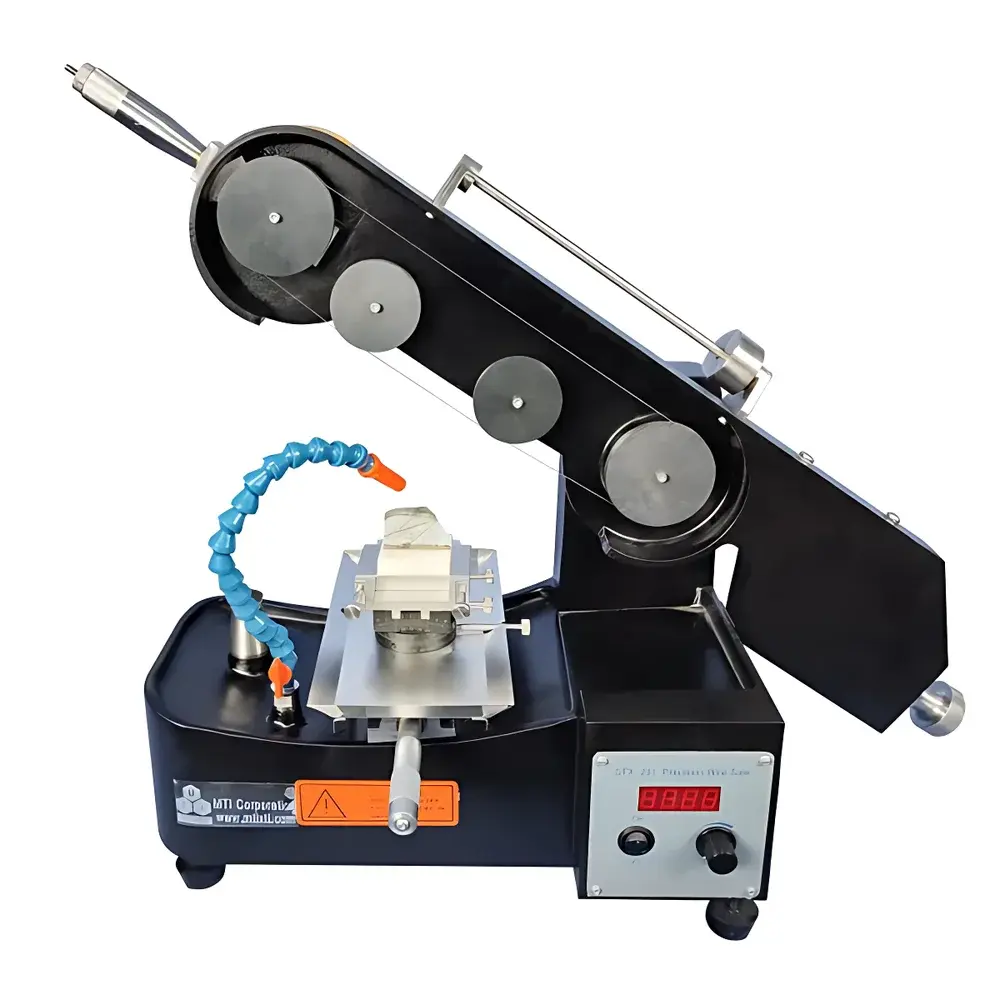
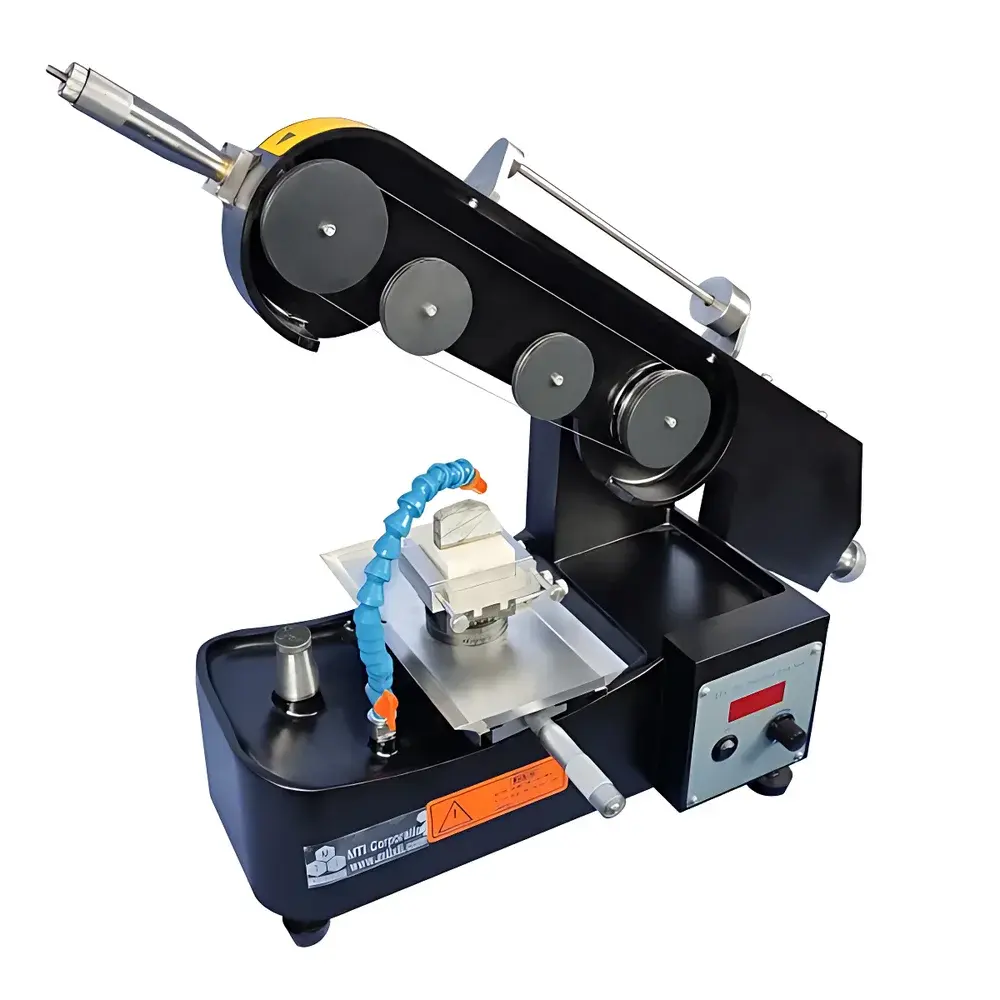
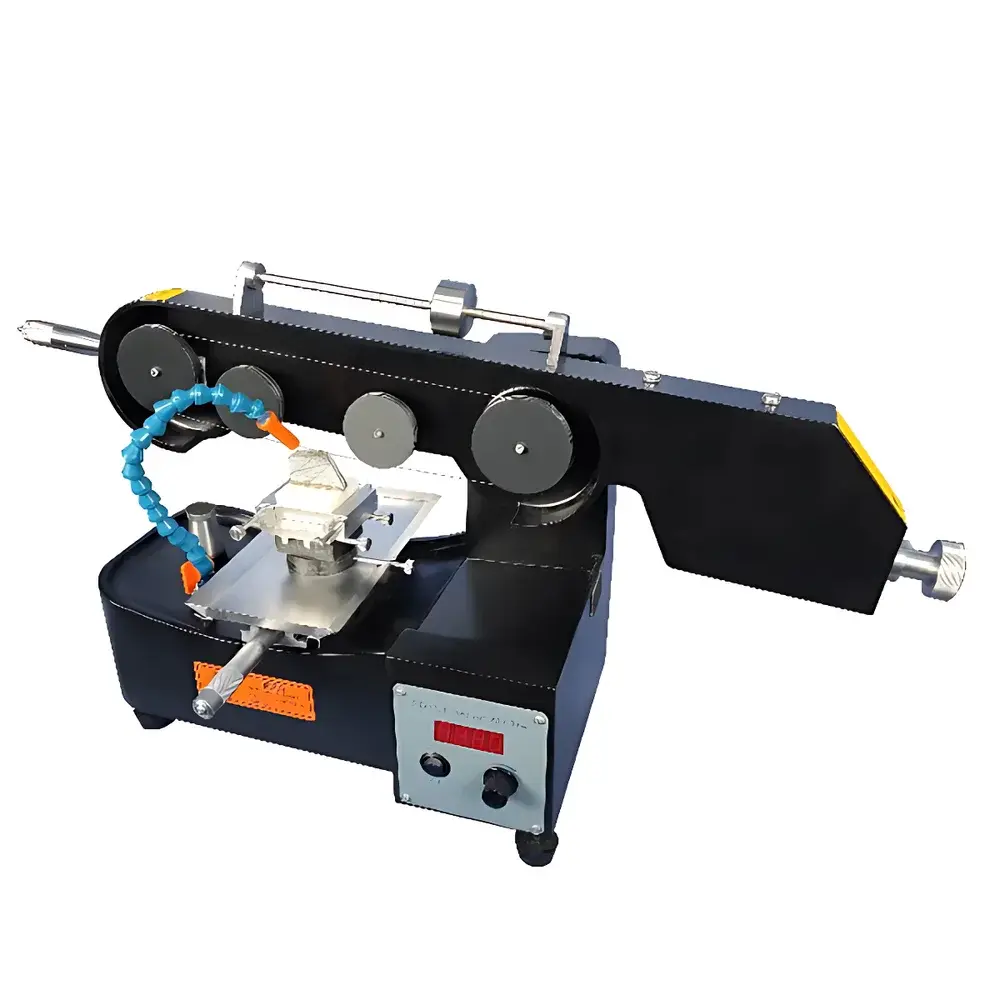
KJ GROUP STX-201 Precision Diamond Wire Saw with Reciprocating Loop Feed
| Brand | KJ GROUP |
|---|---|
| Origin | Liaoning, China |
| Model | STX-201 |
| Instrument Type | Precision Diamond Wire Cutting Machine |
| Wire Speed | 0–3.9 m/s |
| Spindle Speed | 0–900 rpm (effective range: 30–900 rpm) |
| Horizontal Feed Travel | ≤50 mm |
| Feed Resolution | 0.01 mm |
| Rotation Stage | 0–360° (graduation: 10′), Tilt: ±15° (graduation: 5′) |
| Max. Sample Thickness | ≤52 mm |
| Stage Dimensions | 80 × 51 mm |
| Power Supply | AC 110–230 V, 50 Hz, 10 A |
| Motor Power | 50 W |
| Dimensions (W×D×H) | 761 × 295 × 373 mm |
| Weight | 25 kg |
| Operating Environment | 0–45 °C, 10–85 % RH (non-condensing), vibration- and corrosion-free |
Overview
The KJ GROUP STX-201 Precision Diamond Wire Saw is a manually operated, gravity-fed, reciprocating-loop diamond wire cutting system engineered for high-fidelity sectioning of brittle, fragile, or high-value specimens in academic, industrial, and clinical research laboratories. Unlike continuous-feed or CNC-controlled systems, the STX-201 employs a single-loop diamond-impregnated wire driven by a variable-speed motor, where material removal occurs via abrasive action under controlled mechanical load. Its operation relies on the principle of low-stress, low-heat mechanical abrasion—ideal for preserving microstructural integrity in materials sensitive to thermal shock, plastic deformation, or subsurface cracking. The system is widely deployed in materials science, geoscience, semiconductor R&D, infrared optics development, and hard-tissue histology, where precise orientation control, minimal kerf loss (< 0.3 mm typical), and surface finish consistency are critical pre-analytical requirements.
Key Features
- Manual gravity-based feed mechanism enables fine-tuned control over cutting force—critical for preventing wire breakage and minimizing chipping in low-fracture-toughness materials such as sapphire, silicon wafers, and bioceramics.
- High-resolution micrometer-driven horizontal feed (0.01 mm resolution) ensures repeatable slice thickness across successive cuts, supporting quantitative microstructural analysis and serial sectioning protocols.
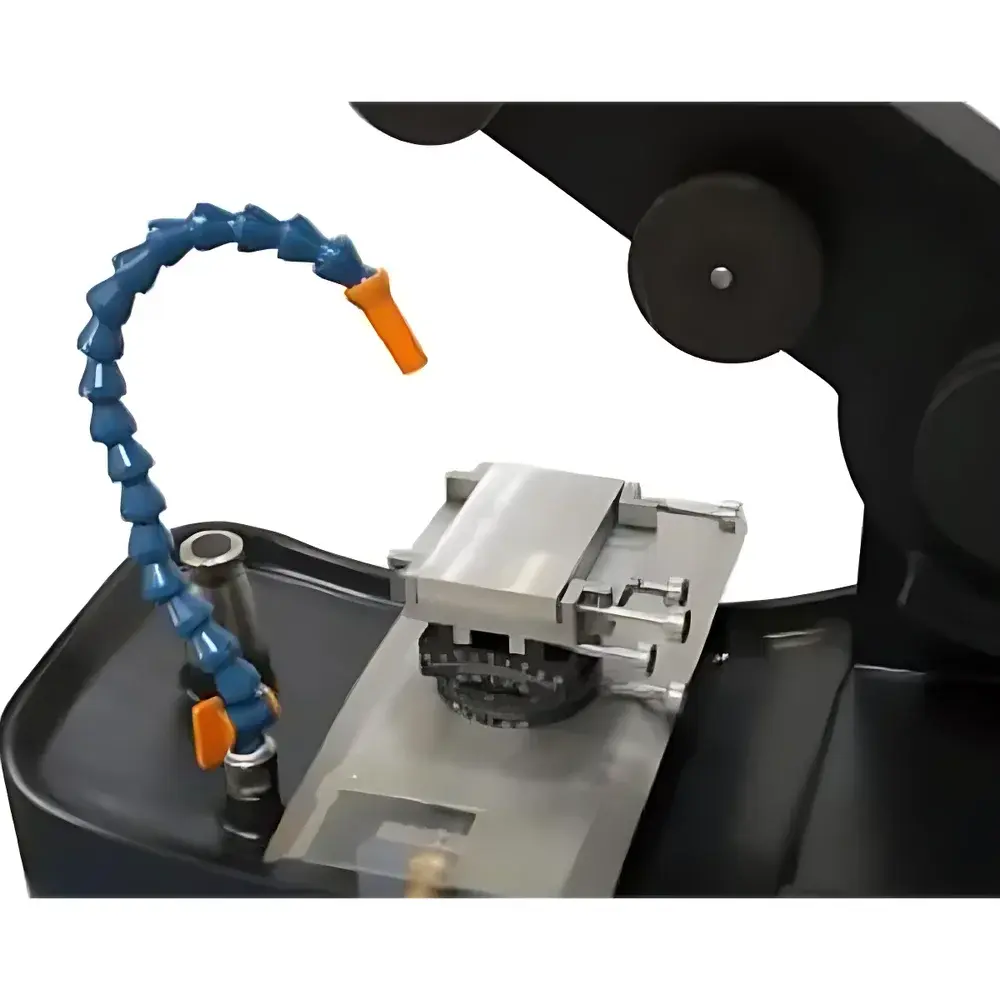
- 360° continuously rotatable horizontal stage with ±15° tilt adjustment allows precise crystallographic alignment—essential for preparing oriented thin sections for XRD, TEM lamella extraction, or anisotropic property evaluation.
- Dual-axis manual stage equipped with 90°-indexed cross vise facilitates rapid orthogonal positioning and reproducible multi-angle sectioning without realignment.
- Adjustable wire tensioning system maintains consistent loop geometry and contact pressure during extended operation, improving cut straightness and extending diamond wire service life.
- Compact benchtop footprint (761 × 295 × 373 mm) and low power consumption (50 W motor) support integration into shared lab spaces, cleanrooms, or glovebox-adjacent workflows.
Sample Compatibility & Compliance
The STX-201 accommodates a broad spectrum of inorganic and organic solids with hardness values below that of diamond (Mohs 10), including but not limited to oxide ceramics (Al₂O₃, ZrO₂), nitride and carbide crystals (SiC, AlN), IR-transmissive substrates (ZnS, ZnSe, Ge, Si), geological specimens (granite, basalt, meteorites), metallic alloys (Ti-6Al-4V, Cu-Be), carbon-based composites, and mineralized biological tissues (bone, calcified vasculature, dental enamel). All mechanical adjustments—rotation, tilt, feed—are fully manual and traceable via engraved scales and vernier readouts, satisfying GLP-aligned documentation requirements for method validation. While the instrument itself does not carry CE/UKCA or FDA 510(k) certification, its design adheres to IEC 61010-1 safety standards for laboratory electrical equipment, and operational procedures can be documented to support ISO/IEC 17025 method validation when integrated into accredited testing workflows.
Software & Data Management
The STX-201 operates without embedded firmware or proprietary software; all controls are hardware-based and fully deterministic. This architecture eliminates cybersecurity risks associated with networked instruments and ensures long-term operational continuity—no driver updates, license expirations, or OS compatibility constraints. Users maintain complete procedural control through physical dials, micrometers, and calibrated angular scales, enabling full auditability of every positional parameter per cut. For laboratories requiring electronic recordkeeping, integration with LIMS or ELN platforms is achieved via operator-entered metadata (e.g., sample ID, orientation angle, feed increment, wire usage count) logged alongside imaging or downstream analytical data. Optional accessories—including the DX-100 single-crystal orienter and HEATER-series heated stage—extend functional capability while preserving manual traceability and compliance-ready documentation pathways.
Applications
- Preparation of transmission electron microscopy (TEM) and focused ion beam (FIB) lamellae from semiconductor devices and ceramic coatings.
- Sectioning of geological thin sections (30 µm) for petrographic analysis under polarized light microscopy per ASTM D5777 and ISO 14688 standards.
- Cutting of thermoelectric ingots (Bi₂Te₃, PbTe) along crystallographic planes to assess anisotropic Seebeck coefficient behavior.
- Production of optical windows and detector substrates from brittle IR materials (e.g., CdZnTe, GaAs) with minimal subsurface damage.
- Histological slicing of undecalcified bone-implant interfaces for SEM-EDS elemental mapping and push-out mechanical testing per ISO 13356 and ASTM F1147.
- Serial sectioning of bio-plastinated specimens for 3D anatomical reconstruction and morphometric analysis in medical education and surgical planning.
FAQ
What types of diamond wire are compatible with the STX-201?
The system accepts standard 0.25 mm diameter resin-bonded diamond wire (e.g., U.S.-sourced wires with ~1–2 µm diamond grit), supplied as looped configurations. Wire length and tension must be manually adjusted using the integrated pulley and spring-tension assembly.
Can the STX-201 perform automated sequential cuts?
No—it is a manually actuated system requiring operator intervention after each cut for specimen repositioning and feed advancement. It is not programmable or motorized for auto-feeding.
Is cooling required during operation?
While not mandatory, deionized water or ethanol-based coolant is recommended for extended cutting sessions (>5 min) on heat-sensitive materials (e.g., polymers, biological tissues) to suppress localized thermal degradation and improve wire longevity.
How is alignment verified prior to cutting?
The stage includes machined reference surfaces and a built-in bubble level. Crystallographic orientation is confirmed externally using optional tools such as the DX-100 single-crystal orienter or Laue X-ray diffractometers.
What maintenance is required for long-term accuracy?
Monthly inspection of wire guide wear, recalibration of micrometer zero point, and cleaning of stage dovetails with isopropyl alcohol are sufficient. No lubrication of precision motion components is advised—dry operation preserves micron-level repeatability.



