
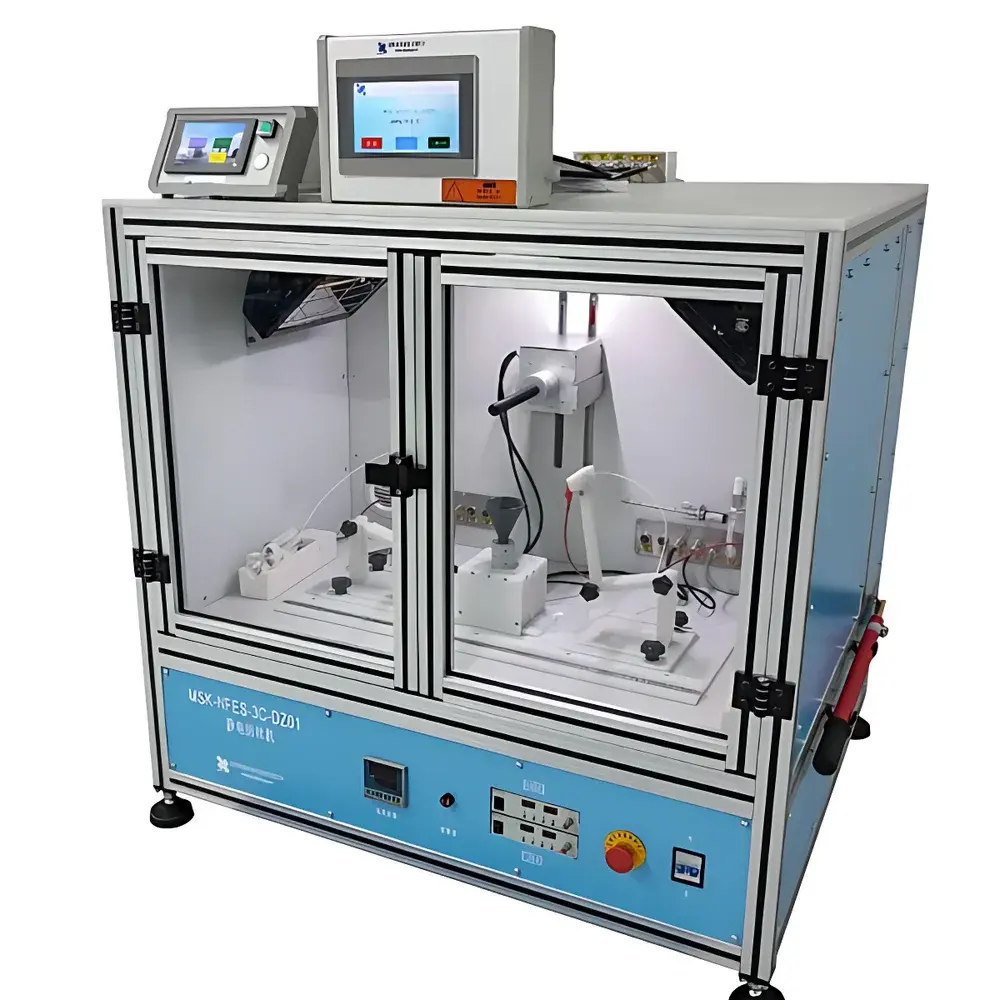
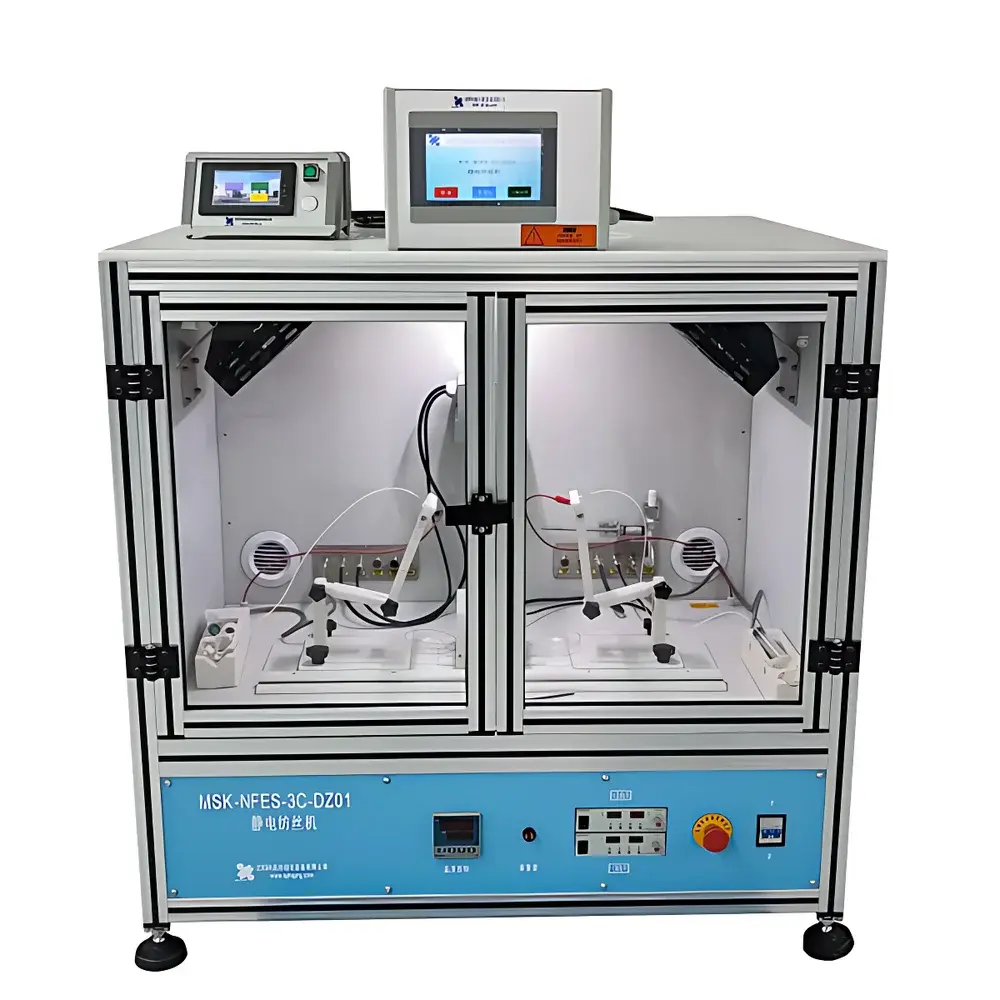
KJ GROUP MSK-NFES-3C-DZ01 Electrospinning System
| Brand | KJ GROUP |
|---|---|
| Origin | Liaoning, China |
| Manufacturer Type | Manufacturer |
| Model | MSK-NFES-3C-DZ01 |
| Input Voltage | 220 V AC, 50 Hz |
| Positive High Voltage Output | +30 kV |
| Negative High Voltage Output | −30 kV |
| Heating Range | RT to 50 °C (Infrared Lamp, 1600 W) |
| Dehumidification Capacity | 420 W (Humidity Control Range: 10–60 %RH) |
| Total System Power | 5194 W (Conjugate Collector: 3352 W |
| Drum Collector | 1842 W) |
| Syringe Pump Feed Rate | 0.001–20 mm/min |
| Syringe Volume Compatibility | 10–50 mL (Standard: 20 mL) |
| Syringe Plunger Stroke Range | 0.01–90 mm |
| Drum Collector Speed | 500–3800 rpm (Increment: 100 rpm) |
| Drum Oscillation Speed | 5–100 mm/s (Increment: 5 mm/s) |
| Oscillation Amplitude | 100–200 mm |
| Drum Dimensions | Ø80 × 200 mm |
| Conjugate Collector Needle-to-Collector Distance | 20–60 cm |
| Conjugate Axis Rotation Speed | 500–3000 rpm |
| Rod Collector Speed | 1–500 rpm |
| Vertical Travel Range (Conjugate Stage) | 180 mm (Speed: 0.1–5 mm/s) |
| Overall Dimensions | 1100 × 1100 × 1200 mm |
| Net Weight | 100 kg |
Overview
The KJ GROUP MSK-NFES-3C-DZ01 Electrospinning System is a fully integrated, industrial-grade laboratory instrument engineered for the controlled fabrication of polymeric nanofibers via electrohydrodynamic processing. It operates on the principle of electrostatic fiber drawing: a high-voltage electric field induces charge accumulation at the surface of a polymer solution or melt extruded through a fine capillary, overcoming surface tension to generate a Taylor cone and initiate jet elongation. As the charged jet travels toward a grounded or counter-polarized collector, rapid solvent evaporation yields solidified fibers with diameters ranging from ~50 nm to several micrometers. This system supports both single-nozzle and coaxial (core–shell) configurations, enabling precise structural control over fiber morphology—including bead-free filaments, porous surfaces, nanoparticle-embedded strands, and hierarchical architectures—critical for advanced functional materials development in filtration, tissue engineering scaffolds, drug delivery carriers, and protective membranes.
Key Features
- Integrated PLC-based control architecture with 7-inch industrial touchscreen interface, supporting real-time parameter adjustment, multi-stage program sequencing, and module-specific firmware profiles for drum, conjugate, and planar collectors.
- Dual independent high-voltage power supplies (+30 kV / −30 kV), each equipped with adjustable rotary potentiometers, arc-fault detection, automatic discharge circuitry, and interlocked safety cutoffs compliant with IEC 61010-1 Class I requirements.
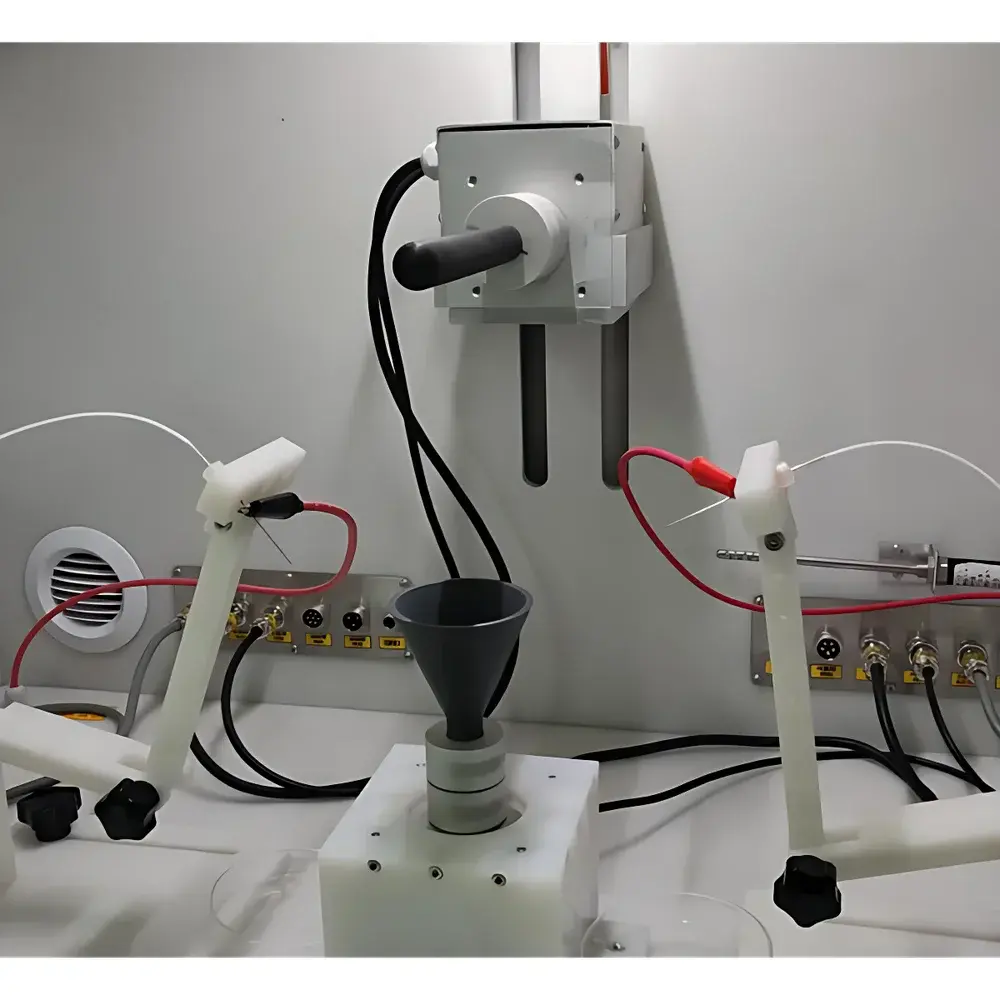
- Two precision syringe pumps featuring high-voltage-rated stepper motors, PTFE-lined fluid paths, and flexible hose-based needle coupling—enabling stable, pulseless flow delivery across 0.001–20 mm/min (plunger speed) with 20 mL standard syringes (10–50 mL compatible).
- Active environmental conditioning system comprising an industrial-grade condensation dehumidifier (420 W, 10–60 %RH range) and infrared heating lamp (1600 W, RT–50 °C), independently controllable to stabilize ambient conditions during humidity-sensitive electrospinning processes.
- Modular collector platform with interchangeable drum (Ø80 × 200 mm) and conjugate rod assemblies; drum rotation (500–3800 rpm), oscillation (5–100 mm/s), and amplitude (100–200 mm) are programmable; conjugate stage offers vertical travel (0.1–5 mm/s, 180 mm stroke), dual-axis rotation (500–3000 rpm main axis; 1–500 rpm rod), and adjustable nozzle–collector spacing (20–60 cm).
- Electrostatically shielded chamber constructed from aluminum extrusion frames lined internally with PTFE sheeting (dielectric strength >20 kV/mm, chemical resistance to organic solvents), ensuring field uniformity and operator safety; integrated high-luminance LED observation lighting enables direct visual monitoring of jet initiation and fiber deposition dynamics.
Sample Compatibility & Compliance
The MSK-NFES-3C-DZ01 accommodates a broad spectrum of processable feedstocks—including aqueous and organic solvent-based polymer solutions (e.g., PVA, PAN, PLGA, chitosan), thermoplastic melts (e.g., PP, TPU), prepolymers, and nanoparticle-dispersed suspensions. Its design adheres to fundamental electrical safety standards per IEC 61010-1 and electromagnetic compatibility guidelines per EN 61326-1. While not certified for GMP production environments, its traceable parameter logging, hardware interlocks, and reproducible operational protocols support GLP-aligned experimental workflows. All high-voltage components meet creepage and clearance requirements for Pollution Degree 2 environments.
Software & Data Management
The embedded HMI firmware records all active parameters—including voltage setpoints, pump displacement, temperature/humidity readings, collector speeds, and runtime stamps—with timestamped CSV export capability via USB interface. No cloud connectivity or remote access is implemented, preserving data sovereignty and aligning with institutional IT security policies. Firmware updates are performed locally via encrypted firmware packages validated by digital signature, ensuring integrity during version upgrades. Audit trail functionality includes user login timestamps and configuration change logs—supporting basic 21 CFR Part 11 readiness when paired with institutional electronic record governance frameworks.
Applications
- Preparation of ultra-high-surface-area nanofibrous membranes for air/water filtration media (e.g., PM2.5 capture, virus retention).
- Fabrication of biodegradable scaffolds for 3D cell culture and regenerative medicine applications requiring tunable fiber alignment and porosity.
- Development of core–shell nanofibers for controlled release of therapeutics, enzymes, or antimicrobial agents.
- Synthesis of composite nanofibers incorporating conductive nanoparticles (e.g., Ag, carbon black) for flexible electronics and sensor substrates.
- Rapid prototyping of functional coatings on substrates such as PET, silicon wafers, or metallic foils using near-field electrospinning modes.
- Method development and optimization studies under ISO 18562-2 (biocompatibility of breathing gas pathways) and ASTM D2524 (fiber diameter distribution analysis) test frameworks.
FAQ
What types of polymers can be processed using this system?
The system is compatible with any polymer soluble or meltable under process conditions—including synthetic (e.g., PCL, PLA, PVDF), natural (e.g., collagen, gelatin, silk fibroin), and hybrid systems—as long as viscosity, conductivity, and volatility permit stable jet formation.
Is coaxial electrospinning supported out-of-the-box?
Yes. The dual syringe pump configuration, combined with optional coaxial needle sets and dedicated conjugate collector firmware, enables immediate implementation of core–shell and Janus fiber fabrication without hardware modification.
Can environmental parameters be logged alongside process data?
Yes. Internal sensors continuously monitor chamber temperature and relative humidity, and these values are synchronized with all operational parameters in the exported CSV dataset.
Does the system comply with FDA or ISO regulatory requirements for medical device R&D?
It meets general electrical safety and EMC requirements (IEC 61010-1, EN 61326-1). While not a certified GMP manufacturing tool, its repeatable performance, parameter traceability, and configurable audit logging support preclinical material development aligned with ISO 13485 and USP analytical instrument qualification principles.
What maintenance is required for long-term reliability?
Routine cleaning of nozzle tips and collector surfaces with appropriate solvents; periodic verification of HV cable insulation resistance (>100 MΩ at 1 kV DC); annual calibration of syringe pump displacement accuracy and temperature/humidity sensor drift against NIST-traceable references.



