
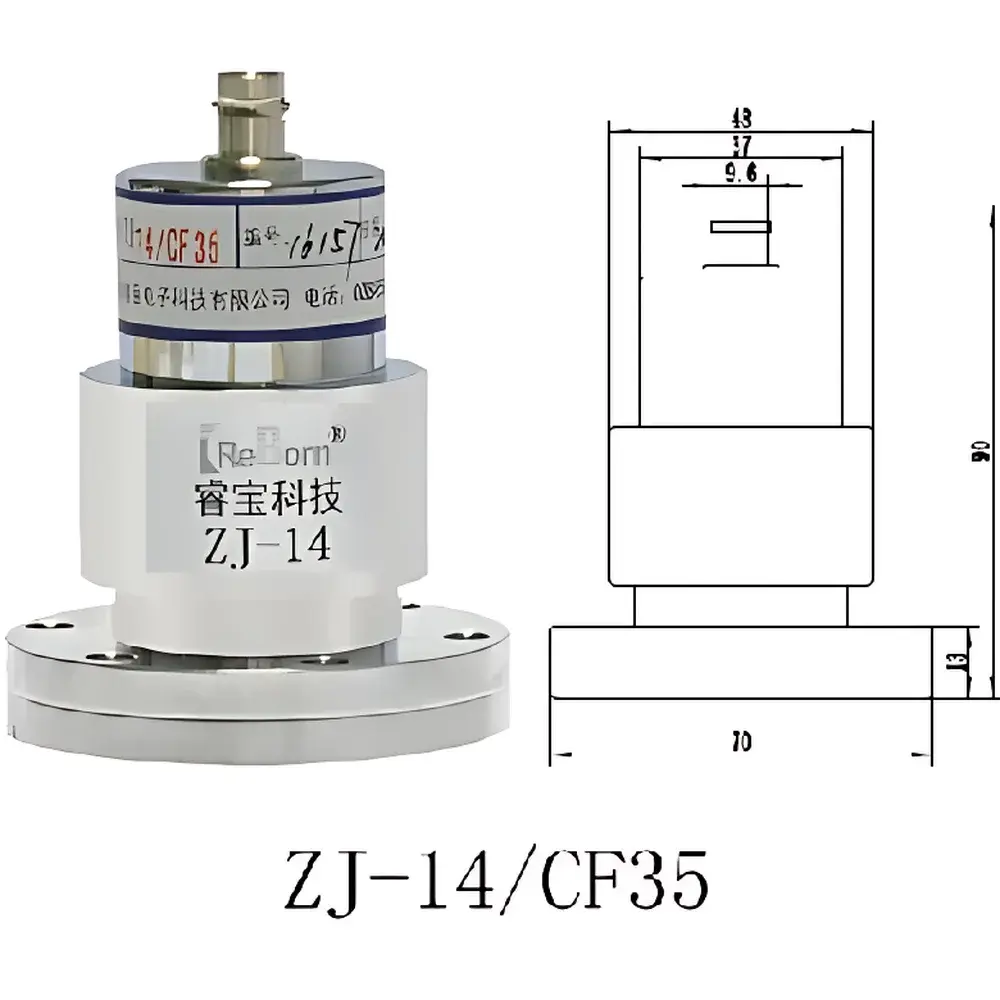
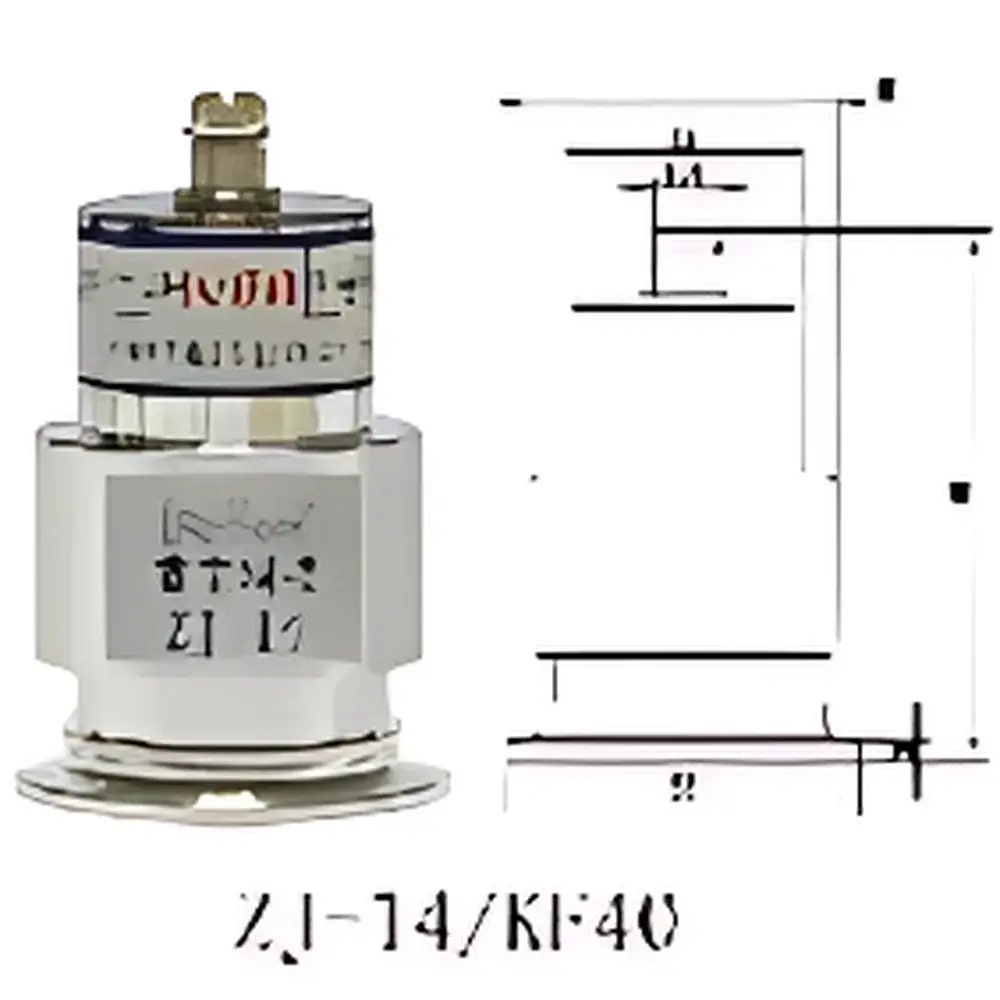
ZJ-14 Inverted Magnetron Vacuum Gauge
| Brand | KJ GROUP (Shenyang Kejing) |
|---|---|
| Origin | Liaoning, China |
| Manufacturer Type | Authorized Distributor |
| Country of Origin | China |
| Model | ZJ-14 |
| Pricing | Available Upon Request |
| Measurement Range | 1×10¹ to 1×10⁻⁷ Pa |
| Operating Voltage | 3 V / 3.3 V (KF-compatible) |
| Max. Anode Current | 0.7 mA |
| Cathode & Anode Material | Non-magnetic Stainless Steel |
| Insulator Material | 95% Alumina Ceramic |
| Flange Options | KF40 (Bakeable to 80 °C) |
Overview
The ZJ-14 Inverted Magnetron Vacuum Gauge is a cold-cathode ionization gauge engineered for stable, long-term pressure measurement in high vacuum (HV) and ultra-high vacuum (UHV) environments—typically spanning 1×10¹ Pa down to 1×10⁻⁷ Pa. Unlike hot-filament gauges, the ZJ-14 employs an inverted magnetron configuration: it generates electron trajectories via crossed electric and magnetic fields without thermionic emission, eliminating filament burnout risk and enabling safe atmospheric exposure during system venting or maintenance. Its robust, non-evaporative discharge mechanism ensures operational resilience across repeated pump-down cycles and extended bake-out procedures. The gauge operates on low DC voltage (3 V or 3.3 V), compatible with standard KF-integrated controller interfaces, and delivers inherently stable output due to its symmetric orthogonal electromagnetic field geometry—critical for minimizing spatial charge asymmetry and drift under dynamic vacuum conditions.
Key Features
- Cold-cathode design with no heated filament—immune to oxidation, sputtering damage, or catastrophic failure upon air exposure
- Modular, demountable electrode assembly sealed with high-purity 95% alumina ceramic insulators—enabling in-situ cleaning, reconditioning, and electrode replacement without gauge recalibration
- Dual-flange compatibility: KF40 (rated for bake-out up to 80 °C) and CF35 metal-sealed flange (rated for UHV bake-out up to 450 °C), supporting integration into both standard HV and stringent UHV systems
- Precision-machined non-magnetic stainless steel electrodes—minimizing magnetic hysteresis and ensuring field homogeneity across the discharge region
- Integrated auxiliary excitation circuit—reducing ignition delay and improving startup reliability below 10⁻² Pa, where conventional cold-cathode gauges often exhibit unstable discharge onset
- Low power consumption (≤0.7 mA anode current) and minimal thermal load—suitable for cryogenic or vibration-sensitive vacuum chambers
Sample Compatibility & Compliance
The ZJ-14 is compatible with inert, reactive, and corrosive gas environments common in thin-film deposition (e.g., sputtering, e-beam evaporation), surface science UHV chambers, particle accelerator beamlines, and space simulation facilities. Its all-metal/ceramic construction avoids organic outgassing sources, meeting ASTM E595 low-total-mass-loss (TML) requirements for space-grade instrumentation. While not intrinsically certified to ISO/IEC 17025, the gauge’s repeatable calibration traceability supports compliance with GLP and GMP vacuum monitoring protocols when paired with NIST-traceable reference standards and documented calibration intervals. Its bake-out capability (CF35 version) aligns with ISO 20483 (vacuum technology — terminology and definitions) and IEC 60446 (electrical safety in vacuum systems).
Software & Data Management
The ZJ-14 outputs analog voltage (0–10 V) or digital RS-485 signal proportional to logarithmic pressure, interfacing seamlessly with industry-standard vacuum controllers (e.g., Pfeiffer Vacuum MultiControl, Leybold Vacuubrand VACUU·VIEW). When integrated into SCADA or LabVIEW-based DAQ systems, its linearized output enables real-time logging with timestamped audit trails—supporting FDA 21 CFR Part 11-compliant electronic records when deployed with validated software layers and user-access controls. Firmware-upgradable controllers can implement auto-zero compensation, multi-point linearization, and alarm thresholds configurable per process step—essential for batch consistency in semiconductor tool qualification or coating uniformity validation.
Applications
- Monitoring base pressure and process pressure in magnetron sputtering and ion plating systems
- UHV chamber conditioning and leak-check verification in synchrotron beamline front-ends
- Pressure feedback control in molecular beam epitaxy (MBE) growth chambers
- Long-duration vacuum integrity testing in hermetic packaging and MEMS device encapsulation
- Calibration transfer standard for Pirani and capacitance manometer cross-checks in metrology labs
- Backup or redundancy gauge in critical aerospace ground-test vacuum vessels requiring fail-safe cold-cathode operation
FAQ
Does the ZJ-14 require periodic filament replacement?
No—its cold-cathode inverted magnetron structure contains no thermionic filament; electrode lifetime is governed by sputter erosion rates, typically exceeding 5 years under continuous HV operation.
Can the ZJ-14 be used in oxygen or halogen-containing process gases?
Yes—non-magnetic stainless steel electrodes and alumina insulation resist oxidation and halogen corrosion better than tungsten or nickel alloys, though prolonged exposure to Cl₂ or F₂ above 10⁻³ Pa may accelerate cathode sputtering.
Is the ZJ-14 compatible with automated bake-out sequences?
Yes—the CF35-flanged variant is rated for continuous operation at 450 °C, enabling full-chamber bake-out without gauge removal; KF40 version must be isolated below 80 °C.
How does the ZJ-14 compare to Bayard-Alpert gauges in UHV accuracy?
While B-A gauges offer superior absolute accuracy below 10⁻⁸ Pa, the ZJ-14 provides higher stability and repeatability between 10⁻⁵–10⁻⁷ Pa due to reduced X-ray limit effects and absence of filament-induced background emission.
Does the ZJ-14 support Modbus RTU communication?
Not natively—but RS-485 output allows protocol translation via third-party gateways compliant with Modbus RTU, Profibus DP, or EtherCAT industrial networks.



