
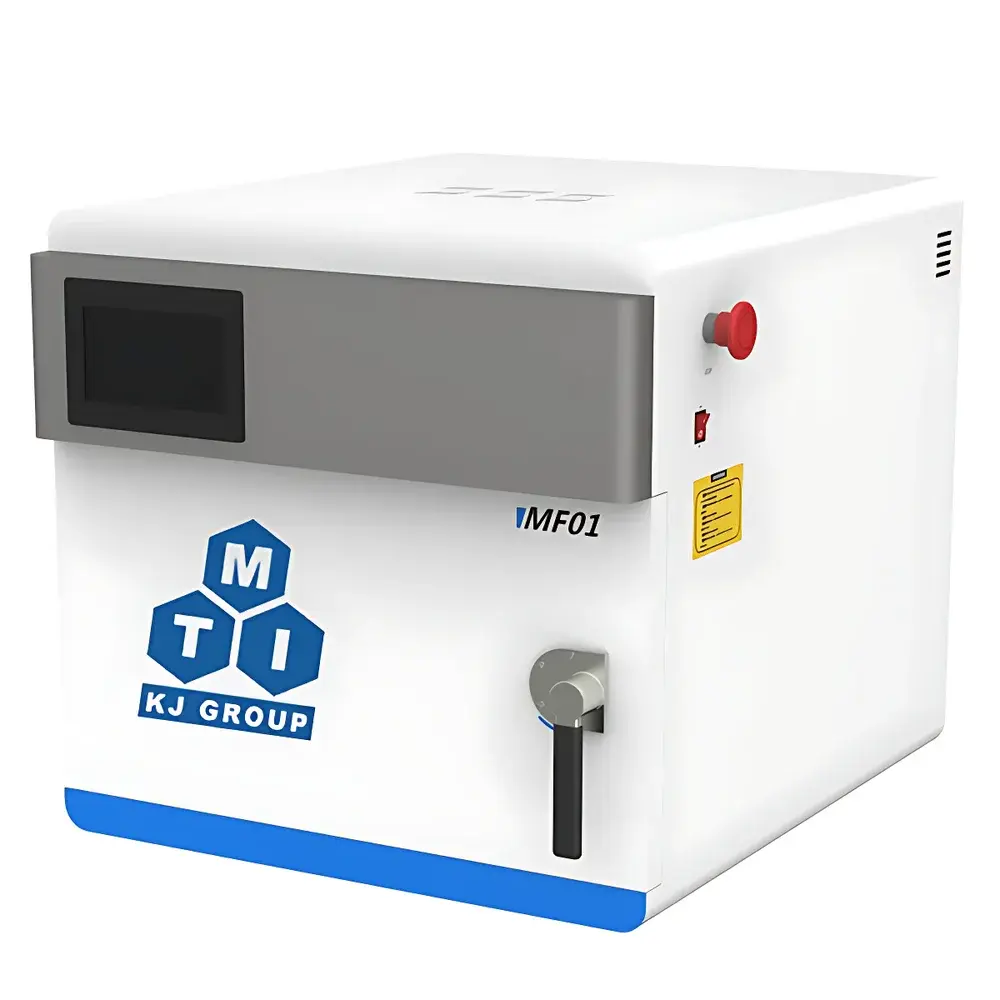
KJ GROUP FY Series Microwave Reactor
| Brand | KJ GROUP |
|---|---|
| Origin | Liaoning, China |
| Manufacturer Type | Authorized Distributor |
| Country of Origin | China |
| Model | FY |
| Pricing | Available Upon Request |
| Microwave Frequency | 2.45 GHz |
| Max Operating Temperature | ≤600 °C |
| Microwave Power Output Range (FY1510) | 0.01–1.40 kW (continuously adjustable) |
| Microwave Power Output Range (FY6010) | 0.01–5.60 kW (continuously adjustable) |
| Input Voltage (FY1510) | 220 ±10 V, 50 Hz |
| Input Voltage (FY6010) | 380 ±10 V, 50 Hz |
| Rated Power (FY1510) | 3 kW |
| Rated Power (FY6010) | 8 kW |
| Heating Cavity Dimensions (FY1510) | Ø20 mm × 150 mm |
| Heating Cavity Dimensions (FY6010) | Ø40 mm × 300 mm |
| Temperature Measurement | Type K Thermocouple |
| Temp. Range & Accuracy | 0–800 °C |
| Control System | Mitsubishi PLC + Schneider Touchscreen HMI |
| Programmable Steps | Up to 40-segment ramp/soak profiles |
| Data Handling | Internal storage, USB export, real-time curve display, dynamic screen-saver logging |
| Safety Compliance | Microwave leakage < 0.05 mW/cm² (per GB/T 18801 & IEC 61000-3-2) |
| Enclosure Dimensions (FY1510) | ~750 × 550 × 650 mm (L×W×H) |
| Enclosure Dimensions (FY6010) | ~850 × 650 × 750 mm (L×W×H) |
Overview
The KJ GROUP FY Series Microwave Reactor is a purpose-engineered laboratory-scale system designed for controlled, energy-efficient microwave-assisted catalytic reactions under atmospheric or regulated atmosphere conditions. It operates on the principle of dielectric heating—where electromagnetic energy at 2.45 GHz induces molecular rotation and friction in polar materials—enabling rapid, volumetric, and selective heating of reaction mixtures. Unlike conventional conductive heating methods, microwave irradiation delivers thermal energy directly to the reactants, minimizing thermal gradients and reducing reaction times significantly. The FY Series supports heterogeneous catalysis across solid–gas, solid–liquid, and liquid–gas phase systems, making it particularly suitable for environmental remediation research (e.g., VOC abatement, wastewater oxidation), fine chemical synthesis, and catalytic cracking studies. Its dual-platform configuration (FY1510 and FY6010) accommodates both small-batch screening and larger-scale process development, with scalable cavity geometries and power delivery optimized for reproducible kinetic profiling and method transfer.
Key Features
- Industrial-grade magnetron source with continuous, stepless microwave power regulation—from 10 W to 5.6 kW—ensuring precise energy dosing and stable long-duration operation.
- Integrated control architecture featuring Mitsubishi programmable logic controller (PLC) and Schneider touchscreen human-machine interface (HMI), supporting intuitive navigation, parameter validation, and audit-ready operation logs.
- Monolithic furnace design incorporating proprietary multi-layer insulation and reflective cavity lining, achieving >75% energy efficiency while eliminating cross-contamination from external thermal mass or refractory leaching.
- Comprehensive safety engineering: electromagnetic shielding compliant with IEC 61000-4-3 and GB/T 18801; mechanical door interlock with zero-delay power cutoff and mandatory restart delay; real-time monitoring of magnetron temperature, current draw, and cavity pressure (optional).
- Modular atmosphere integration capability—compatible with N₂, Ar, O₂, and forming gas lines—via standardized flange ports and leak-tight quick-connect fittings, enabling controlled oxidative, reductive, or inert reaction environments.
Sample Compatibility & Compliance
The FY Series accommodates a broad range of sample formats—including crucibles, quartz tubes, ceramic boats, and custom reactor inserts—within its cylindrical heating zones. Both models accept standard laboratory consumables conforming to ISO 9001-certified dimensional tolerances. The system meets electromagnetic compatibility (EMC) requirements per IEC 61326-1 for laboratory equipment and complies with occupational exposure limits defined in ICNIRP 2020 guidelines. All electrical components are rated for industrial environments (IP54 enclosure rating), and firmware adheres to GLP-relevant data integrity principles—including immutable timestamped event logging, user-access controls, and non-volatile memory retention for up to 10,000 experimental records. Optional validation packages support IQ/OQ documentation aligned with ASTM E2500 and FDA 21 CFR Part 11 expectations for regulated laboratories.
Software & Data Management
Embedded control software enables full-cycle experiment management: 40-segment programmable temperature/power/time profiles with ramp rate constraints, real-time graphical overlay of thermocouple feedback versus setpoint, and automatic fault-triggered shutdown sequences. Experimental datasets—including time-stamped temperature, power absorption, and system status flags—are stored internally and exportable via USB 2.0 to CSV or Excel-compatible formats. No proprietary drivers or cloud dependencies are required; raw files retain native timestamp resolution (100 ms) and support post-acquisition analysis in MATLAB, Python (Pandas), or OriginLab. Audit trails record operator ID, session start/stop timestamps, parameter modifications, and alarm events—satisfying traceability requirements for ISO/IEC 17025 accredited testing facilities.
Applications
- Catalytic degradation of persistent organic pollutants (e.g., phenols, dyes, pharmaceutical residues) in aqueous matrices using supported metal oxide catalysts.
- Gas-phase reforming of light hydrocarbons (e.g., methane, propane) over Ni/Al₂O₃ or Co/ZSM-5 under controlled flow and stoichiometry.
- Solvent-free esterification, amidation, and Suzuki coupling reactions employing immobilized Pd catalysts and microwave-specific ligand systems.
- Thermal stability assessment of battery electrode materials (e.g., LiFePO₄, NMC) under simulated fast-charge cycling conditions.
- Preparation of mesoporous metal–organic frameworks (MOFs) via microwave-assisted solvothermal synthesis with sub-5-minute crystallization cycles.
FAQ
Is the FY Series compatible with reactive or corrosive atmospheres?
Yes—when equipped with optional quartz-lined reaction tubes and stainless-steel gas manifolds, the system supports H₂, NH₃, Cl₂, and SO₂ environments up to 0.5 MPa gauge pressure, subject to third-party pressure vessel certification.
Can temperature uniformity be validated across the heating zone?
Yes—using calibrated infrared thermography (±1.5 °C accuracy) or multi-point fiber-optic probes, users may map axial/radial thermal distribution; typical ΔT across the FY6010 cavity is ≤15 °C at 500 °C steady state.
Does the system support remote monitoring or network integration?
The FY Series includes RS-485 Modbus RTU and Ethernet TCP/IP interfaces for SCADA-level integration; OPC UA support is available via optional firmware upgrade.
What maintenance intervals are recommended for the magnetron and waveguide assembly?
Magnetron service life exceeds 5,000 operating hours under nominal load; quarterly visual inspection of waveguide gaskets and annual calibration of thermocouple inputs are advised per manufacturer’s maintenance schedule.
Are custom cavity liners or sample holders available?
KJ GROUP offers OEM-design support for application-specific inserts—including SiC susceptors, alumina diffusers, and RF-transparent polymer fixtures—subject to minimum order quantities and lead-time confirmation.



