
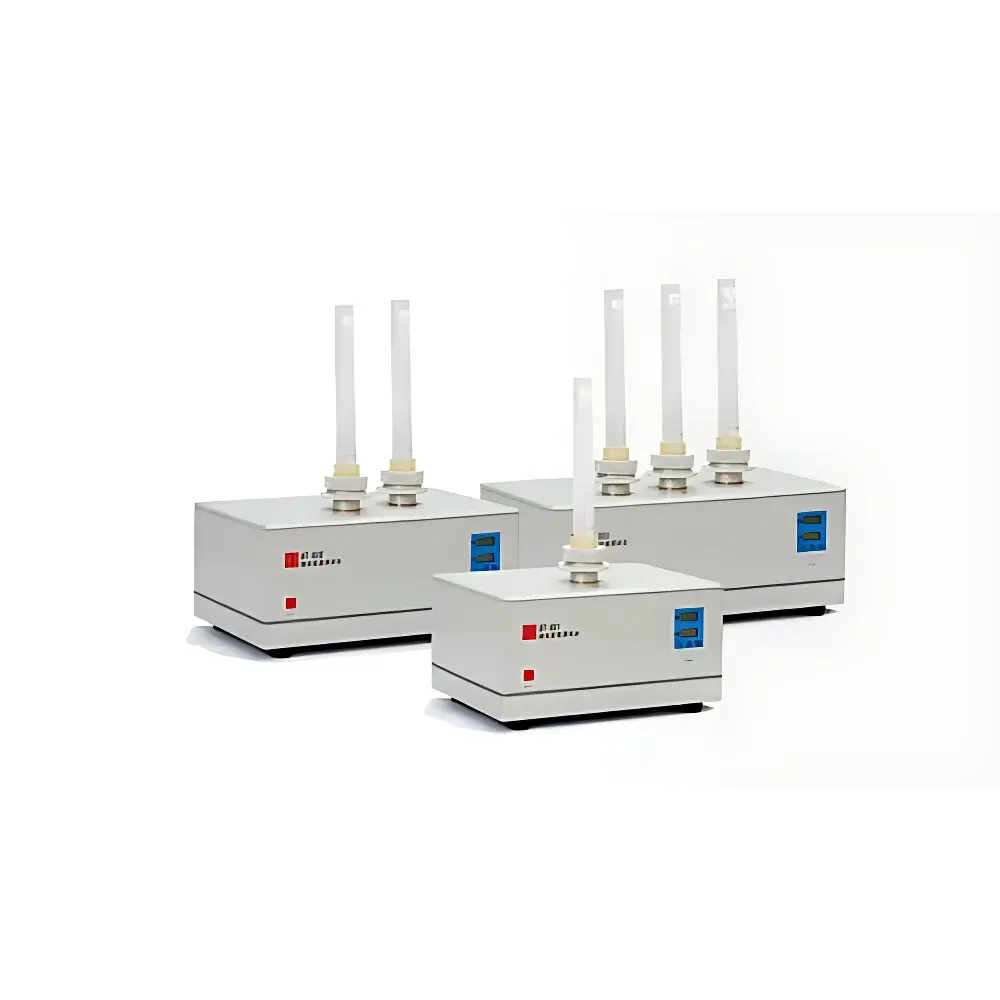
KJ GROUP BT-300 Series Tap Density Tester
| Brand | KJ GROUP |
|---|---|
| Origin | Liaoning, China |
| Manufacturer Type | Authorized Distributor |
| Country of Origin | China |
| Model | BT-300 Series (BT-301 / BT-302 / BT-303) |
| Vibration Amplitude | 3 mm |
| Vibration Frequency Range | 100–300 cycles/min |
| Sample Capacity | 1 × 100 mL or 25 mL cylinder (BT-301), 2 × 100 mL or 25 mL cylinders (BT-302), 3 × 100 mL or 25 mL cylinders (BT-303) |
| Repeatability | ≤1% |
| Compliance | GB/T 21354–2008, ISO 3953:1993, USP <616> |
| Cylinder Volume Options | 25 mL, 100 mL |
| Volume Reading Precision | ±0.1 mL (25 mL cylinder), ±0.5 mL (100 mL cylinder) |
| Maximum Counter Value | 9999 |
| Dimensions (L×W×H) | 500 × 310 × 230 mm |
Overview
The KJ GROUP BT-300 Series Tap Density Tester is a precision-engineered instrument designed for the standardized determination of tap density (also known as tapped density or settled density) of free-flowing powders and granular materials. Tap density is defined as the bulk density achieved after a powder sample undergoes controlled mechanical tapping—vertical vibration combined with horizontal rotation—to minimize interstitial voids and achieve a reproducible, densely packed state. This measurement is critical in pharmaceutical formulation development, battery cathode/anode material qualification, metal powder sintering process control, and quality assurance across advanced ceramics, catalysts, and fine chemicals. The BT-300 Series implements a dual-axis motion profile: vertical oscillation at adjustable frequencies (100–300 taps/min) coupled with synchronized horizontal rotation. This unique motion ensures uniform powder surface leveling during compaction, eliminating edge effects and significantly improving volumetric repeatability compared to conventional single-axis tap testers.
Key Features
- Dual-axis compaction mechanism: Simultaneous vertical tapping (3 mm amplitude) and horizontal rotation for consistent surface planarity and minimized segregation.
- Modular configuration options: BT-301 (single-cylinder), BT-302 (dual-cylinder), and BT-303 (triple-cylinder) models enable parallel testing of up to three independent samples per cycle—enhancing throughput in QC labs and R&D environments.
- High-precision volumetric measurement: Compatible with calibrated 25 mL and 100 mL stainless steel or glass cylinders; reading resolution of ±0.1 mL (25 mL) and ±0.5 mL (100 mL) supports both high-sensitivity and high-capacity applications.
- Programmable tap count and frequency: Digital counter with 0–9999 range and continuously adjustable vibration frequency (100–300 taps/min) allows full compliance with method-specific protocols across pharmacopeial and industrial standards.
- Robust mechanical architecture: All-metal frame with anti-vibration base, ergonomic cylinder clamping system, and dust-resistant actuator housing ensure long-term stability and minimal maintenance under routine laboratory use.
Sample Compatibility & Compliance
The BT-300 Series accommodates a broad spectrum of dry, non-cohesive to moderately cohesive powders—including inorganic oxides (e.g., LiCoO₂, SiO₂), metallic powders (Al, Cu, Ni alloys), pharmaceutical excipients (lactose, microcrystalline cellulose), polymer granules, abrasives, and catalyst supports. It is explicitly validated for use in environments requiring adherence to regulatory documentation practices. The instrument meets the physical test requirements of GB/T 21354–2008 (Chinese National Standard for Tap Density of Powders), ISO 3953:1993 (Determination of Tap Density of Metallic Powders), and USP Chapter <616> “Density of Solids” for pharmaceutical dosage forms. While the device itself does not generate electronic audit trails, its operational parameters (tap count, frequency, cylinder ID) are manually recorded in accordance with GLP/GMP-compliant lab notebooks or integrated into LIMS workflows via external documentation protocols.
Software & Data Management
The BT-300 Series operates via an embedded digital control panel with LED display, offering direct access to tap count, real-time frequency setting, and elapsed cycle indication. No proprietary software is required for basic operation; however, the instrument’s deterministic mechanical behavior—combined with its ≤1% repeatability—supports seamless integration into paper-based or electronic batch records. For laboratories implementing 21 CFR Part 11-compliant systems, manual entry of instrument ID, operator initials, date/time, cylinder volume, sample mass, final tapped volume, and calculated tap density (g/cm³) into validated Excel templates or ELN platforms satisfies data integrity requirements. Optional accessories include certified calibration weights and NIST-traceable cylinder volume verification kits for periodic performance verification.
Applications
- Pharmaceutical solid dosage development: Quantifying powder flowability, compressibility, and blend uniformity prior to tableting.
- Battery materials characterization: Assessing electrode powder packing efficiency and predicting calendering behavior in Li-ion cell manufacturing.
- Metal injection molding (MIM) feedstock qualification: Verifying powder loading consistency in polymer-binder systems.
- Quality control of catalysts and adsorbents: Correlating tap density with surface area, pore volume, and attrition resistance.
- Academic research in powder mechanics: Supporting studies on particle shape effects, cohesion-adhesion balance, and dynamic compaction modeling.
FAQ
What standards does the BT-300 Series comply with?
It conforms to GB/T 21354–2008, ISO 3953:1993, and USP <616> for tap density determination.
Can the instrument be used for cohesive or hygroscopic powders?
It is optimized for free-flowing, dry powders. For cohesive materials, pre-drying and use of anti-static cylinders are recommended; results should be interpreted with reference to flow function tests.
Is calibration traceable to international standards?
Cylinders may be verified using NIST-traceable volumetric standards; vibration frequency and amplitude are factory-set and mechanically stabilized—requiring only periodic verification against a calibrated tachometer and displacement gauge.
How is data integrity maintained during routine testing?
Operators record raw inputs (mass, initial/final volume, tap count) and calculations manually or in validated electronic systems; the instrument provides no internal storage but enables fully auditable manual data capture.
What maintenance is required?
Routine cleaning of cylinder contact surfaces, periodic inspection of drive belt tension, and lubrication of rotating shaft bearings every 6 months under normal use conditions.



