
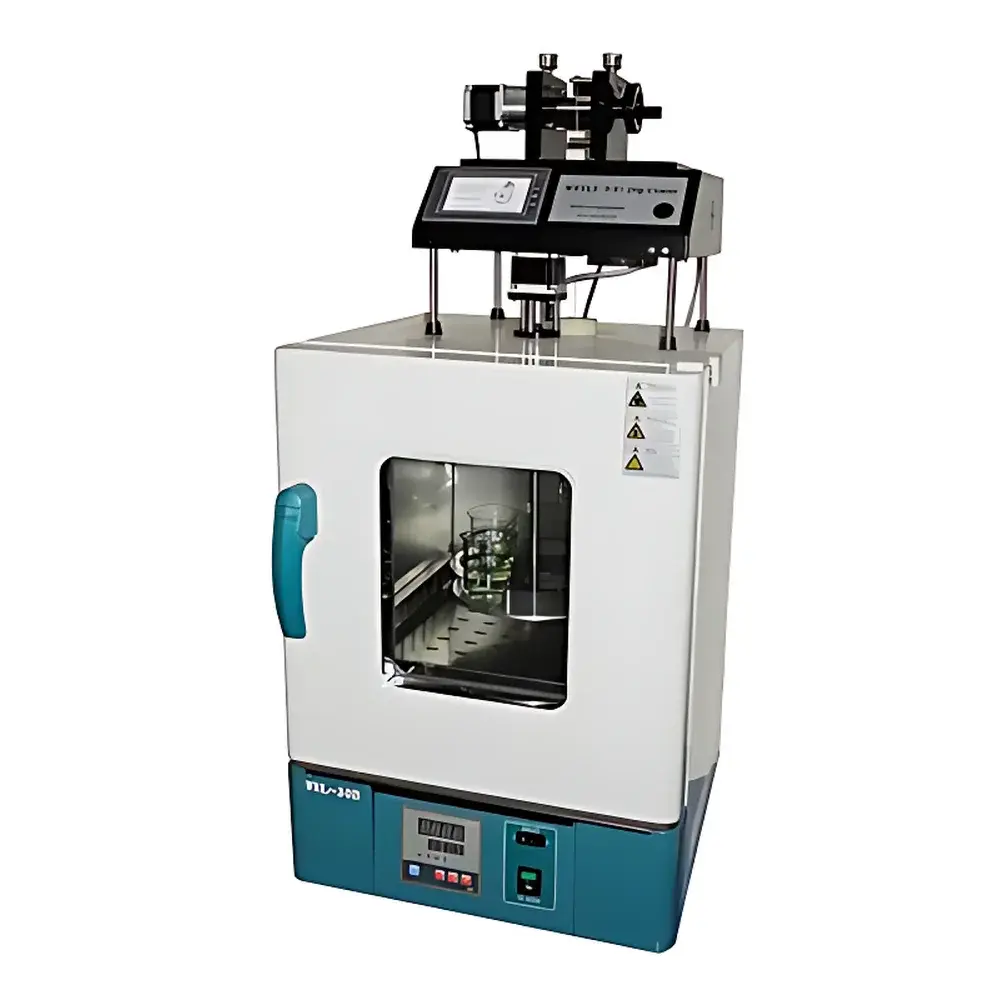
KJ GROUP PTL-OV5P Fully Automated 5-Station Dip-Coating System with Integrated恒温 Chamber
| Brand | KJ GROUP |
|---|---|
| Origin | Liaoning, China |
| Model | PTL-OV5P |
| Power Supply | AC 220 V, 50 Hz, 3 A, 850 W |
| Pulling Speed Range | 1–200 mm/min |
| Temperature Control Range (Chamber) | RT+5°C to 100°C |
| Temperature Uniformity | ±1.5°C |
| Sample Dimensions | 75 mm × 25 mm × 2.5 mm |
| Immersion Length | 60 mm |
| Vial Capacity | Φ60 mm, 150 mL |
| Dwell Time per Station | 1–999 s |
| Coating Cycles per Station | 1–20 |
| Number of Stations | 5 |
| Chamber Dimensions | 460 mm × 510 mm × 695 mm |
| Overall Dimensions | 450 mm × 500 mm × 1060 mm |
| Weight | 45 kg |
| Compliance | CE-certified |
| Operating Environment | 5–40°C, ≤85% RH, altitude <1000 m, no strong vibration or corrosive gases |
Overview
The KJ GROUP PTL-OV5P Fully Automated 5-Station Dip-Coating System with Integrated恒温 Chamber is an engineered solution for controlled, reproducible thin-film fabrication via vertical dip-coating—also known as withdrawal coating or Langmuir–Blodgett-style deposition. This system operates on the principle of controlled immersion and withdrawal of substrates through liquid-phase precursor solutions under precisely regulated thermal and kinematic conditions. Unlike manual or single-station systems, the PTL-OV5P enables sequential multi-layer deposition across up to five distinct chemical environments without manual intervention, supporting graded, heterostructured, or combinatorial film architectures. Its integrated恒温 chamber maintains a stable thermal environment during both immersion and post-dip drying phases—critical for minimizing solvent evaporation gradients, suppressing Marangoni instabilities, and promoting uniform nucleation and condensation kinetics in sol-gel, polymer, or nanoparticle-based coatings.
Key Features
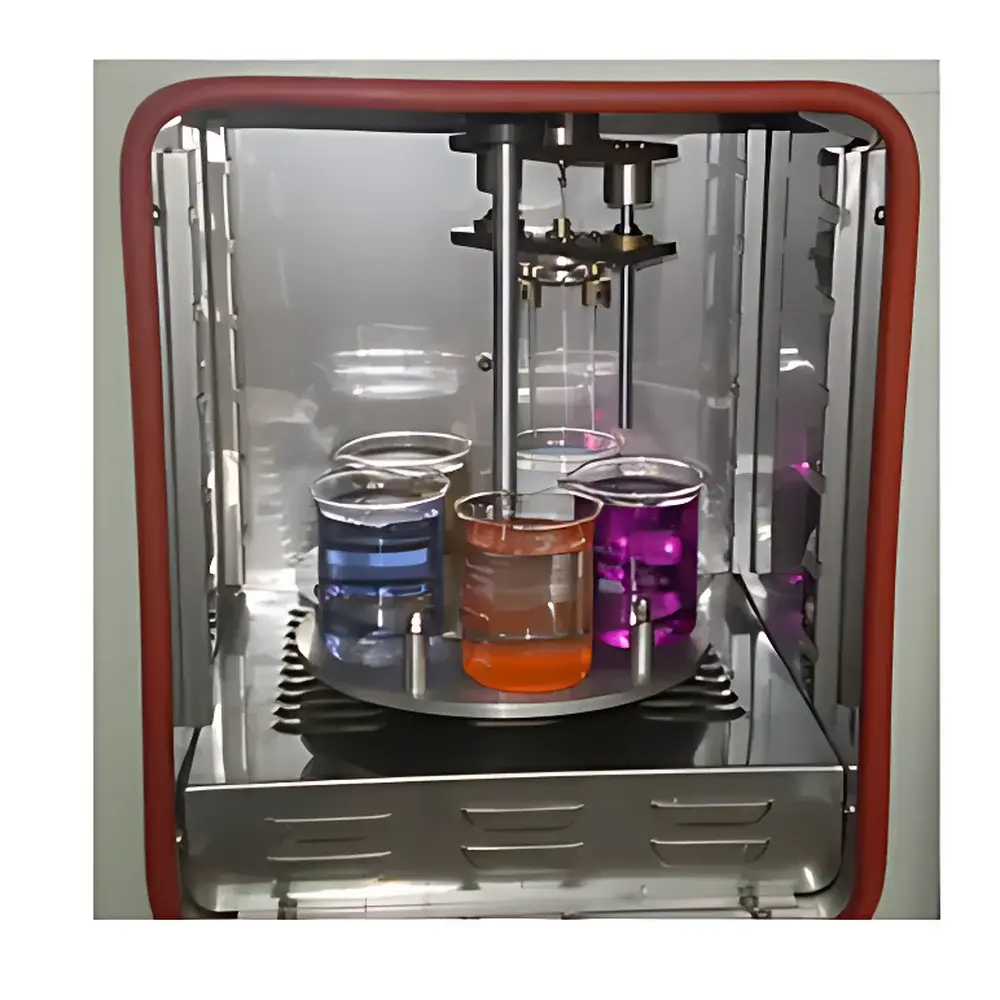
- Fully automated 5-position rotating sample carrier with programmable station indexing—enabling unattended sequential processing across five independent precursor baths.
- High-precision stepper motor-driven vertical translation mechanism with adjustable pulling speed (1–200 mm/min) and descent speed, ensuring repeatable meniscus break dynamics and film thickness control via the Landau–Levich–Derjaguin model.
- Integrated恒温 chamber (RT+5°C to 100°C, ±1.5°C stability) surrounding the entire coating zone—eliminating ambient thermal drift and enabling thermally activated crosslinking or solvent annealing immediately after withdrawal.
- Touchscreen HMI interface for intuitive setup of immersion dwell time (1–999 s), withdrawal cycles per station (1–20), and thermal ramp profiles—supporting GLP-compliant parameter logging.
- Suspended motor mounting architecture with mechanical isolation to suppress vibrational coupling—essential for sub-micron thickness uniformity and defect minimization in sensitive optical or electronic films.
- CE-certified design compliant with EN 61000-6-2 (immunity) and EN 61000-6-4 (emission) standards; suitable for installation in ISO Class 7 cleanrooms when operated with filtered air supply.
Sample Compatibility & Compliance
The PTL-OV5P accommodates standard rectangular substrates measuring 75 mm × 25 mm × 2.5 mm—including glass slides, silicon wafers, ITO-coated PET, stainless steel coupons, and ceramic plates. Each station accepts Φ60 mm × 150 mL vials compatible with aqueous, alcoholic, and low-boiling organic solvents (e.g., ethanol, isopropanol, chloroform). The system’s open bath geometry supports viscosity ranges typical of colloidal dispersions (1–1000 mPa·s) and sol-gel precursors (e.g., TEOS, titanium isopropoxide). All wetted components are constructed from chemically resistant 316 stainless steel and PTFE-lined seals. As a CE-marked instrument, it meets essential requirements of the Machinery Directive 2006/42/EC and Low Voltage Directive 2014/35/EU. While not inherently 21 CFR Part 11 compliant, audit-trail-capable data export (CSV/TXT) and user-access-level password protection support integration into GMP/GLP workflows when paired with validated third-party LIMS.
Software & Data Management
The embedded controller stores full process logs—including timestamped speed profiles, temperature setpoints, dwell durations, and station rotation events—for each run. Data export is supported via USB 2.0 port in comma-separated format, enabling traceability and post-hoc correlation with ellipsometry, XRD, or SEM characterization results. Optional RS-485 Modbus RTU interface allows integration into centralized lab automation platforms (e.g., LabVIEW, Ignition SCADA) for remote monitoring and synchronized scheduling with adjacent equipment such as spin coaters or vacuum dryers. Firmware updates are delivered via encrypted firmware image files, preserving integrity verification.
Applications
This system is routinely deployed in academic and industrial R&D labs for fabricating functional thin films used in antireflective coatings, gas-sensing metal oxides (e.g., SnO₂, ZnO), perovskite photovoltaic layers, biocompatible hydrogel films, corrosion-inhibiting silanes on aluminum alloys, and templated mesoporous silica membranes. Its five-station architecture is particularly valuable for rapid screening of solvent–polymer interactions, interfacial compatibility studies in multilayer OLED stacks, and accelerated aging tests where identical substrates undergo sequential exposure to varying pH or ionic strength media.
FAQ
What is the maximum film thickness achievable with this system?
Film thickness depends on withdrawal speed, solution viscosity, and substrate wettability—not instrument limits. Typical range spans ~10 nm to several micrometers per dip, governed by the Landau–Levich equation.
Can the system accommodate non-standard substrate sizes?
Yes—custom fixture kits (e.g., for 100 mm wafers or flexible roll substrates) are available upon request; contact technical support for mechanical interface specifications.
Is nitrogen purge capability available for oxygen-sensitive coatings?
Not standard, but the chamber can be retrofitted with inlet/outlet ports for inert gas purging; engineering consultation required prior to modification.
Does the system support real-time force feedback during immersion?
No—this is a kinematically controlled dip-coater, not a force-sensing rheometer; surface tension effects are managed via speed/temperature optimization rather than active load regulation.
What maintenance intervals are recommended?
Lubrication of linear guides every 6 months; calibration of temperature sensor annually using NIST-traceable reference probe; visual inspection of PTFE seals before high-temperature (>80°C) operation.



