
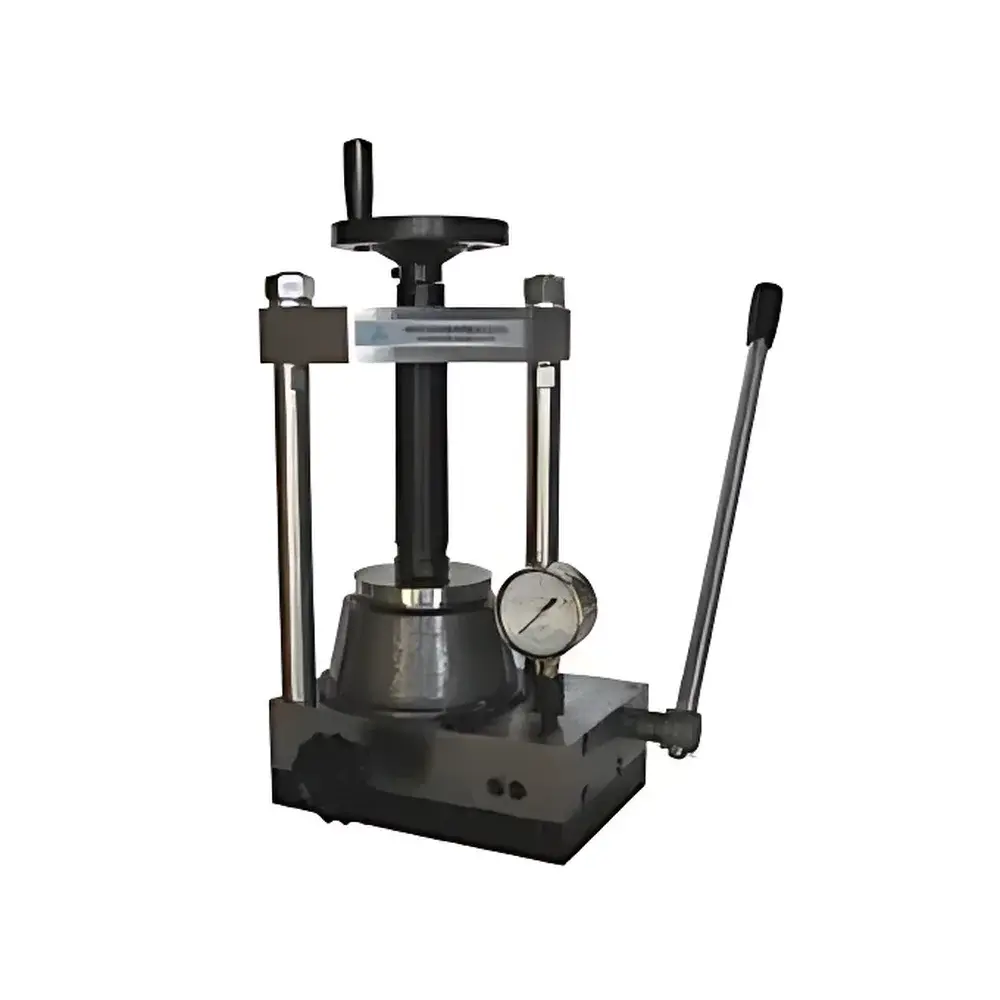
KJ GROUP YLJ-15T Manual Hydraulic Pellet Press
| Brand | KJ GROUP |
|---|---|
| Origin | Liaoning, China |
| Manufacturer Type | Authorized Distributor |
| Country of Origin | China |
| Model | YLJ-15T |
| Instrument Type | Manual Hydraulic Pellet Press |
| Maximum Force | 0–15 Ton (0–134 kN) |
| Gauge Pressure Range | 0–25 MPa (0–250 kgf/cm²) |
| Pressure Stability | ≤1 MPa/5 min |
| Piston Stroke | ≤20 mm |
| Working Chamber Dimensions | 94 mm × 94 mm × 120 mm (W × D × H) |
| Quick Preload Function | Yes |
| Overall Dimensions | 280 mm × 210 mm × 500 mm (W × D × H) |
| Net Weight | 36 kg |
Overview
The KJ GROUP YLJ-15T Manual Hydraulic Pellet Press is a compact, precision-engineered laboratory press designed for reproducible sample compaction under controlled uniaxial pressure. Operating on the principle of hydraulic force transmission via a manually actuated hand pump, the system delivers calibrated compressive loads up to 15 metric tons (134 kN) to specimens confined within interchangeable dies. This enables deterministic densification of powders—such as ceramic precursors, battery electrode materials, geological standards, and pharmaceutical blends—into mechanically stable pellets or cylindrical compacts suitable for quantitative spectroscopic and elemental analysis. Its fixed-frame architecture with adjustable upper crossbeam ensures consistent alignment between punch and die, minimizing shear-induced density gradients and edge cracking. Unlike motorized or pneumatic presses, the YLJ-15T eliminates dependency on external power sources or compressed air infrastructure, making it ideal for benchtop deployment in teaching labs, quality control environments, and field-deployable analytical workflows.
Key Features
- Compact footprint (280 × 210 × 500 mm) and lightweight design (36 kg) facilitate integration into space-constrained laboratories and mobile analytical units.
- Adjustable upper crossbeam allows rapid reconfiguration for dies ranging from 6 mm to 32 mm in diameter—no tools required—supporting standardized ASTM E1775 and ISO 13320-compliant pellet geometry.
- Hydraulic circuit incorporates dual-stage pressure regulation: coarse preloading (quick stroke mode) followed by fine-tuned holding pressure, enabling precise control over green density and interparticle bonding kinetics.
- Pressure stability ≤1 MPa over 5 minutes ensures minimal load drift during dwell periods—critical for achieving uniform compaction across heterogeneous powder batches.
- Stainless steel-plated cylinder bore and hardened tool-steel piston minimize wear and maintain long-term calibration integrity under repeated loading cycles.
- Front-accessible oil reservoir with sight gauge simplifies routine maintenance; all hydraulic seals conform to ISO 3601-1 NBR specifications for compatibility with mineral-based hydraulic fluids.
Sample Compatibility & Compliance
The YLJ-15T accommodates a broad spectrum of inorganic and organic powdered samples—including metal oxides (e.g., LiCoO₂, Al₂O₃), polymer composites, soil aggregates, fly ash, and pharmaceutical excipients—provided particle size distributions fall within the practical range of 0.1–250 µm. Die sets are available in standard geometries (flat-faced, recessed, and stepped) compatible with common XRF fusion cups, IR spectroscopy sample holders (KBr/Pellet format), and XRD sample spindles. The press meets mechanical safety requirements per EN 692:2009 (mechanical presses) and incorporates overload protection via pressure-relief valve set at 28 MPa. While not certified to GLP or GMP out-of-the-box, its traceable pressure readout (via analog Bourdon-tube gauge) supports audit-ready documentation when paired with calibrated external transducers and logbooks compliant with ISO/IEC 17025 clause 7.7.
Software & Data Management
As a manually operated hydraulic system, the YLJ-15T does not include embedded electronics or digital control interfaces. However, it is fully compatible with third-party pressure data acquisition systems: analog 0–10 V or 4–20 mA outputs can be integrated via optional pressure transducer kits (e.g., Honeywell ST3000 series), enabling time-stamped load profiling in LabVIEW, MATLAB, or custom Python-based DAQ platforms. Users may generate SOP-compliant reports—including date/time stamps, operator ID, die ID, target load, dwell duration, and observed stability deviation—using spreadsheet templates aligned with FDA 21 CFR Part 11 electronic record guidelines when deployed in regulated environments.
Applications
- Preparation of homogeneous pellets for wavelength-dispersive X-ray fluorescence (WD-XRF) quantification of major/minor elements in cement, ores, and catalysts.
- Formation of KBr-mixed IR transmission discs for functional group identification in polymer degradation studies.
- Compaction of electrode slurries (e.g., NMC + PVDF + carbon black) into freestanding disks for electrochemical impedance spectroscopy (EIS) and binder distribution analysis.
- Routine QA/QC pressing of reference materials (e.g., NIST SRM 278, GBW(E) 070040) prior to calibrating handheld XRF analyzers.
- Teaching laboratory demonstrations of powder rheology, Heckel analysis, and densification kinetics in materials science curricula.
FAQ
What is the maximum recommended operating pressure for routine use?
For optimal longevity and repeatability, sustained operation should remain below 22 MPa (220 kgf/cm²), reserving the full 25 MPa range for infrequent high-density compaction tasks.
Can the YLJ-15T be used with heated dies?
No—the frame and hydraulic components are not rated for elevated temperatures; heated die applications require dedicated hot-press systems with integrated thermal management.
Is calibration certification included with purchase?
Factory calibration verification is provided; however, users must perform periodic in-house verification using traceable dead-weight testers per ISO 7500-1 Class 1 requirements.
Which die sizes are supported without modification?
Standard configurations support 6 mm, 8 mm, 10 mm, 13 mm, 16 mm, 20 mm, 25 mm, and 32 mm diameter dies—all utilizing M12 × 1.25 threaded retention.
How often should hydraulic oil be replaced?
Under typical academic lab usage (≤50 cycles/week), mineral-based ISO VG 32 hydraulic oil should be replaced every 12 months or after 500 operating hours—whichever occurs first.
Related Products



