
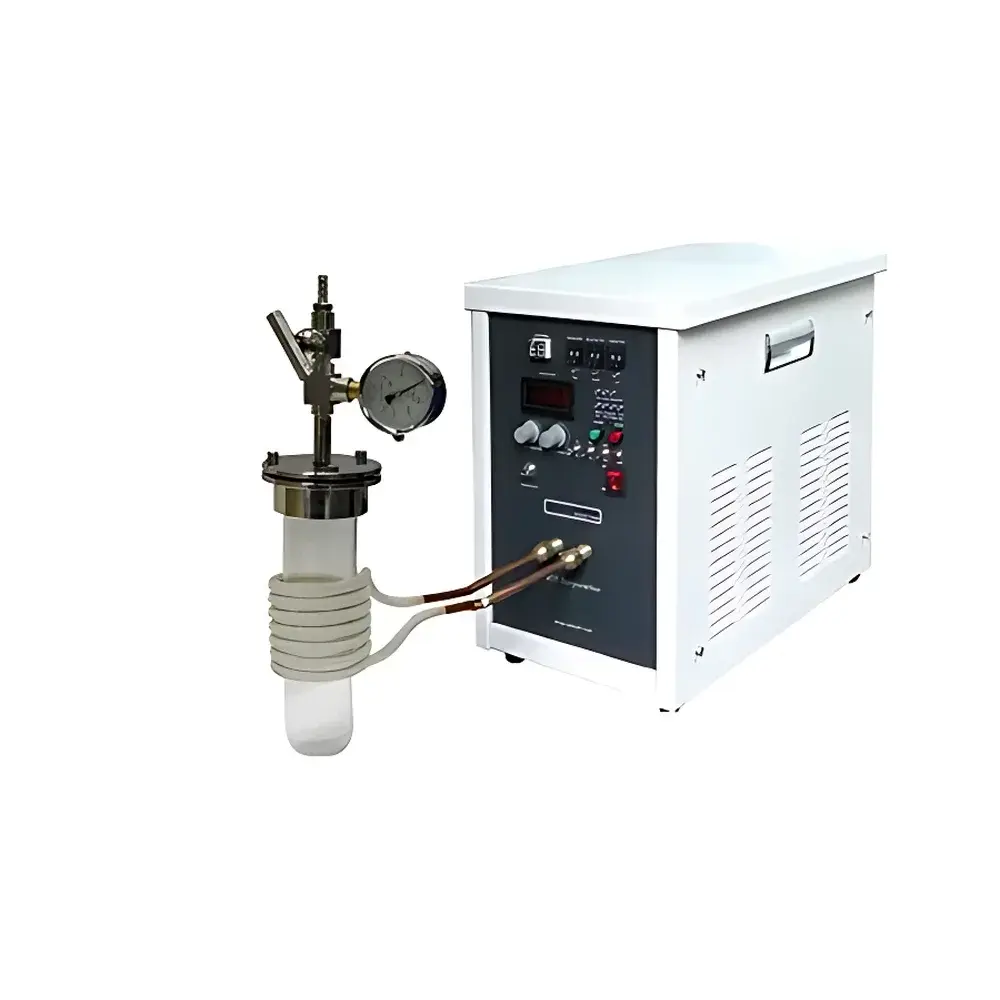
KJ GROUP 16V Vacuum Induction Melting Furnace
| Brand | KJ GROUP |
|---|---|
| Origin | Liaoning, China |
| Manufacturer Type | Authorized Distributor |
| Origin Category | Domestic |
| Model | 16V |
| Pricing | Upon Request |
| Heating Element | Induction Coil |
| Input Voltage | AC 220 V, 50/60 Hz |
| Output Power Range | 2–16 kW |
| Frequency Range | 30–110 kHz (adjustable) |
| Auto-Heating Time | 1–99 s |
| Auto-Hold Time | 1–99 s |
| Cooling Method | Rear-Mounted Fan + Recirculating Water Chiller (5–10 L/min, ≥0.2 MPa) |
| Max Sample Mass | ≤500 g |
| Operating Altitude | ≤1000 m |
| Ambient Temp | 25 °C ±15 °C |
| Relative Humidity | 55 %RH ±10 %RH |
| Protective Atmosphere | High-Purity Argon (≥99.99 %), supplied via 6 mm double-ferrule fitting |
| Footprint Requirement | 1500 × 600 × 700 mm (min.), load capacity ≥200 kg |
| Safety Interlocks | Water pressure & temperature monitoring, over-power cutoff, grounding compliance (AC 380 V, 50 Hz, 63 A circuit breaker required) |
Overview
The KJ GROUP 16V Vacuum Induction Melting Furnace is a compact, benchtop-scale induction heating system engineered for controlled melting and refining of small metallic samples—up to 500 g—in inert or reduced-pressure environments. It operates on the principle of electromagnetic induction: an alternating current passes through a water-cooled copper coil, generating a time-varying magnetic field that induces eddy currents within electrically conductive materials placed inside the coil. These eddy currents produce resistive heating (Joule heating), enabling rapid, contactless, and highly localized temperature rise in metals such as Fe, Ni, Co, Cu, Al, Ti, and their alloys. Unlike resistance-heated furnaces, induction-based systems eliminate contamination from heating elements and provide superior thermal response and reproducibility—critical for alloy development, phase diagram studies, and pre-forming of master alloys in academic and R&D settings.
Key Features
- Adjustable high-frequency power supply (30–110 kHz) ensures optimal coupling efficiency across diverse metal types and crucible geometries.
- Programmable auto-heating and auto-hold sequences (1–99 s each) support repeatable thermal protocols for metallurgical consistency.
- Integrated safety architecture includes real-time water pressure and temperature monitoring, automatic power cutoff upon interlock violation, and mandatory grounding compliance per IEC 61000-3-12.
- Modular vacuum compatibility: accepts user-supplied vacuum pumps (e.g., dual-stage rotary vane or turbomolecular systems) and digital vacuum gauges for pressure control down to 10−3 mbar.
- Compact footprint (1500 × 600 × 700 mm) and low mass (45 kg) enable deployment in shared laboratory spaces with standard structural floor loading.
- Front-access quartz tube chamber (Ø80 mm, one-end sealed) accommodates graphite or ceramic crucibles and permits visual process monitoring under inert gas flow.
Sample Compatibility & Compliance
The 16V furnace supports crucibles made of high-purity graphite (standard), alumina (optional), or fused quartz (optional), selected based on sample reactivity and maximum operating temperature requirements (graphite crucibles rated to ~2500 °C in inert atmosphere). Argon purging (≥99.99 % purity) mitigates oxidation during melting and solidification—essential for oxygen-sensitive alloys including titanium aluminides and rare-earth-containing intermetallics. The system meets fundamental electrical safety requirements per GB/T 19001–2016 (equivalent to ISO 9001) and supports GLP-compliant operation when integrated with validated vacuum measurement and power logging tools. While not certified to ASTM F2623 or ISO 13485, its design aligns with common lab-scale metallurgical practice guidelines referenced in ASTM E8/E8M (tensile testing) and ASTM E112 (grain size analysis) workflows.
Software & Data Management
The 16V operates via front-panel digital controls with LED display; no proprietary software is embedded. However, analog output signals (0–5 V or 4–20 mA) for power level and cooling water temperature are provided for integration into third-party data acquisition systems (e.g., LabVIEW, MATLAB, or PLC-based SCADA). Users may log heating cycles manually or interface with external chart recorders or USB DAQ modules to capture time-stamped power, dwell, and cooldown profiles—supporting audit-ready documentation for internal R&D reports or preliminary feasibility studies prior to pilot-scale trials.
Applications
- Rapid prototyping of novel alloy compositions in university metallurgy labs and national research institutes.
- Preparation of homogeneous master alloys for subsequent arc-melting, casting, or additive manufacturing feedstock synthesis.
- Thermal history studies—including solidification kinetics, segregation behavior, and metastable phase formation—under controlled argon partial pressure.
- Small-batch recycling of precious metal scraps (e.g., Pt, Pd, Au) with minimal vapor loss due to short melt durations and sealed chamber design.
- Calibration reference material production where compositional homogeneity and trace-element retention are critical.
FAQ
What vacuum level can the 16V achieve with a typical two-stage rotary vane pump?
With a standard 4–6 m³/h rotary vane pump and proper leak-tight assembly (including O-ring maintenance and flange torque verification), base pressures of 1×10⁻² to 5×10⁻³ mbar are routinely attainable.
Is the quartz tube reusable after multiple melting cycles?
Yes—provided thermal shock is minimized (e.g., gradual cooldown, avoidance of direct water quenching) and surface etching from reactive melts is inspected visually before reuse. Typical service life exceeds 20 cycles for non-corrosive alloys.
Can the system operate continuously at 16 kW?
No. The 16 kW rating is peak output; sustained operation above 10 kW requires active water cooling at ≥8 L/min and ambient temperature ≤30 °C to prevent thermal derating of the RF generator.
Does the furnace include vacuum gauge readout capability?
No—the digital vacuum gauge is an optional accessory. Users must select a compatible capacitance manometer or Pirani gauge with appropriate range (1×10⁻⁴–1000 mbar) and analog output for integration.
Are CE or UL certifications available for this model?
The 16V complies with EMC and LVD directives in principle; however, formal CE marking requires end-user responsibility for system-level conformity assessment under EU 2014/30/EU and 2014/35/EU, including final installation validation.



