
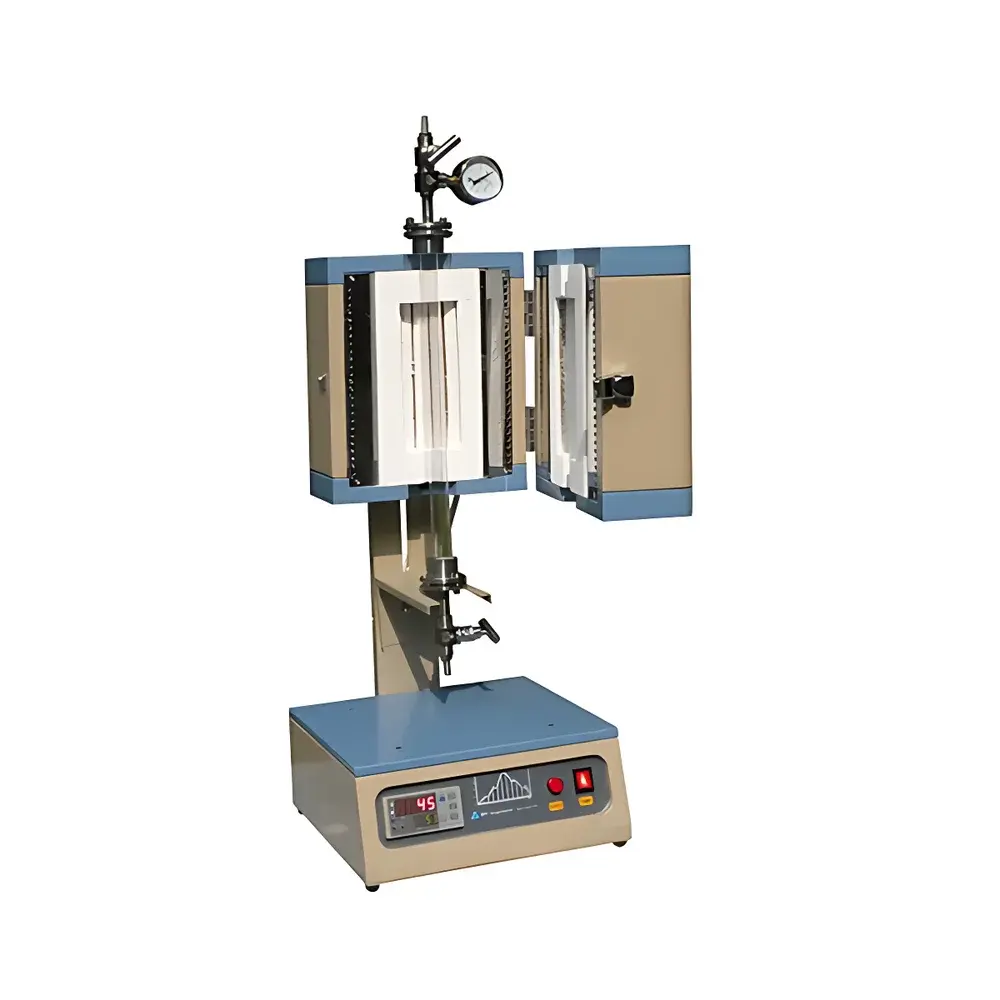
KJ GROUP OTF-1200X-S-VT Vertical Vacuum Tube Furnace
| Brand | KJ GROUP |
|---|---|
| Origin | Liaoning, China |
| Model | OTF-1200X-S-VT |
| Instrument Type | Vertical Tube Furnace |
| Max Temperature | 1200 °C (continuous operation at 1100 °C) |
| Temperature Control Accuracy | ±1 °C |
| Max Power | 1.2 kW |
| Heating Rate | up to 20 °C/min |
| Heating Element | Molybdenum-doped Fe-Cr-Al resistance wire with zirconia coating |
| Tube Dimensions | Quartz tube Ø25 mm OD / Ø20 mm ID × 450 mm L |
| Heating Zone Length | 200 mm |
| Uniform Temperature Zone | 100 mm |
| Vacuum Level | 10⁻² torr (mechanical pump), 10⁻⁵ torr (turbo-molecular pump) |
| Dimensions (W×D×H) | 300 mm × 340 mm × 1000 mm |
| Weight | 20 kg |
| Certification | CE |
Overview
The KJ GROUP OTF-1200X-S-VT is a compact, vertically oriented vacuum tube furnace engineered for precise thermal processing under controlled atmosphere or high-vacuum conditions. Designed around the principles of resistive heating and radial thermal symmetry, it employs a molybdenum-doped Fe-Cr-Al alloy heating element with zirconia surface passivation—ensuring stable emissivity, oxidation resistance, and long-term repeatability at elevated temperatures. Its vertical configuration enables gravity-assisted sample handling, facilitating rapid quenching, vertical CVD precursor delivery, and suspended sample annealing without substrate interference. The furnace supports continuous operation at 1100 °C and short-term excursions to 1200 °C, making it suitable for sintering, annealing, calcination, and thin-film deposition workflows in materials science, solid-state chemistry, and nanomaterial synthesis laboratories.
Key Features
- Double-layer steel housing with forced-air cooling system maintains external surface temperature below 60 °C during full-load operation—enhancing operator safety and minimizing ambient thermal drift.
- Front-opening vertical design allows unobstructed access to quartz tubes for rapid exchange, alignment verification, and in-situ sample loading/unloading without horizontal translation constraints.
- Internal chamber lined with imported U.S.-sourced alumina ceramic coating—improving infrared reflectivity, reducing particle shedding, and extending furnace lifetime under repeated thermal cycling.
- PID-based temperature controller with 30-segment programmable ramp-soak profiles, enabling complex thermal protocols such as multi-step annealing, controlled cooling, and dwell-time optimization.
- K-type thermocouple integrated within the heating zone provides real-time feedback; combined with digital PID tuning, achieves ±1 °C thermal stability over the uniform zone (100 mm length).
- CE-certified construction complies with EN 61000-6-3 (EMC emission) and EN 61000-6-2 (immunity), ensuring electromagnetic compatibility in shared laboratory environments.
Sample Compatibility & Compliance
The OTF-1200X-S-VT accommodates standard quartz tubing (Ø25/Ø20 mm and Ø50/Ø44 mm, both 450 mm long), compatible with inert gas purging (Ar, N₂), reducing (H₂/N₂ mixtures), or vacuum-based processes. Optional KF25 adapters, stainless-steel flanges, and corrosion-resistant digital vacuum gauges support integration into ISO-classified cleanrooms or GLP-compliant synthesis setups. While not inherently compliant with FDA 21 CFR Part 11, the furnace’s analog PID interface may be paired with validated data acquisition systems meeting audit-trail and electronic signature requirements for regulated QC/QA applications. All electrical components meet IEC 61000-4 immunity standards; mechanical pump interfaces conform to ISO 2859-1 sampling plans for vacuum integrity verification.
Software & Data Management
This model operates via a standalone digital PID controller with front-panel keypad navigation and LED display—designed for deterministic, low-latency temperature regulation without embedded firmware dependencies. Though no proprietary software is included, the controller supports analog 0–5 V or 4–20 mA output signals for connection to third-party SCADA systems (e.g., LabVIEW, Ignition, or Delta Tau PMAC). Optional RS485 Modbus RTU communication modules enable remote parameter readback, setpoint adjustment, and alarm logging—supporting traceable recordkeeping aligned with ISO/IEC 17025 clause 7.7 (result reporting) and ASTM E2913 (thermal process validation guidelines).
Applications
- Solid-state reaction synthesis of oxide ceramics, phosphors, and battery cathode precursors (e.g., LiCoO₂, NMC, LiFePO₄).
- Controlled-atmosphere annealing of graphene, transition metal dichalcogenides (TMDs), and perovskite thin films.
- Vacuum-assisted pyrolysis of MOFs and polymer-derived ceramics (PDCs) with minimal carbon residue.
- Rapid thermal processing (RTP) of semiconductor substrates using vertical orientation for improved dopant diffusion uniformity.
- Thermogravimetric pre-treatment of catalyst supports prior to BET surface area analysis.
FAQ
What vacuum level can be achieved with standard configuration?
With an included mechanical rotary vane pump, base pressure reaches ≤10⁻² torr. For ultra-high vacuum applications (e.g., metalorganic CVD), optional turbo-molecular pump integration achieves ≤10⁻⁵ torr.
Is the furnace compatible with hydrogen or ammonia atmospheres?
Yes—when equipped with appropriate stainless-steel flanges, leak-tested O-rings, and gas flow controllers. Hydrogen service requires additional safety interlocks (not supplied) per NFPA 55 and local jurisdictional codes.
Can the heating zone be extended beyond 200 mm?
No—the heating element geometry and thermal gradient profile are fixed. For longer uniform zones, consider the OTF-1200X-VT series with extended 300-mm heating zones.
Does the unit include vacuum sealing hardware?
Standard delivery includes two SS304 flanges with Viton O-rings rated to 200 °C. High-temperature applications (>200 °C) require optional Kalrez or metal-CF gaskets.
What maintenance is required for long-term reliability?
Quarterly inspection of quartz tube integrity, thermocouple calibration verification, and cleaning of air intake filters. Avoid thermal shock by limiting ramp rates to ≤10 °C/min when operating above 1000 °C.
Related Products



