
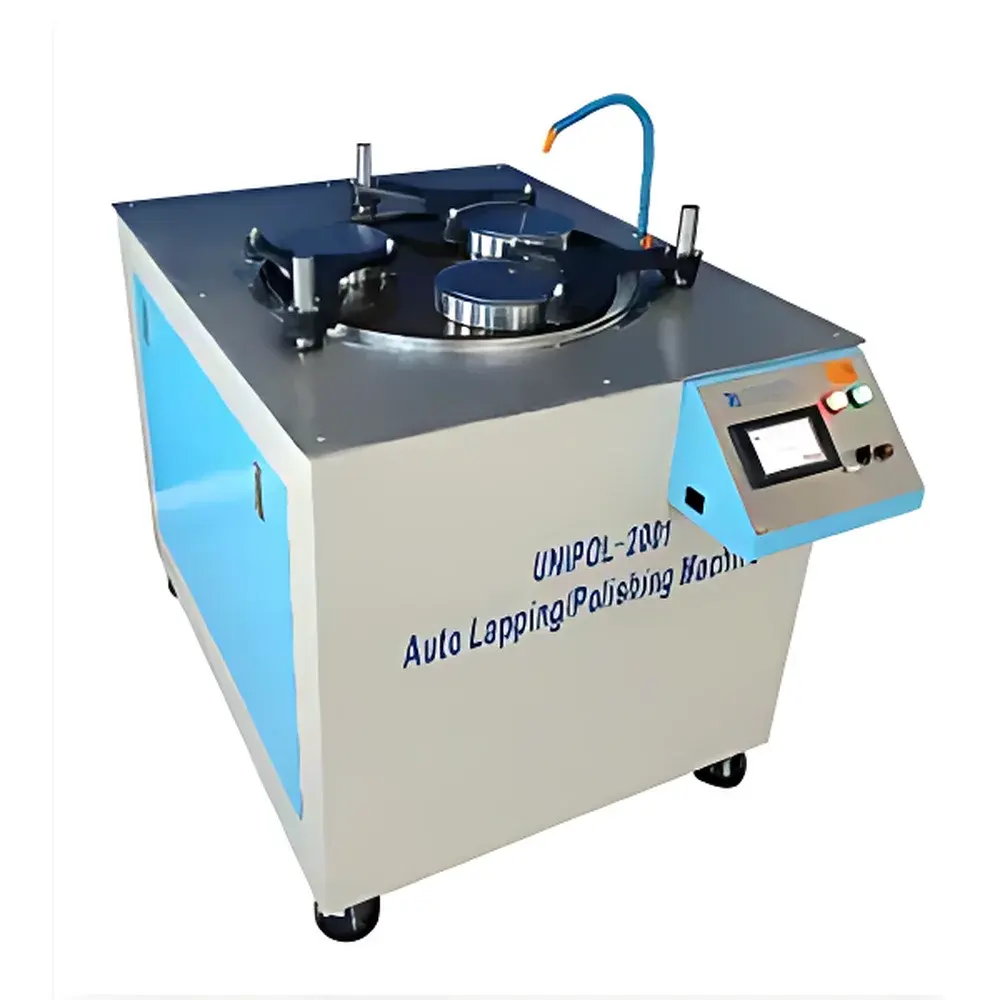
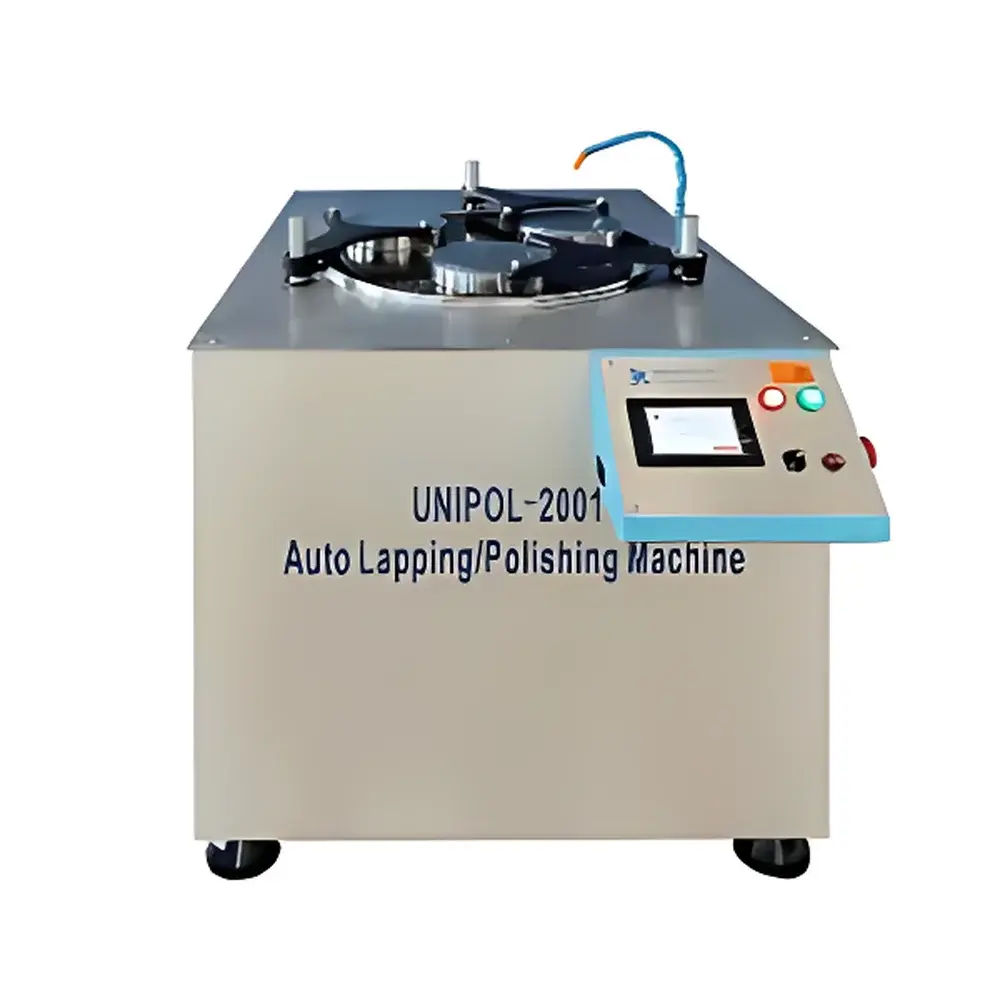
KJ GROUP UNIPOL-2001 Precision Lapping and Polishing Machine
| Brand | KJ GROUP |
|---|---|
| Origin | Liaoning, China |
| Manufacturer Type | Authorized Distributor |
| Country of Origin | China |
| Model | UNIPOL-2001 |
| Dimensions (L×W×D) | 820 × 1180 × 945 mm |
| Number of Grinding/Polishing Stations | 3 |
| Platen Diameter | φ508 mm (20 in) |
| Platen Speed | 10–90 rpm |
| Carrier Block Diameter | φ160 mm (6 in) |
| Carrier Block Thickness | 36 mm |
| Arm Oscillation Frequency | 5.5–13.5 cycles/min (15–30 adjustable steps) |
| Motor | 1.5 kW Variable-Frequency Drive (220 V) |
| Total Power Consumption | 1.7 kW (220 V) |
| Weight | 450 kg |
Overview
The KJ GROUP UNIPOL-2001 Precision Lapping and Polishing Machine is a floor-standing, multi-station lapping system engineered for high-precision planarization of rigid solid materials. It operates on the principle of controlled relative motion between a rotating platen and multiple carrier-mounted specimens, combined with synchronized orbital oscillation of the carrier arms. This dual-motion architecture—comprising both specimen self-rotation and eccentric planetary motion—ensures uniform material removal across the entire surface, minimizing edge rounding and preserving critical dimensional tolerances. Designed for reproducible sample preparation in metrology-critical workflows, the UNIPOL-2001 supports full-face lapping and polishing of wafers, optical substrates, geological thin sections, and advanced ceramics up to Ø160 mm or 160 mm diagonal (square/rectangular). Its robust cast-iron base, precision-machined spindle assembly, and coaxial platen-carrier alignment deliver long-term mechanical stability essential for sub-micron flatness consistency.
Key Features
- Three independently adjustable processing stations spaced at 120° intervals on a single φ508 mm platen, enabling parallel sample preparation without cross-contamination.
- High-accuracy carrier blocks (φ160 mm × 36 mm) manufactured from hardened stainless steel with certified flatness ≤1 µm and parallelism ≤2 µm—critical for maintaining edge integrity and surface planarity.
- Stepless platen speed control (10–90 rpm) via integrated variable-frequency drive, optimized for both coarse lapping (e.g., SiC slurry on cast iron) and fine polishing (e.g., colloidal silica on polyurethane pads).
- Programmable oscillation frequency (5.5–13.5 cycles/min, 15–30 discrete steps) to modulate shear distribution and prevent localized wear patterns during extended runs.
- Magnetic quick-mount interface for platens and polishing pads—compatible with optional φ508 mm cast iron, aluminum, glass, or polymer-based substrates—reducing setup time and improving repeatability.
- Optional automated dispensing modules (SKZD-2/SKZD-3) support precise, timed delivery of slurries or lubricants, enhancing process control in GLP/GMP-aligned laboratories.
- Integrated timer function enables unattended operation with preset cycle termination, supporting standardized SOPs for routine quality control testing.
Sample Compatibility & Compliance
The UNIPOL-2001 accommodates a broad spectrum of brittle and ductile materials requiring planar surface finishing prior to SEM, XRD, AFM, or optical inspection. Validated applications include single-crystal wafers (Si, Ge, ZnSe, ZnS), sapphire and fused silica optics, alumina and zirconia ceramics, metallographic cross-sections (Fe, Al, Ti alloys), geological thin sections (quartzite, basalt, shale), PCB laminates, and refractory composites. All mechanical components conform to ISO 2768-mK general tolerances; electrical subsystems meet IEC 61000-6-2/6-4 EMC standards. When operated with traceable calibration protocols and documented parameter logs, the system supports compliance with ASTM E3-22 (Standard Guide for Preparation of Metallographic Specimens), ISO 14836 (Geological Thin Section Preparation), and USP (Surface Characterization of Solid Dosage Forms).
Software & Data Management
While the UNIPOL-2001 operates as a hardware-controlled instrument without embedded firmware or touchscreen UI, it integrates seamlessly into regulated environments through external documentation practices. Process parameters—including platen speed, oscillation step, run duration, slurry type/concentration, and ambient temperature—are recorded manually or via external data loggers compliant with FDA 21 CFR Part 11 requirements when paired with validated electronic lab notebooks (ELNs). Optional GPC-series precision control units provide analog/digital I/O interfaces for integration with PLC-based manufacturing execution systems (MES), enabling batch-level traceability for semiconductor wafer fabrication or medical device component production.
Applications
- Preparation of optically flat infrared transmission windows (ZnSe, Ge) for FTIR spectroscopy and laser cavity alignment.
- Production of artifact-free metallographic mounts for quantitative grain size analysis per ASTM E112.
- Lapping of ceramic substrates used in high-frequency RF modules, where surface roughness Ra < 0.02 µm and total indicator reading (TIR) < 0.5 µm are required.
- Thickness reduction and surface planarization of geological thin sections for petrographic microscopy and electron microprobe analysis.
- Final-stage polishing of silicon carbide (SiC) power device wafers prior to epitaxial growth or die attach evaluation.
- Routine QC preparation of PCB core laminates for peel strength and solder mask adhesion testing per IPC-TM-650.
FAQ
What types of consumables are compatible with the UNIPOL-2001?
The system accepts magnetic-backed polishing pads (e.g., polyurethane, nylon, or felt), adhesive-backed abrasive papers (P80–P4000), and loose abrasive slurries (Al₂O₃, SiC, diamond, colloidal silica) delivered manually or via optional SKZD-series dispensers.
Can the UNIPOL-2001 be used for final polishing without intermediate grinding steps?
Yes—when configured with appropriate soft polishing pads and sub-micron abrasives, the machine achieves surface finishes suitable for optical inspection; however, optimal results require sequential processing from coarse to fine grits per ASTM E3-22 guidelines.
Is the platen removable for cleaning or replacement?
Yes—the φ508 mm platen mounts via a keyed, center-locking flange and can be exchanged in under five minutes without tools, facilitating rapid transition between lapping and polishing modes.
Does the machine support vacuum chucks or custom fixtures?
Standard configuration uses mechanical clamping via precision carrier blocks; vacuum-compatible fixtures are available upon request but require validation against maximum permissible pressure differentials for safe operation.
What maintenance schedule is recommended for long-term reliability?
Daily inspection of platen runout (≤0.02 mm TIR), biweekly lubrication of oscillation arm pivots, and quarterly verification of motor torque response and encoder feedback accuracy ensure >10,000 hours of operational service life.
Related Products



