
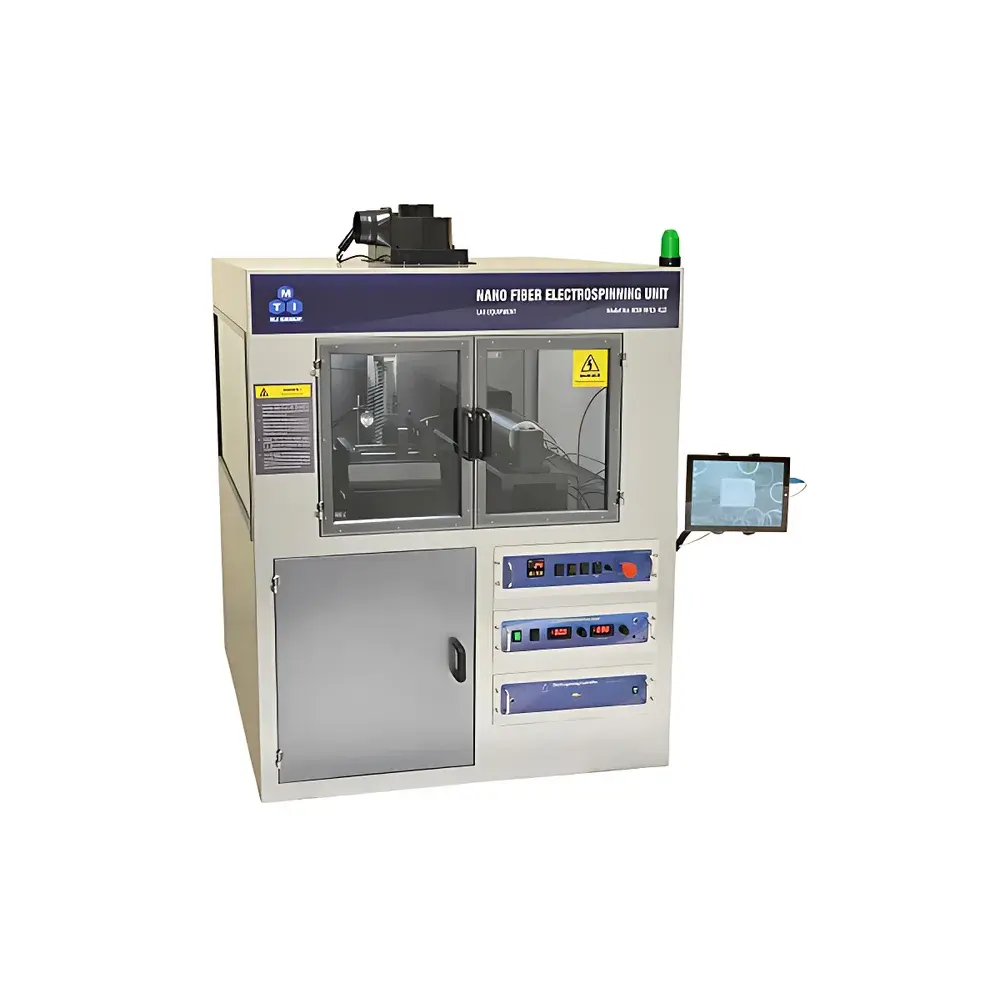
KJ GROUP MSK-NFES-4 Electrospinning Nanofiber Fabrication System
| Brand | KJ GROUP |
|---|---|
| Origin | China |
| Manufacturer Type | Authorized Distributor |
| Equipment Category | Imported Lab Equipment |
| Model | MSK-NFES-4 |
| Power Input | AC 208–240 V, 50 Hz |
| High-Voltage Output | 0–30 kV, max. 0.5 mA |
| Temperature Control Range | Ambient to 60 °C |
| Rotational Speed Range (Drum Collector) | 300–4000 rpm, stability ±1% |
| Collector Options | 6-diameter drum (Ø2–100 mm), fixed stainless steel plate (320 × 100 × 2 mm), programmable XY-stage (300 × 200 × 5 mm) |
| Syringe Capacity | 2.5–60 mL (glass only) |
| Enclosure Dimensions | 1200 × 800 × 1900 mm (W × D × H) |
| Total Weight | 590 kg |
Overview
The KJ GROUP MSK-NFES-4 Electrospinning Nanofiber Fabrication System is a fully integrated, CE-certified laboratory platform engineered for reproducible production of polymeric and composite nanofibers via electrohydrodynamic processing. It operates on the principle of electrospinning—where high-voltage electric fields induce jetting of polymer solutions or melts from a conductive nozzle toward a grounded or biased collector—enabling fiber diameters ranging from 20 nm to 1000 nm. Complementing electrospinning, the system supports electrospraying mode for uniform thin-film deposition using low-viscosity precursors under elevated voltage conditions. Designed for controlled ambient environments (25 °C ±15 °C, 55% RH ±10%, altitude <1000 m), the MSK-NFES-4 integrates high-voltage generation, precision fluid delivery, thermally regulated collection, and real-time visual monitoring within a single electromechanically synchronized architecture. Its modular configuration accommodates research-scale development of scaffolds for tissue engineering, filtration membranes, battery separators, drug delivery carriers, and functional coatings—making it suitable for academic labs, R&D centers, and pre-GMP process development.
Key Features
- CE-compliant high-voltage power supply delivering 0–30 kV DC with adjustable current limiting up to 0.5 mA; dual-mode operation (constant voltage or constant current) with built-in arc suppression and over-current protection.
- Integrated fume hood enclosure constructed from stainless steel frame, anodized aluminum panels, and tempered safety glass; features epoxy-coated interior for electrical insulation and integrated static discharge rods to mitigate residual charge accumulation.
- Multi-channel syringe pump system with four independently controllable axes; compatible with borosilicate glass syringes (2.5–60 mL); motorized injection control ensures flow stability and repeatability across extended runs.
- Tri-modal collector system: (1) Six interchangeable drum mandrels (Ø2, Ø6, Ø12, Ø25, Ø75, Ø100 mm × 200 mm) driven by brushless DC motors with Hall-effect speed sensing (300–4000 rpm, ±1% stability); (2) Fixed stainless steel plate (320 × 100 × 2 mm) with grounding terminal; (3) Programmable XY-stage (300 × 200 × 5 mm) enabling patterned deposition through trajectory-defined motion paths.
- Environmental regulation module inside the hood includes halogen illumination, top-mounted exhaust fan (compatible with external ducting), and radiant heating element calibrated to maintain internal temperature up to 60 °C.
- Dedicated control software pre-installed on industrial-grade Microsoft Surface Pro tablet; provides unified interface for parameter synchronization across pumps, collectors, HV source, and environmental subsystems.
Sample Compatibility & Compliance
The MSK-NFES-4 supports a broad range of solvent-based polymer systems—including PVP, PCL, PLA, PAN, chitosan, and gelatin—as well as nanoparticle-loaded suspensions and precursor solutions for metal oxide nanofibers. All wetted components (syringe holders, nozzles, collector surfaces) are chemically inert and compatible with common organic solvents (e.g., DMF, chloroform, THF, ethanol/water mixtures). The system meets CE marking requirements per Directive 2014/30/EU (EMC) and 2014/35/EU (LVD), and its enclosure design complies with EN 61000-6-3 (emission) and EN 61000-6-2 (immunity). While not certified to ISO 13485 or FDA 21 CFR Part 11 out-of-the-box, the software architecture supports audit trail logging and user-access controls required for GLP/GMP-aligned documentation workflows when configured with appropriate IT infrastructure.
Software & Data Management
The proprietary control software provides a unified graphical interface for defining, executing, and archiving electrospinning/electrospray protocols. Users configure parameters including voltage setpoint, pump flow rate (µL/min), drum rotation speed (rpm), XY-stage velocity (mm/s), dwell time, heating setpoint (°C), and total process duration. Each run is automatically timestamped and saved with metadata (operator ID, date/time, hardware configuration snapshot). Protocols may be recalled, edited, and re-executed without manual recalibration. Export options include CSV-formatted process logs and image capture (via optional integrated camera module) for post-run morphology correlation. Software updates are delivered via secure USB media; no cloud connectivity or remote access functionality is included—ensuring full data sovereignty and network isolation in regulated environments.
Applications
- Tissue engineering scaffold fabrication requiring aligned or random nanofibrous architectures with tunable porosity and mechanical compliance.
- Development of high-efficiency air and liquid filtration media leveraging sub-100 nm fiber diameter and high surface-area-to-volume ratios.
- Electrode coating for lithium-ion and solid-state batteries using PVDF-HFP, PAN, or cellulose-derived nanofiber binders.
- Controlled-release pharmaceutical films incorporating therapeutics into biodegradable nanofiber matrices.
- Functional surface modification via electrosprayed catalyst layers, antimicrobial coatings, or hydrophobic/hydrophilic patterning.
- Fundamental studies of jet instability, fiber solidification kinetics, and solvent evaporation dynamics under variable temperature and humidity conditions.
FAQ
What types of polymers and solvents are compatible with the MSK-NFES-4?
The system accommodates standard electrospinnable polymers dissolved in volatile organic solvents (e.g., DMF, chloroform, acetone, ethanol/water mixtures) and aqueous systems with appropriate conductivity modifiers. Avoid highly corrosive or halogenated solvents that degrade glass syringes or elastomeric seals.
Is the high-voltage output isolated and safe for operator use?
Yes—the entire high-voltage circuit is galvanically isolated and housed within a grounded, interlocked enclosure. A red LED warning indicator activates whenever HV is enabled, and automatic shutdown occurs upon door opening or over-current detection.
Can the system operate unattended for long-duration runs?
It supports automated multi-hour operation provided environmental conditions remain stable and syringe volume is sufficient. However, periodic visual inspection is recommended due to potential nozzle clogging or solution viscosity drift.
Does the software support integration with LIMS or third-party data acquisition systems?
Native API or OPC-UA integration is not available; however, exported CSV logs can be imported into external analytics platforms (e.g., MATLAB, Python pandas, LabVIEW) for batch analysis and statistical process control.
What maintenance is required for sustained performance?
Routine tasks include cleaning of nozzles and collector surfaces after each run, verification of syringe seal integrity, calibration of HV meter against traceable standards annually, and inspection of exhaust ducting for particulate buildup.



