
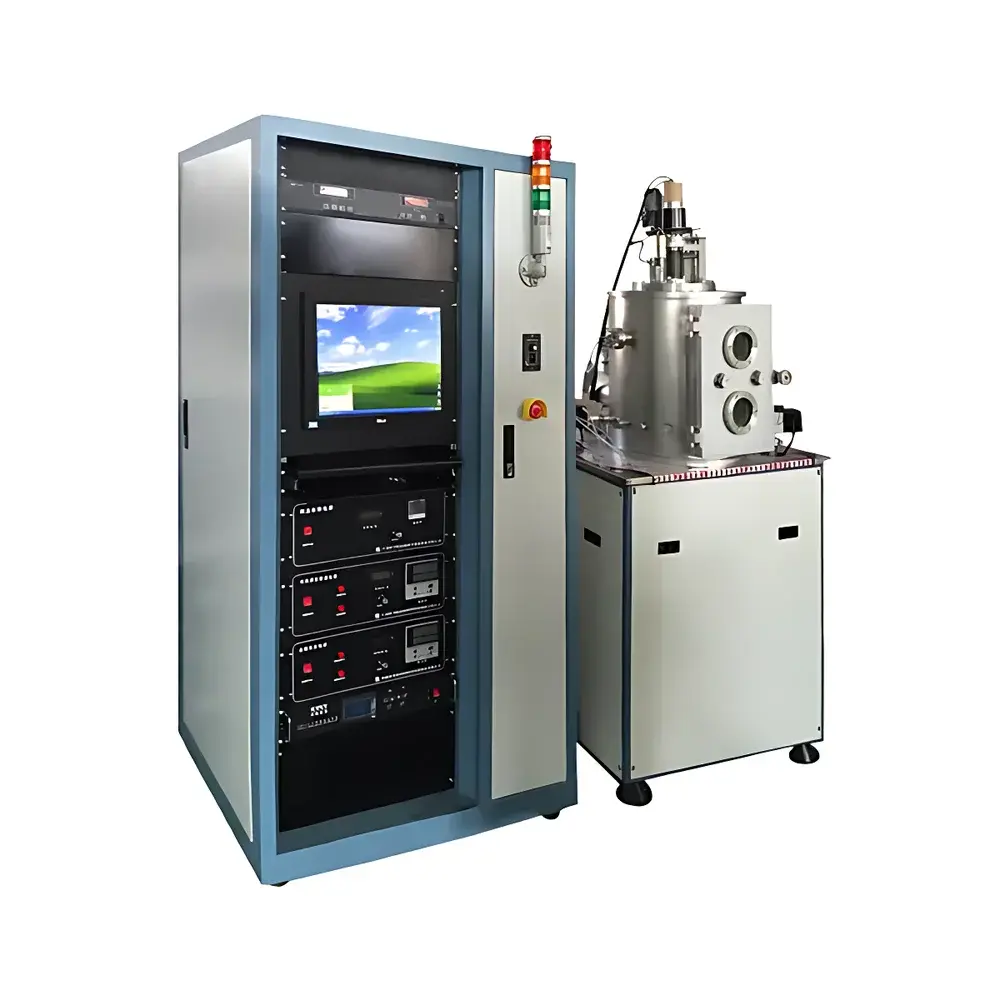
KJ GROUP KJ-Perovskite Thermal Evaporation Coater
| Brand | KJ GROUP |
|---|---|
| Origin | Liaoning, China |
| Manufacturer Type | Authorized Distributor |
| Country of Origin | China |
| Model | KJ-Perovskite Thermal Evaporation Coater |
| Pricing | Available Upon Request |
| Chamber Material | Stainless Steel (304) |
| Chamber Dimensions | 600 mm × 450 mm × 450 mm (W×D×H) |
| Vacuum System | Turbo-molecular Pump + Rotary Vane Mechanical Pump |
| Base Pressure | ≤6×10⁻⁴ Pa |
| System Leak Rate | ≤1×10⁻⁷ Pa·L/s |
| Organic Sources | 4 × 5 mL crucibles, dual 0.5 kW temperature-controlled evaporation power supplies (max 400 °C, thermocouple feedback) |
| Inorganic Sources | 4 × 5 mL water-cooled crucibles, dual 3.2 kW high-current power supplies (max 300 A) |
| Source Shutter | Electromagnetic actuation, synchronized with deposition timing |
| Substrate Holder | Top-mounted, accommodates Ø120 mm wafers or microscope slides, rotation speed 0–30 rpm |
| Substrate Heating | Resistive heating with PID control, RT to 180 °C (±1 °C stability) |
| Thickness Monitoring | Quartz Crystal Microbalance (QCM), resolution 0.1 Å, range 0–999999 Å |
| Safety Interlocks | Coolant flow monitoring, overtemperature cutoff, emergency power disconnect, misoperation prevention logic |
Overview
The KJ GROUP KJ-Perovskite Thermal Evaporation Coater is a purpose-engineered vacuum deposition system designed for the reproducible, multi-source co-evaporation of complex thin-film stacks—particularly perovskite absorber layers, charge transport materials (e.g., spiro-OMeTAD, NiOx, PCBM), and electrode interlayers (e.g., MoOx, LiF, Ag)—under controlled thermal evaporation conditions. Based on resistive thermal evaporation (RTE) principles, it enables precise stoichiometric control via independent, real-time monitored source temperature regulation and synchronized shutter actuation. Its inverted geometry—substrate mounted on the top lid, sources positioned on the bottom plate—minimizes particulate contamination, reduces shadowing effects, and ensures uniform angular flux distribution across large-area substrates. This architecture is especially critical for lab-scale optimization of n-i-p and p-i-n perovskite solar cell architectures, where sequential or simultaneous deposition of organic/inorganic precursors must be executed without cross-contamination or thermal degradation.
Key Features
- Inverted deposition configuration: Substrate holder mounted on chamber ceiling; evaporation sources located at base—enabling upward vapor flux, reduced droplet ejection, and improved film homogeneity over Ø120 mm substrates.
- Dual-source capability: Four independently controlled organic sources (5 mL capacity, 0.5 kW max power, 400 °C limit) and four water-cooled inorganic sources (5 mL, 3.2 kW, 300 A max current) allow co-deposition of hybrid compositions such as CH3NH3PbI3, FA0.83MA0.17Pb(I0.83Br0.17)3, or mixed-halide perovskites with graded interfaces.
- Integrated substrate heating: PID-regulated resistive heater delivers stable temperatures from ambient to 180 °C with ±1 °C accuracy—essential for in-situ annealing during deposition and crystallization control of thermally sensitive perovskite phases.
- High-precision quartz crystal microbalance (QCM): Real-time thickness monitoring with 0.1 Å resolution and full-scale range up to 999,999 Å supports sub-monolayer process calibration and growth rate validation per source.
- Electromagnetic shutter system: Fast-response, programmable shutters for each source enable precise layer sequencing, interface engineering, and gradient composition synthesis without breaking vacuum.
- Comprehensive safety architecture: Interlocked coolant flow sensors, redundant overtemperature cutoffs, emergency power disconnection, and logic-based misoperation prevention ensure compliance with ISO 13857 and IEC 61000-6-2 for laboratory equipment operation.
Sample Compatibility & Compliance
The system accommodates standard substrates including glass/ITO/FTO, silicon wafers, flexible PET/PEN foils, and quartz slides up to Ø120 mm. Rotation (0–30 rpm) ensures radial uniformity for both small-area test cells and mini-module prototypes. All wetted components—including chamber body, flanges, and source crucibles—are constructed from electropolished AISI 304 stainless steel, meeting ASTM F86 surface finish requirements for ultra-high vacuum compatibility. The vacuum architecture complies with ISO 27492 (vacuum system performance) and EN 61000-6-4 (EMC emissions). For regulated R&D environments, the integrated QCM and temperature logging support GLP-compliant data traceability when paired with external timestamped acquisition software.
Software & Data Management
While the coater operates via dedicated front-panel controls with analog metering and manual setpoint entry, all critical process parameters—including source temperatures, chamber pressure, substrate temperature, rotation speed, and QCM thickness/rate—are accessible via RS-485 Modbus RTU interface. Integration with LabVIEW, Python (PySerial), or MATLAB enables automated recipe execution, deposition log export (CSV/TXT), and synchronization with external characterization tools (e.g., in-situ UV-Vis or PL systems). Audit trails—including operator ID, start/stop timestamps, and parameter deviations—can be generated to satisfy internal QA protocols aligned with FDA 21 CFR Part 11 principles when deployed in preclinical photovoltaic material development workflows.
Applications
- Research-scale fabrication of single-junction and tandem perovskite solar cells (PSCs), including mixed-cation/mixed-halide absorbers and low-dimensional perovskites (e.g., Ruddlesden-Popper phases).
- Deposition of hole/electron transport layers (HTLs/ETLs) such as NiOx, MoOx, C60, BCP, and LiF under oxygen- and moisture-free conditions.
- Co-evaporation studies of precursor stoichiometry, crystallization kinetics, and interfacial dipole formation in vacuum-annealed perovskite films.
- Development of encapsulation barrier layers (e.g., Al2O3, MgF2) for accelerated lifetime testing protocols (ISOS-L-1/L-2).
- Process transfer support for pilot-line scale-up, enabling direct correlation between lab-scale evaporation parameters and roll-to-roll thermal evaporation feasibility assessments.
FAQ
What vacuum level is required for high-quality perovskite film deposition?
Base pressure ≤6×10⁻⁴ Pa minimizes residual H2O and O2 partial pressures—critical for suppressing PbI2 decomposition and halide oxidation during organic precursor evaporation.
Can the system deposit both organic and inorganic precursors simultaneously?
Yes—the independent thermal control and electromagnetic shuttering of four organic and four inorganic sources enable true multi-component co-evaporation with millisecond-level timing resolution.
Is substrate rotation necessary for uniform film growth?
Rotation (0–30 rpm) is recommended for substrates >Ø50 mm to mitigate cosine-law flux nonuniformity; static deposition is viable for small-area device optimization.
How is film thickness calibrated and verified?
Quartz crystal microbalance (QCM) provides real-time thickness feedback; calibration against ex-situ XRR or spectroscopic ellipsometry is advised for absolute stoichiometric accuracy.
Does the system support remote monitoring or automation?
RS-485 Modbus RTU connectivity allows integration into centralized lab automation platforms for unattended overnight runs and protocol-driven deposition sequences.



