
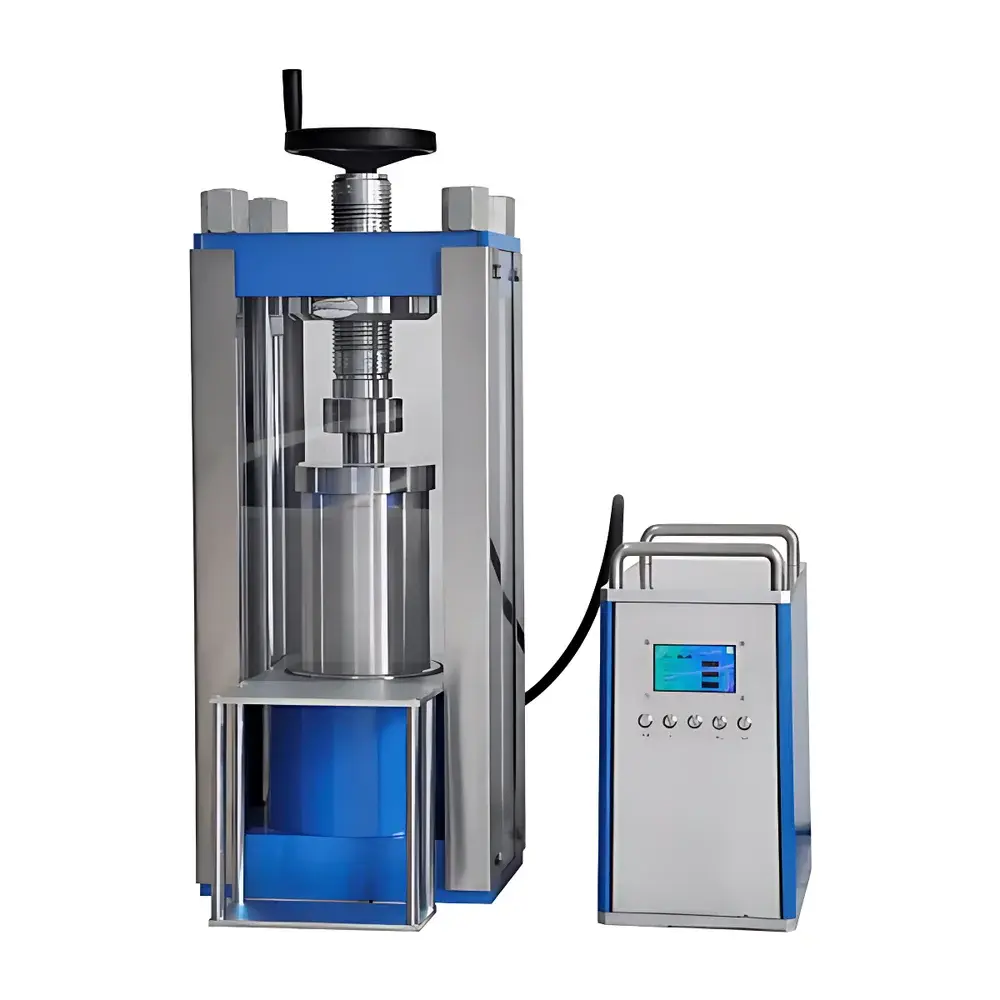
KJ GROUP CIP-80MAF Electric Cold Isostatic Press
| Brand | KJ GROUP |
|---|---|
| Origin | Liaoning, China |
| Manufacturer Type | Authorized Distributor |
| Country of Origin | China |
| Model | CIP-80MAF |
| Power Supply | 220 V, 50/60 Hz |
| Maximum Applied Force | 150 Ton (1.47 MN) |
| Effective Isostatic Pressure Range | 0–300 MPa (optional 400–500 MPa upon request) |
| Isostatic Chamber Dimensions | Ø80 mm × 150 mm (ID × height) |
| Hydraulic Cylinder Bore Diameter | Ø250 mm (chromium-plated) |
| Piston Stroke | 50 mm |
| Pressure Control Mode | Programmable ramp-hold-relief sequence |
| Hold Time Range | 0–999 seconds or minutes (user-selectable) |
| Pressure Calculation | Automatic conversion from applied force to sample-specific pressure based on mold cavity diameter input |
| Display | 4.3-inch TFT LCD touchscreen interface |
| Safety Enclosure | Reinforced steel frame with transparent polycarbonate viewing door |
| Overall Dimensions (W×D×H) | 860 × 600 × 1100 mm |
| Net Weight | 680 kg |
Overview
The KJ GROUP CIP-80MAF Electric Cold Isostatic Press is a precision-engineered laboratory-scale system designed for uniaxial-to-isostatic pressure transfer in powder densification processes. Unlike conventional mechanical presses, it employs a fully enclosed, liquid-filled pressure chamber (typically using deionized water or low-viscosity hydraulic oil as the pressure-transmitting medium) to apply uniform hydrostatic stress—equal in all directions—to encapsulated green bodies. This isotropic compaction mechanism minimizes internal stress gradients and density variations, resulting in near-net-shape components with high dimensional fidelity and enhanced green strength. The system operates at ambient temperature (cold isostatic pressing), making it suitable for thermally sensitive powders, polymer-bonded composites, and pre-sintered ceramics where thermal degradation must be avoided. Its compact footprint and programmable control architecture align with ISO/IEC 17025-compliant materials research environments, particularly in academic labs and R&D centers requiring reproducible, traceable densification protocols.
Key Features
- Electrically driven hydraulic power unit with closed-loop pressure feedback, eliminating external pump stations and reducing noise and maintenance requirements.
- Programmable pressure profile control: user-defined ramp rate (MPa/s), dwell time (0–999 min), and controlled depressurization sequence to prevent sample cracking or delamination.
- Real-time pressure calculation algorithm automatically converts actuator force (kN) into localized isostatic pressure (MPa) based on operator-input mold inner diameter—ensuring accurate, geometry-aware process documentation.
- 4.3-inch industrial-grade TFT LCD touchscreen interface with intuitive menu navigation, data logging timestamping, and password-protected parameter editing.
- Integrated safety enclosure featuring 6-mm polycarbonate viewport and interlocked steel housing compliant with EN ISO 13857 (safety distances) and EN 60204-1 (electrical safety).
- Chromium-plated hydraulic cylinder (Ø250 mm bore) and hardened piston rod ensure long-term dimensional stability and resistance to fluid-induced corrosion under repeated 300 MPa cycling.
Sample Compatibility & Compliance
The CIP-80MAF accommodates cylindrical molds up to Ø80 mm × 150 mm, supporting standard green body configurations used in ceramic, hardmetal, and composite research—including silicone rubber, polyurethane, and seamless metal sleeves. It is routinely employed in ASTM B999 (standard guide for cold isostatic pressing of powder metallurgy parts), ISO 3252 (metallic powders — determination of green strength after compaction), and GB/T 5163 (Chinese standard for sintered bronze and iron porous materials). All operational parameters—including pressure setpoints, hold durations, and cycle timestamps—are stored internally with non-volatile memory retention, satisfying GLP audit requirements for traceability. While not FDA 21 CFR Part 11-certified out-of-the-box, the system’s deterministic control logic and immutable log structure support validation pathways for regulated GMP environments when integrated with qualified LIMS or ELN platforms.
Software & Data Management
The embedded controller firmware supports USB export of compressed CSV files containing full cycle logs: timestamp, target/actual pressure (MPa), elapsed time (s), and status flags (ramp/hold/relief). No proprietary software installation is required; exported datasets are directly compatible with MATLAB, Python (pandas), and JMP for statistical process analysis. Optional RS-485 Modbus RTU interface enables integration into centralized SCADA systems for multi-unit fleet monitoring. Audit trails include operator ID (via numeric login), parameter modification history, and emergency stop event tagging—all retained for ≥12 months without external storage.
Applications
- Densification of advanced ceramics (Al₂O₃, ZrO₂, Si₃N₄) prior to sintering to achieve >55% theoretical density with minimized anisotropy.
- Consolidation of tungsten carbide-cobalt (WC-Co) and Ti-6Al-4V powders for additive manufacturing feedstock qualification.
- Pre-forming of fiber-reinforced polymer matrix composites (PMCs) to eliminate voids and optimize resin distribution.
- Green body fabrication for solid oxide fuel cell (SOFC) electrolytes and electrodes requiring sub-5 µm pore size control.
- Research-scale production of nuclear-grade uranium dioxide (UO₂) pellets under non-oxidizing fluid media (e.g., isopropyl alcohol).
FAQ
What pressure-transmitting fluids are compatible with the CIP-80MAF chamber?
Deionized water, glycerol-water mixtures, and low-viscosity hydraulic oils (ISO VG 10–22) are validated. Fluid selection must consider vapor pressure, compressibility, and chemical compatibility with elastomeric mold sleeves.
Can the system be calibrated to national metrology standards?
Yes—pressure transducers are traceable to NIM (China National Institute of Metrology) via factory calibration certificates (optionally upgraded to ISO/IEC 17025-accredited third-party calibration).
Is remote operation or network connectivity supported?
Standard configuration includes only local HMI control; Ethernet or Wi-Fi modules are available as OEM add-ons subject to site-specific cybersecurity assessment.
What is the typical maintenance interval for the hydraulic system?
Under normal lab use (≤5 cycles/day), fluid replacement and filter inspection are recommended every 12 months or 500 operating hours—whichever occurs first.
Does the CIP-80MAF meet CE marking requirements?
The base unit complies with EU Machinery Directive 2006/42/EC and EMC Directive 2014/30/EU; CE documentation package (including risk assessment and EC Declaration of Conformity) is provided upon order confirmation.
Related Products



