
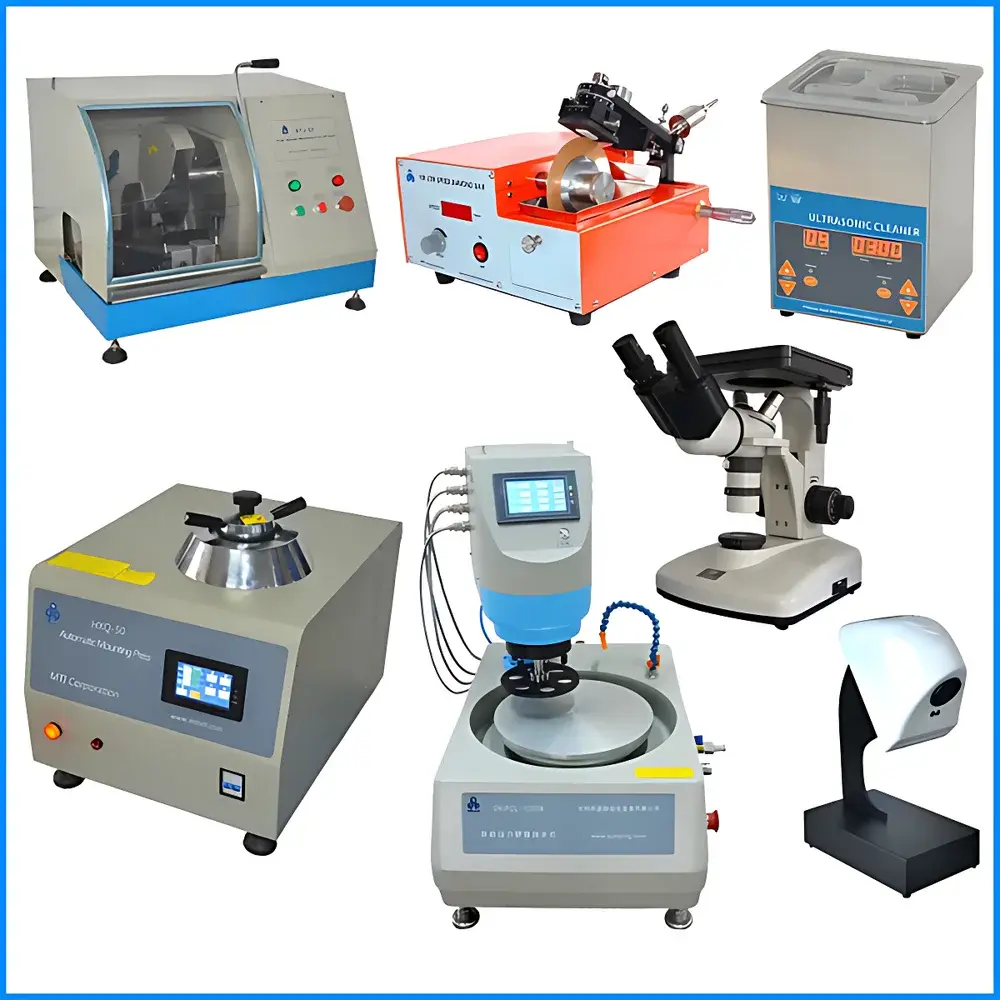
KJ GROUP GoldMet Pro Series Metallographic Sample Preparation System
| Brand | KJ GROUP |
|---|---|
| Origin | Liaoning, China |
| Manufacturer Type | Authorized Distributor |
| Country of Origin | China |
| Model | GoldMet Pro Series |
| Pricing | Contact for Quote |
Overview
The KJ GROUP GoldMet Pro Series Metallographic Sample Preparation System is an integrated, workflow-optimized solution engineered for laboratories requiring consistent, reproducible metallographic specimen preparation under routine QC, R&D, and failure analysis conditions. Designed around the ASTM E3–22 and ISO 14577 standards for metallographic specimen preparation, this system implements a six-stage sequential process—cutting, hot mounting, grinding & polishing, ultrasonic cleaning, air drying, and optical microstructural analysis—to ensure geometric integrity, minimal deformation, and artifact-free surface finish. Each subsystem operates on validated mechanical principles: abrasive cutting via controlled wheel speed and feed rate; thermoplastic resin embedding under programmable temperature/pressure/time profiles; multi-point pneumatic pressure application during planar material removal; cavitation-based particle dislodgement in aqueous cleaning baths; and high-resolution brightfield/darkfield imaging with calibrated magnification (up to 1000×). The system architecture supports GLP-compliant documentation when paired with external lab information management systems (LIMS), and all embedded controllers meet IEC 61000-6-2/6-4 electromagnetic compatibility requirements.
Key Features
- Modular workflow integration: Six functionally dedicated instruments coordinated for seamless transition from bulk sample to analyzable microstructure.
- Dual-cutting capability: SYJ-50 high-speed precision cutter (max. 50 mm cutting depth, 2800 rpm) for rapid sectioning; SYJ-150 low-speed diamond saw (0–500 rpm, variable torque control) for stress-free slicing of brittle or heat-sensitive alloys.
- Automated hot mounting: HXQ-50 thermosetting press with PID-controlled heating (20–200 °C range), digital pressure regulation (0–20 MPa), and programmable dwell time (1–99 min) ensures uniform resin flow and void-free encapsulation.
- Simultaneous multi-sample processing: UNIPOL-1200M automatic grinder-polisher accommodates up to six specimens per cycle using independent pneumatic load control (0.5–50 N per station) and real-time rotational speed monitoring (50–600 rpm).
- Non-contact surface preservation: VGT-1620QTD ultrasonic cleaner features 40 kHz frequency, digital timer (1–99 min), and degassing mode to remove embedded abrasives without mechanical abrasion.
- Optical validation platform: 4XB upright metallurgical microscope with infinity-corrected optics, strain-free objectives (5×, 10×, 20×, 50×, 100× oil), and coaxial LED illumination enables ASTM E112 grain size analysis and phase identification per ISO 643.
Sample Compatibility & Compliance
The GoldMet Pro Series accommodates ferrous and non-ferrous metals, sintered powders, ceramics, composites, and coated substrates ranging from 1 mm to 50 mm in maximum dimension. All instruments comply with CE marking directives (2014/30/EU EMC, 2014/35/EU LVD), and embedded firmware supports audit-ready operation logs (time-stamped start/stop, parameter sets, operator ID input). The system meets essential requirements for ISO/IEC 17025-accredited labs when used in conjunction with documented SOPs and periodic verification per ASTM E749 and ISO 13528. Mounting resins and polishing consumables are selected to conform with RoHS 2015/863/EU restrictions.
Software & Data Management
While individual units operate via intuitive tactile interfaces, the system supports external data capture through RS-232/USB outputs on SYJ-150, HXQ-50, and UNIPOL-1200M controllers. Parameter histories—including cutting speed, mounting temperature ramp rates, polishing force profiles, and ultrasonic bath duration—are exportable as CSV files for traceability. Optional integration with third-party LIMS or ELN platforms enables automated metadata tagging (sample ID, lot number, analyst, date/time) aligned with FDA 21 CFR Part 11 electronic record requirements when paired with user authentication modules.
Applications
- Quality control of castings, forgings, and additive-manufactured metallic components.
- Failure analysis of fracture surfaces, corrosion products, and intergranular degradation.
- Heat treatment verification (e.g., case depth measurement, martensite quantification).
- Research into grain boundary engineering, precipitate morphology, and phase transformation kinetics.
- Accredited testing per ASTM E3, E407, E1245, and ISO 643, 6506, 14577.
FAQ
What is the typical throughput for a full metallographic preparation cycle?
A trained operator can prepare six specimens—from cutting to microscopic evaluation—in approximately 4–6 hours, depending on material hardness and required polish finish.
Can the system be upgraded with digital imaging or hardness testing modules?
Yes. The 4XB microscope accepts C-mount cameras compatible with KJ GROUP’s MetImage Pro software; hardness testers (e.g., TH-150) may be integrated via shared sample stage positioning protocols.
Is technical support available outside mainland China?
KJ GROUP provides remote diagnostics and English-language documentation; regional service partners are available in North America, EU, and Southeast Asia under extended warranty agreements.
Are consumables such as diamond wheels, mounting resins, and polishing cloths included?
No—consumables are ordered separately based on material class and desired finish grade; compatibility matrices are provided in the Operator Manual v3.2.
Does the UNIPOL-1200M support electrolytic polishing or electrochemical etching?
No—the UNIPOL-1200M is a mechanical grinding/polishing unit only; electrochemical modules require separate instrumentation (e.g., Struers LectroPol series).
Related Products



