
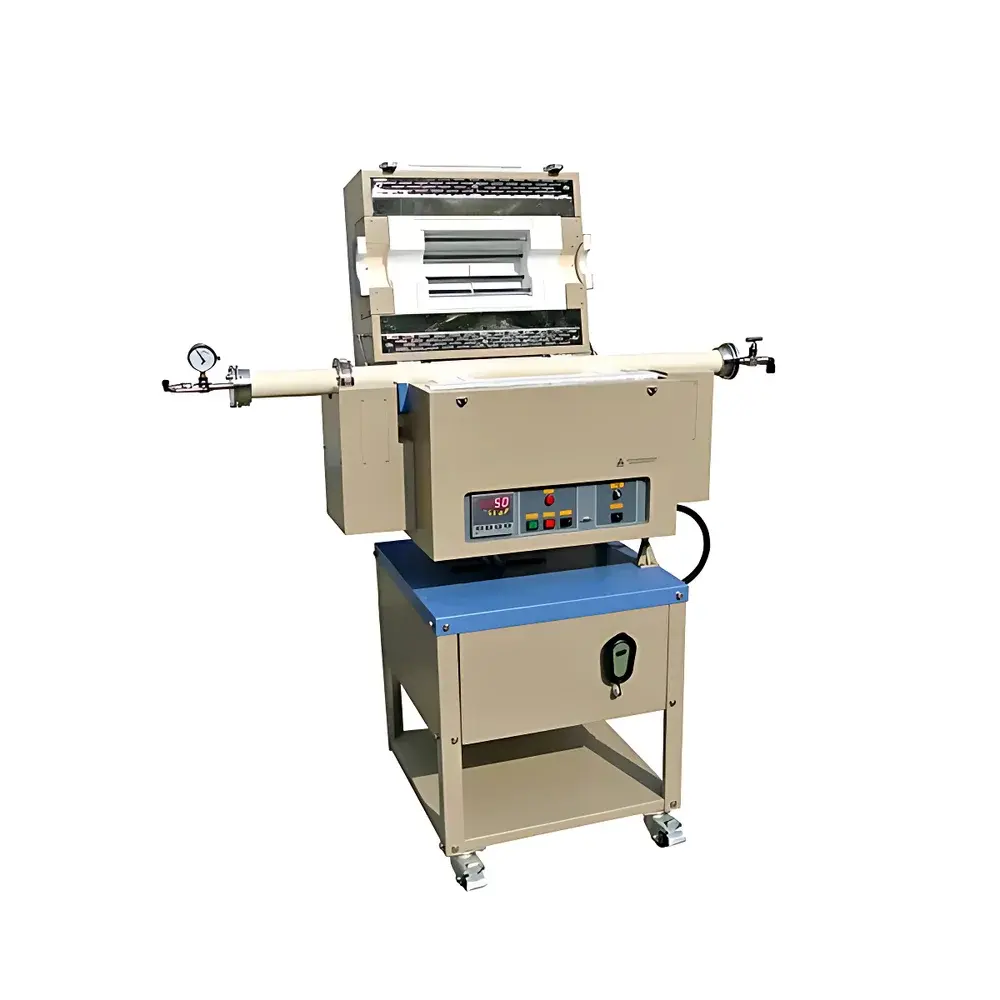
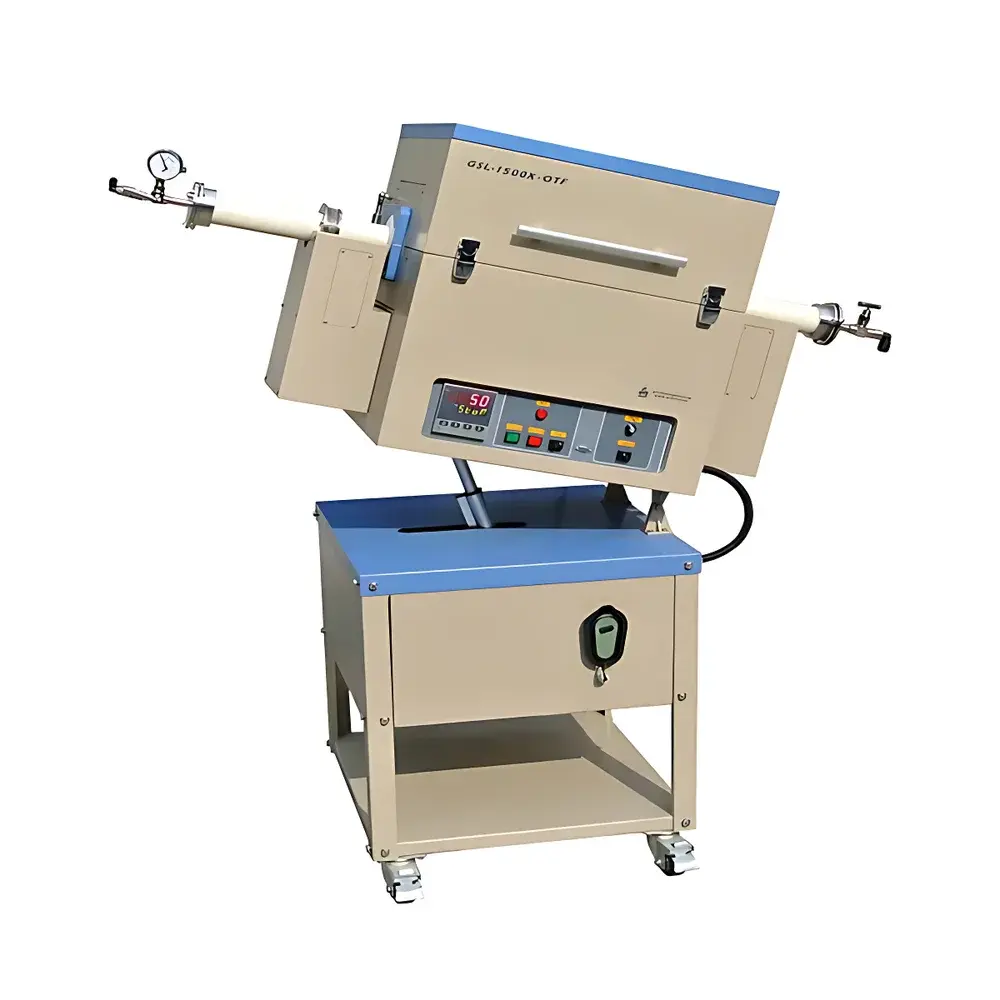
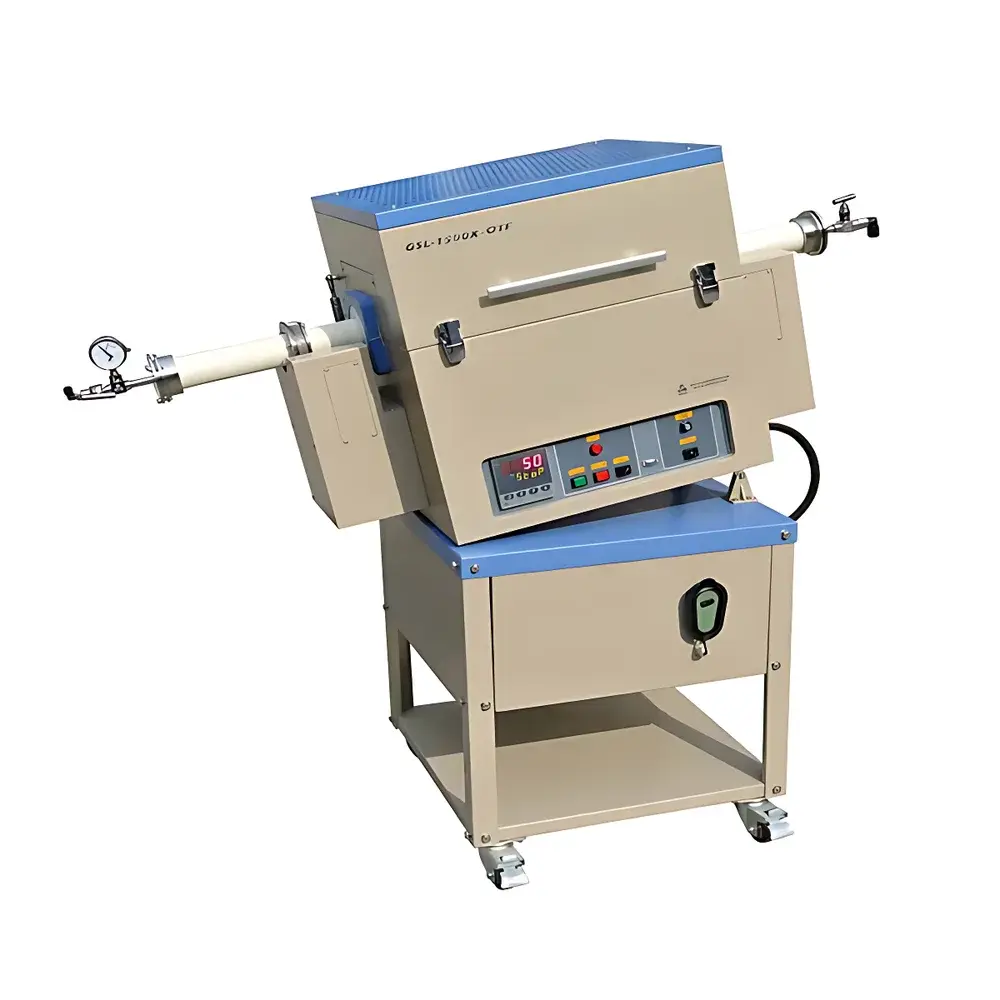
KJ GROUP GSL-1500X-OTF-R60 Single-Zone Tilting Rotating Tube Furnace
| Brand | KJ GROUP |
|---|---|
| Origin | Liaoning, China |
| Manufacturer Type | Authorized Distributor |
| Country of Origin | China |
| Model | GSL-1500X-OTF-R60 |
| Power Supply | AC 220 V, 50/60 Hz, 2.5 kW |
| Max Temperature | 1500 °C (≤2 h), Continuous at 1400 °C |
| Heating Zone Length | 300 mm |
| Uniform Temperature Zone | 150 mm |
| Tube Dimensions | OD 60 mm, ID 54 mm, L 1200 mm |
| Rotation Speed | 0–7 rpm |
| Tilt Angle Range | 0–30° |
| Heating Element | Silicon Carbide Rods |
| Insulation | High-Purity Alumina Fiber |
| Interior Coating | 1750 °C Rated Alumina Reflective Coating |
| Max Vacuum | 4.5 × 10⁻² Torr |
| Leak Rate | <0.1 mTorr/s |
| Control Accuracy | ±1 °C |
| Cooling | Dual-shell with three axial fans |
| External Dimensions | 1300 × 600 × 1200 mm |
| Net Weight | 100 kg |
| Compliance | IEC 61000-6-3, IEC 61000-6-4, EN 61000-3-2 |
Overview
The KJ GROUP GSL-1500X-OTF-R60 is a precision-engineered single-zone tilting rotating tube furnace designed for controlled thermal processing of inorganic powders, precursors, and composite mixtures under vacuum or reactive/inert atmospheres. Its operational architecture integrates rotational symmetry and programmable tilt to ensure homogeneous heat transfer and uniform particle mixing—critical for solid-state synthesis, precursor decomposition, and oxide sintering where batch consistency directly impacts phase purity and crystallinity. The furnace employs silicon carbide (SiC) heating elements embedded within high-purity alumina fiber insulation, enabling stable operation up to 1500 °C for short-duration cycles and sustained 1400 °C processing. The internal chamber features a 1750 °C-rated alumina reflective coating, enhancing radiant efficiency and minimizing contamination from volatilized species. All electrical and thermal subsystems conform to CE safety directives (EN 61000-3-2, EN 61000-6-3/6-4), supporting integration into ISO 9001-certified R&D and pilot-scale manufacturing environments.
Key Features
- Dual-layer stainless steel housing with three integrated axial cooling fans, maintaining external shell temperature below 60 °C during continuous operation at 1400 °C.
- Optimized thermal geometry: 300 mm active heating zone with ±1 °C temperature uniformity over a 150 mm isothermal region—validated per ASTM E220 calibration practice.
- Motor-driven rotation system with 0–7 rpm adjustable speed and 0–30° programmable tilt angle, enabling precise control over powder dynamics and residence time distribution.
- Top-hinged door mechanism for rapid access and accelerated cooldown; compatible with quench protocols requiring sub-5-minute ambient recovery after 1400 °C holds.
- Vacuum-ready construction with standard Swagelok-compatible (Braze-on) 1/4″ NPT inlet/outlet ports; base vacuum performance of 4.5 × 10⁻² Torr achievable using a two-stage rotary vane pump (not included).
Sample Compatibility & Compliance
The GSL-1500X-OTF-R60 accommodates cylindrical sample containers up to 54 mm inner diameter and 1200 mm length—including high-purity alumina, quartz, and silicon carbide crucibles—enabling compatibility with oxide ceramics, battery cathode materials (e.g., NMC, LFP), and refractory metal powders. It supports inert (Ar, N₂), reducing (H₂/N₂), and oxidizing (O₂-diluted) atmospheres via externally regulated gas manifolds. The furnace meets essential electromagnetic compatibility (EMC) and low-voltage directive requirements per CE marking (2014/35/EU, 2014/30/EU). While not inherently GLP/GMP validated, its ±1 °C control stability, digital audit trail capability (with optional PC software), and traceable calibration paths support compliance with USP , ISO/IEC 17025, and FDA 21 CFR Part 11 when deployed with documented SOPs and periodic verification.
Software & Data Management
An optional Windows-based PC control interface enables remote setpoint programming, real-time temperature/rotation/tilt logging, and automated ramp-soak-cool sequences. Data export is supported in CSV format with timestamps synchronized to system clock (NTP-capable). The firmware implements non-volatile memory for parameter retention across power cycles and includes configurable alarm thresholds (over-temperature, vacuum loss, motor stall). When paired with third-party DAQ systems, the furnace’s analog output (0–5 V) and RS485 Modbus RTU port allow integration into centralized LabVIEW or DeltaV-controlled process networks.
Applications
- Solid-state synthesis of layered oxides and spinel cathodes for lithium-ion batteries.
- Controlled calcination of metal-organic frameworks (MOFs) and coordination polymers under dynamic atmosphere switching.
- Thermal reduction of metal oxides (e.g., Fe₂O₃ → Fe, CuO → Cu) with in-situ rotation to prevent agglomeration.
- Atmospheric CVD pre-treatment of substrates prior to thin-film deposition.
- Homogenization and densification of ceramic green bodies prior to hot pressing.
FAQ
What vacuum level can be achieved without auxiliary pumping equipment?
The furnace achieves ≤4.5 × 10⁻² Torr using a standard two-stage rotary vane pump (recommended ultimate vacuum: 1 × 10⁻³ Torr). For UHV applications, a turbomolecular pump with cold trap is required.
Is the furnace suitable for hydrogen atmosphere processing?
Yes—when equipped with H₂-compatible gas fittings (e.g., double ferrule compression), leak-tested per ASTM E499, and operated within certified explosion-proof zones (Class I, Div 2). Optional hydrogen sensors and purge interlocks are available.
Can the rotation and tilt functions operate independently?
Yes. Motorized rotation (0–7 rpm) and hydraulic/pneumatic tilt (0–30°) are decoupled and controllable via separate PID loops in the touchscreen interface or PC software.
What maintenance intervals are recommended for the SiC heating elements?
Under continuous 1400 °C operation, SiC rods typically retain ≥90% resistance stability for 1,200–1,500 hours. Visual inspection every 200 hours and resistance measurement every 500 hours are advised per manufacturer guidelines.
Does the system include vacuum gauge instrumentation?
No—the base configuration requires user-supplied vacuum gauges (thermocouple for rough vacuum, capacitance manometer for low-pressure monitoring). Optional integrated dual-range gauges (0.1 mTorr–1000 Torr) are available as an add-on kit.



