
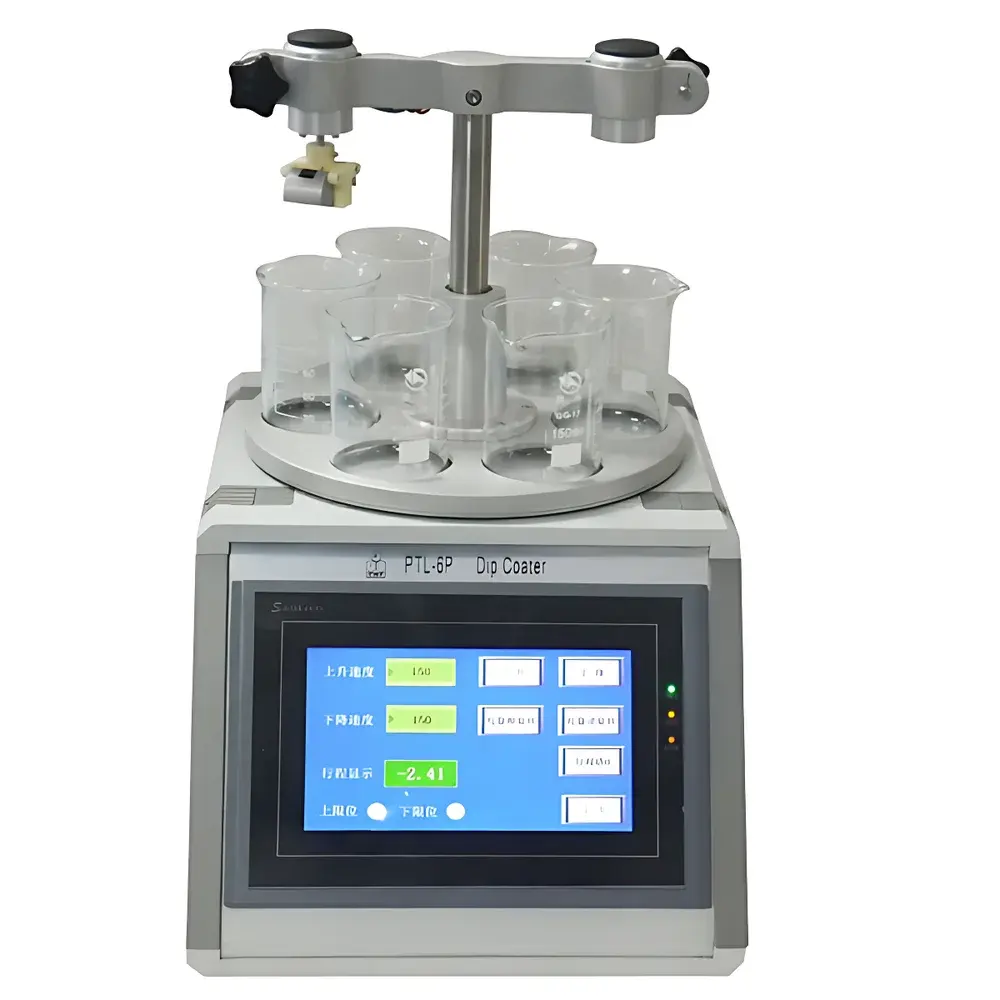
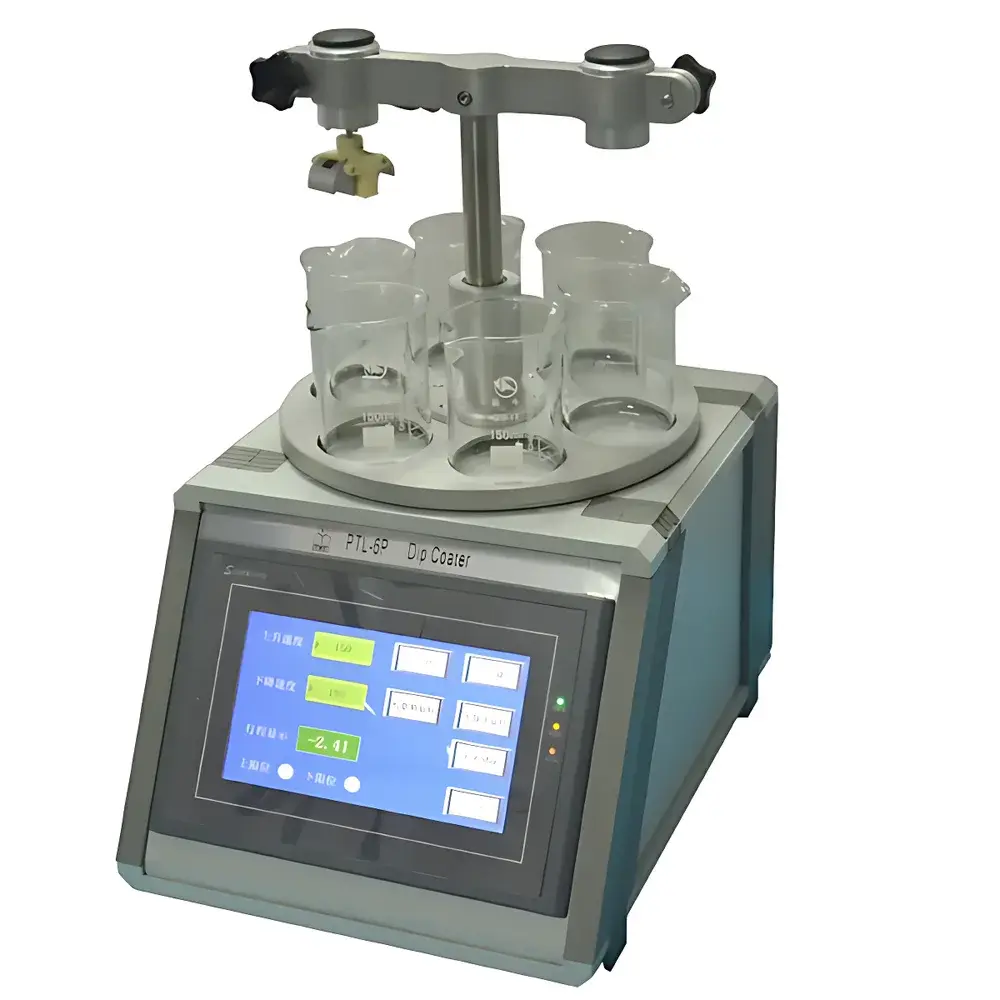
KJ GROUP PTL-6P Six-Position Dip Coater
| Brand | KJ GROUP |
|---|---|
| Origin | Liaoning, China |
| Manufacturer Type | Authorized Distributor |
| Country of Origin | China |
| Model | PTL-6P |
| Pricing | Upon Request |
| Certification | CE Certified |
| Power Supply | AC 220 V, 50 Hz, 100 W |
| Operating Environment | Altitude < 1000 m, Temperature 10–40 °C, Relative Humidity 45–65 % RH |
| Dimensions (W×D×H) | 260 × 340 × 420 mm |
| Weight | 15 kg |
| Sample Holder Dimensions | 75 × 25 × 2 mm |
| Immersion Length | 60 mm |
| Travel Stroke | 1–80 mm |
| Dip Speed (Auto) | 1–400 mm/min |
| Dip Speed (Manual) | 1–150 mm/min |
| Immersion/Drying Time Range | 1–999 s |
| Dip Cycles | 1–45 |
| Stirring | Independent on/off control per station, dual-speed (low/high) |
| Dip Vessel Capacity | 150 mL × 6 |
| Footprint Requirement | ≥ 500 × 800 mm, Load Capacity ≥ 50 kg |
| Grounding | Mandatory |
| Ventilation | Not required |
Overview
The KJ GROUP PTL-6P Six-Position Dip Coater is a precision-engineered laboratory instrument designed for controlled, reproducible thin-film deposition via vertical dip-coating methodology. Based on the classical immersion–withdrawal principle, the system immerses substrates vertically into liquid or low-viscosity paste-phase precursor solutions, then withdraws them at programmable linear velocities to form uniform coatings through capillary-driven meniscus formation and solvent evaporation kinetics. Unlike spin coating or spray techniques, dip coating enables precise control over film thickness via withdrawal speed, solution concentration, and immersion dwell time—making it particularly suitable for sol-gel synthesis, metal oxide nanoparticle dispersions, polymer electrolytes, and functional ceramic precursors. The PTL-6P accommodates six independent sample stations, each with synchronized rotational motion (counter-clockwise only) during immersion to enhance lateral homogeneity and minimize edge effects. Its compact footprint, non-heated bath configuration, and ambient-temperature operation ensure compatibility with thermally sensitive precursors—including aqueous colloids, ethanol-based sols, and shear-thinning slurries—without risk of premature gelation or solvent boiling.
Key Features
- Six independently addressable dip stations, each equipped with dedicated motor-driven sample holders capable of continuous counter-clockwise rotation during immersion
- High-resolution stepper motor actuation enabling repeatable withdrawal speeds from 1 to 400 mm/min (auto mode) and 1 to 150 mm/min (manual jog mode)
- Fully programmable process parameters: immersion time (1–999 s), drying interval (1–999 s), number of dip cycles (1–45), and vertical stroke length (1–80 mm)
- Independent stirring control per station with dual-speed (low/high) agitation capability—enabling real-time suspension stabilization without cross-contamination
- CE-certified electrical architecture with mandatory grounding compliance; operates on standard AC 220 V / 50 Hz supply (100 W max load)
- Non-heated 150 mL borosilicate glass dipping vessels—optimized for stability, chemical resistance, and easy cleaning between material systems
- Modular sample fixture design supporting standardized 75 × 25 × 2 mm substrates; optional dual-sample clamps available for comparative studies
Sample Compatibility & Compliance
The PTL-6P supports a broad range of substrate geometries and coating chemistries compatible with ambient-pressure dip-coating protocols. It is routinely deployed for depositing TiO₂, SiO₂, ZnO, and SnO₂ thin films from alkoxide-derived sols; conductive polymer layers (e.g., PEDOT:PSS); perovskite precursor films; and bioactive hydrogel coatings. Substrate materials include silicon wafers, glass slides, ITO-coated glass, stainless steel foils, and flexible PET films—provided dimensional tolerances fall within the specified 75 × 25 × 2 mm envelope. All mechanical and electrical subsystems conform to EN 61000-6-2 (immunity) and EN 61000-6-3 (emission) standards. CE marking affirms compliance with the EU Machinery Directive 2006/42/EC and Low Voltage Directive 2014/35/EU. While not inherently GLP/GMP validated, the device’s deterministic program execution, non-volatile parameter storage, and absence of analog calibration drift support audit-ready documentation when integrated into SOP-controlled workflows.
Software & Data Management
The PTL-6P utilizes an embedded microcontroller-based interface with tactile membrane keypad and LCD display—eliminating reliance on external PCs or proprietary software stacks. All process parameters are stored in non-volatile memory and retain settings after power cycling. Each station maintains its own parameter set, allowing concurrent execution of heterogeneous coating protocols across the six positions. Timestamped operation logs—including start time, cycle count, actual withdrawal speed, and immersion duration—are accessible via on-device menu navigation and can be manually recorded for traceability. Though the system does not feature USB/Ethernet connectivity or FDA 21 CFR Part 11-compliant electronic signatures, its deterministic behavior, fixed firmware versioning, and absence of cloud dependencies render it suitable for regulated environments where procedural consistency—not digital audit trails—is the primary validation criterion.
Applications
- Sol-gel derived metal oxide optical coatings (anti-reflective, photocatalytic, electrochromic)
- Perovskite absorber layer fabrication for prototype photovoltaic devices
- Layer-by-layer (LbL) assembly of polyelectrolyte multilayers on planar substrates
- Functionalization of biosensor surfaces with chitosan, collagen, or heparin hydrogels
- Preparation of solid-state battery interfacial layers (e.g., Li₇La₃Zr₂O₁₂ garnet coatings on lithium metal anodes)
- Academic teaching labs for introducing thin-film physics, rheology of colloidal dispersions, and nucleation/growth kinetics
FAQ
Is heating of the dipping bath supported?
No. The PTL-6P operates exclusively at ambient temperature. Bath heating is not integrated and is not recommended due to thermal expansion mismatches, solvent volatility risks, and lack of temperature feedback control.
Can different coating solutions be used simultaneously across the six stations?
Yes. Each of the six 150 mL dipping vessels is physically isolated and may contain distinct precursor formulations, enabling parallel optimization of composition–thickness relationships.
What is the maximum substrate thickness accommodated by the standard holder?
The default single-sample clamp accepts substrates up to 2 mm thick. Custom fixtures for thicker or irregular samples are available upon request.
Does the system support automated post-dip annealing?
No. The PTL-6P performs only the dip-coating step. Thermal processing must be conducted separately using a programmable furnace or hotplate following standard protocol sequencing.
Is maintenance of the stepper motors required?
No scheduled lubrication or recalibration is necessary. The sealed stepper motors are rated for >10,000 operational hours under typical lab usage conditions.



