
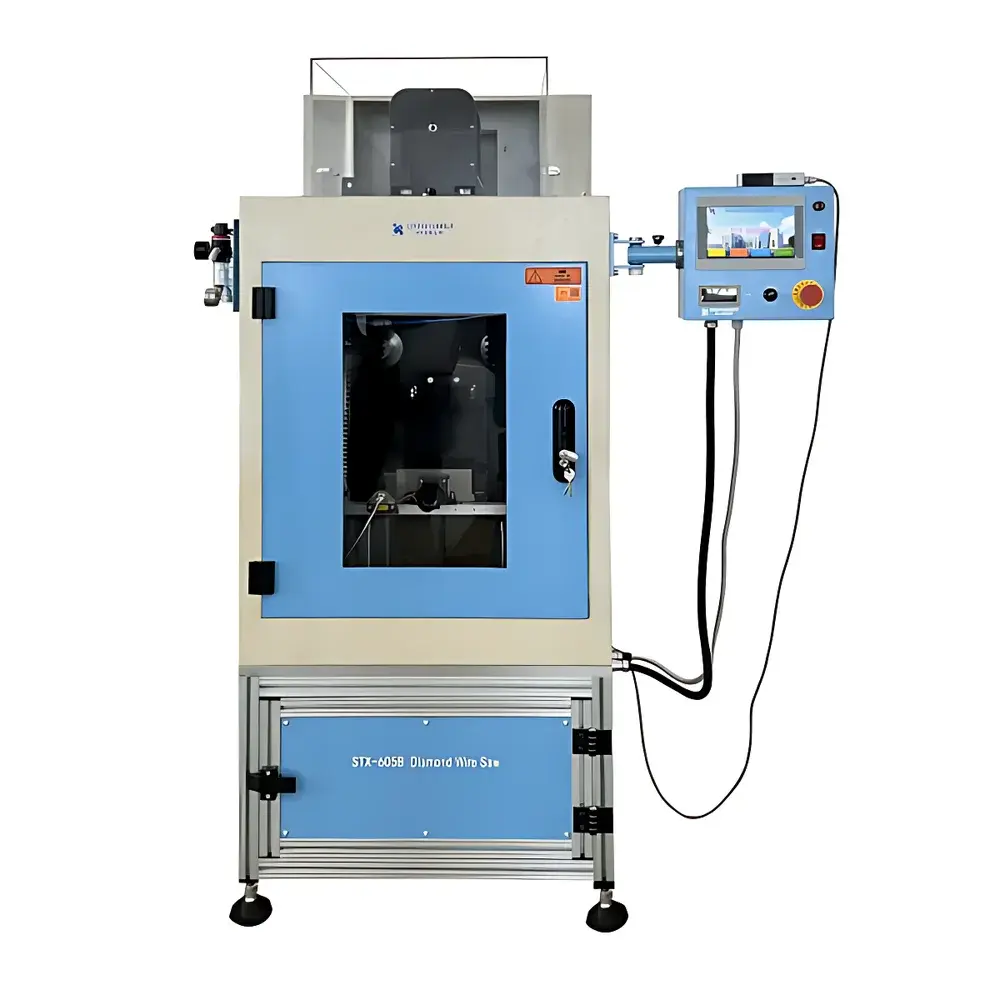
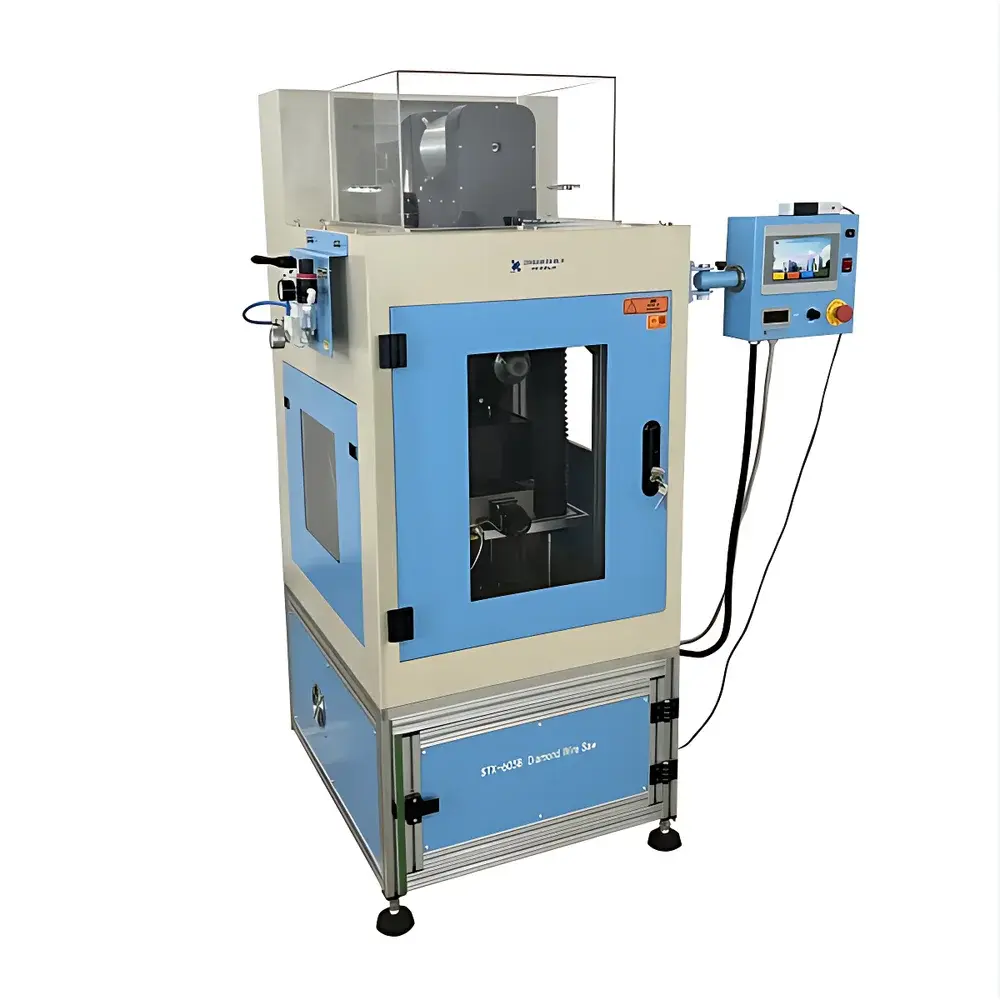
KJ GROUP STX-605B Fully Automated Diamond Wire Saw
| Brand | KJ GROUP |
|---|---|
| Origin | Liaoning, China |
| Manufacturer Type | Authorized Distributor |
| Country of Origin | China |
| Model | STX-605B |
| Pricing | Upon Request |
| Wire Length | 150 m |
| Maximum Sample Diameter | Φ150 mm |
| Max Sample Weight | 3 kg |
| Wire Speed | 0–5 m/s |
| Z-Axis Travel | ≤160 mm |
| Y-Axis Travel | ≤180 mm |
| Pneumatic Tension Range | 0.1–0.4 MPa |
| Diamond Wire Diameter Compatibility | <0.45 mm |
| Electric Rotary Stage | 0–360°, Repeatability ±0.02° |
| Electric Tilting Stage | ±10°, Repeatability ±450″ |
| Ambient Operating Conditions | Altitude <1000 m, Temp. 25°C ±15°C, RH 55% ±10%, AC220V/50Hz, Compressed Air (0–1 MPa), Ventilation Required |
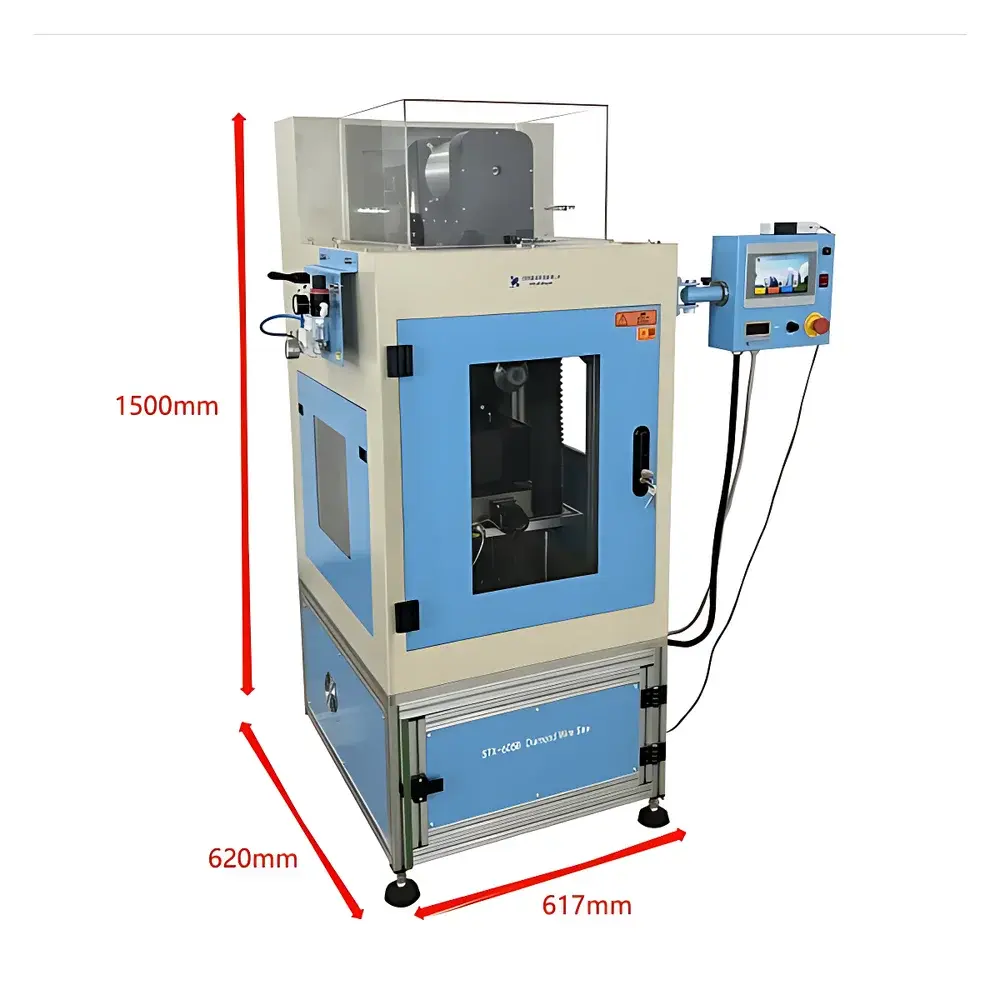
| Dimensions (W×D×H) | 617×620×1500 mm |
| Net Weight | 183 kg |
Overview
The KJ GROUP STX-605B Fully Automated Diamond Wire Saw is a CE-certified, precision-engineered instrument designed for high-accuracy sectioning of brittle, anisotropic, and high-value materials in research laboratories, materials science facilities, and quality control environments. It operates on the principle of abrasive wire cutting—utilizing a continuously reciprocating diamond-impregnated wire under controlled tension to achieve low-damage, kerf-minimized slicing. Unlike rotary saws or abrasive cutters, this system eliminates mechanical shock and thermal distortion, preserving crystallographic integrity and surface morphology—critical for subsequent SEM, XRD, TEM, or optical characterization. Its fully automated feed mechanism enables unattended, programmable slicing with dimensional repeatability within ±10 µm, making it especially suited for preparing ultra-thin sections down to 0.2 mm thickness for transmission-level analysis.
Key Features
- Fully automated linear feed system with programmable stroke control and real-time position feedback via integrated stepper motor drives
- Pneumatic wire tensioning architecture with adjustable pressure regulation (0.1–0.4 MPa) to optimize force application across wire diameters from Ø0.125 mm to Ø0.42 mm
- High-stability aluminum extrusion frame with vibration-damping base, engineered for long-term geometric fidelity during extended cutting cycles
- Dual-axis motorized positioning: electric rotary stage (0–360°, ±0.02° repeatability) and tilting stage (±10°, ±450″ repeatability) for angularly resolved sectioning and oblique-plane preparation
- 150-meter diamond wire capacity with single-loop recirculation design—reducing wire consumption and minimizing downtime associated with frequent rethreading
- Integrated coolant delivery system compatible with non-aqueous cutting fluids; supports continuous lubrication without emulsion degradation or corrosion risk
- Modular tooling interface accommodating optional accessories including MTI heating platforms, DX-100 single-crystal orienters, and STX-2500 automatic wire threading units
Sample Compatibility & Compliance
The STX-605B is validated for sectioning materials with hardness below that of diamond (HV ~7000–10000), encompassing ceramics (Al₂O₃, ZrO₂, SiC), single crystals (Si, Ge, sapphire, CsI), optical and IR-transmitting substrates (ZnS, ZnSe, fused silica), metallic alloys (Ti-6Al-4V, Mg-Al composites), geological specimens (granite, basalt, meteorites), thermoelectrics (Bi₂Te₃, PbTe), and biohard tissues (mineralized bone, dental enamel, calcified vascular plaques). All structural and electrical components comply with EN 61000-6-2 (immunity) and EN 61000-6-4 (emission) standards. The machine’s CE marking confirms conformity with Machinery Directive 2006/42/EC and Low Voltage Directive 2014/35/EU. For regulated labs operating under GLP or GMP frameworks, the system supports audit-ready documentation when paired with optional timestamped log export functionality.
Software & Data Management
The STX-605B is operated via an embedded industrial HMI with intuitive touchscreen interface supporting multi-step program storage (up to 99 protocols), parameter locking, and password-protected user tiers. Cutting parameters—including wire speed, feed rate, tension setpoint, total stroke length, and dwell time—are stored in non-volatile memory with version-controlled backup capability. Raw motion logs (position vs. time, tension feedback, motor current) can be exported in CSV format for post-processing in MATLAB or Python-based QA pipelines. While the base configuration does not include FDA 21 CFR Part 11-compliant electronic signatures or audit trail generation, the platform architecture permits integration with third-party LIMS or ELN systems via RS-485 or Ethernet/IP protocols upon request.
Applications
- Preparation of wafer-thin cross-sections (<0.3 mm) for TEM lamella extraction from semiconductor devices and thin-film stacks
- Sectioning of orthopedic implants embedded in bone tissue for histomorphometric analysis of osseointegration
- Orientation-specific slicing of thermoelectric ingots to isolate crystallographic planes for anisotropic property mapping
- Geological thin-section fabrication meeting ASTM D3282 and ISO 14688-1 standards for petrographic microscopy
- Cutting of infrared optical elements (e.g., Ge lenses, ZnS windows) without subsurface damage or edge chipping
- Serial sectioning of large-volume biological specimens (e.g., whole human vertebrae with spinal hardware) for micro-CT registration and 3D reconstruction
- Production of calibration standards for XRF and EPMA—ensuring uniform matrix geometry and minimal elemental redistribution
FAQ
What types of diamond wire are compatible with the STX-605B?
The system accepts diamond wires with diameters ranging from Ø0.125 mm to Ø0.42 mm. Recommended wire specifications include electroplated or resin-bonded monolayer configurations optimized for low-kerf, high-material-removal-rate applications.
Is compressed air supply mandatory for operation?
Yes—the pneumatic tensioning system requires a clean, oil-free air source regulated between 0–1 MPa. A quiet, maintenance-free air compressor (e.g., MTI AC-100) is recommended for lab environments.
Can the STX-605B cut conductive samples without electrical discharge risks?
Absolutely. As a purely mechanical abrasive process, it imposes no electrical bias or thermal plasma—making it inherently safe for conductive, piezoelectric, or electrostatic-sensitive materials.
What is the minimum achievable slice thickness, and how is thickness consistency ensured?
Under optimal conditions (stable temperature, calibrated feed, appropriate wire selection), consistent 0.2 mm slices are routinely achieved. Thickness reproducibility is maintained through closed-loop stepper control, pre-load compensation algorithms, and real-time tension monitoring.
Does the system support integration with crystal orientation instruments?
Yes—via standardized mounting interfaces and digital I/O ports, the STX-605B is interoperable with the DX-100 single-crystal orienter for lattice-aligned sectioning, enabling crystallographically precise sample preparation per ASTM E112 and ISO 13067 protocols.



