
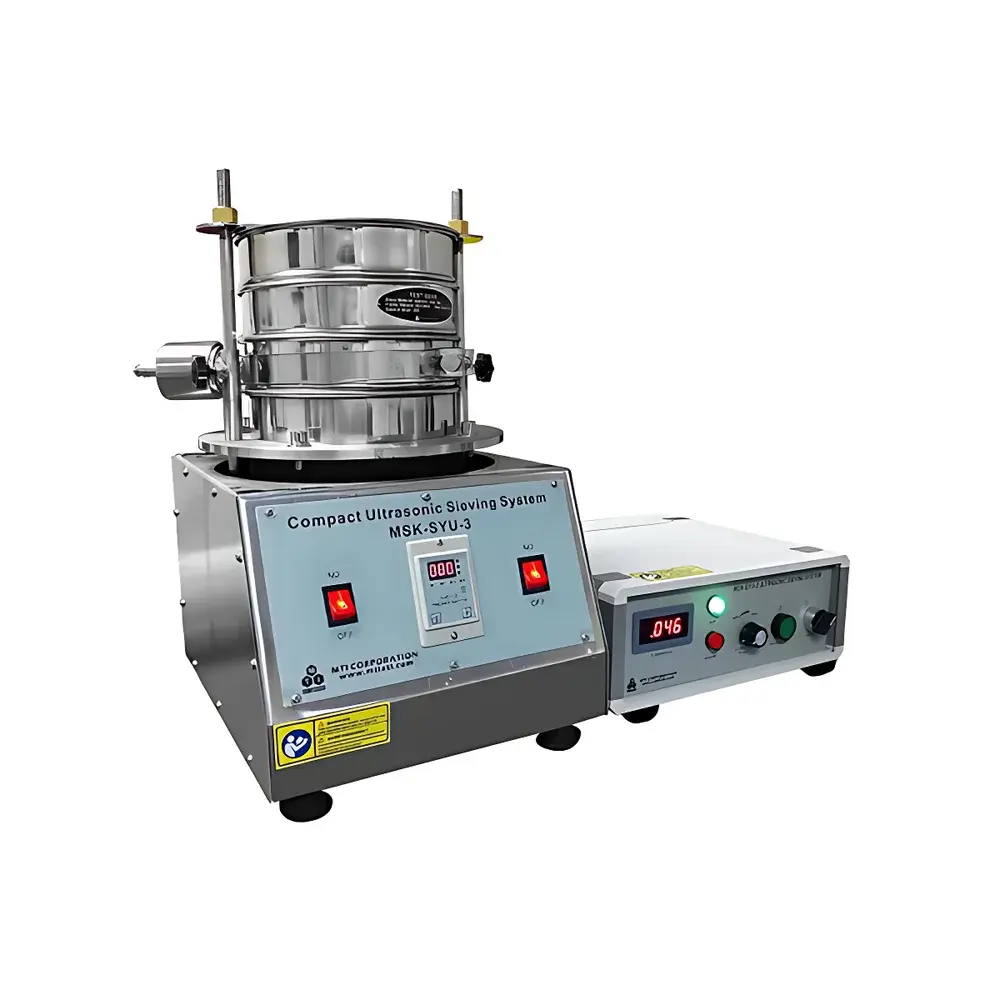
KJ GROUP SYU-3 Ultrasonic Laboratory Test Sieving System
| Brand | KJ GROUP |
|---|---|
| Origin | Liaoning, China |
| Manufacturer Type | Authorized Distributor |
| Country of Origin | China |
| Model | SYU-3 |
| Price | Upon Request |
| Operating Frequency | 38 kHz |
| Maximum Sample Load | 1 kg |
| Total Current Draw | ≤0.6 A |
| Motor Speed | 1400 RPM |
| Power Supply | AC 220 V ±10%, 50 Hz |
| Included Sieves | 100, 200, and 450 mesh (ID 200 mm × H 50 mm) |
| System Dimensions | 360 × 300 × 740 mm |
| Ultrasonic Generator Dimensions | 350 × 300 × 200 mm |
Overview
The KJ GROUP SYU-3 Ultrasonic Laboratory Test Sieving System is an engineered solution for high-precision particle size analysis in quality control and R&D laboratories where conventional mechanical sieving fails due to agglomeration, electrostatic adhesion, or cohesive behavior of fine powders. It operates on the principle of superimposing high-frequency ultrasonic vibration (38 kHz) onto standard three-dimensional circular motion of the sieve deck—effectively decoupling particles from mesh wires while maintaining gentle handling of fragile or heat-sensitive materials. This dual-motion architecture enables reliable separation of particles down to sub-45-micron fractions (corresponding to 450 mesh), with minimal sample loss and consistent reproducibility across repeated runs. The system is purpose-built for compliance-driven environments, supporting documented sieve calibration protocols and traceable operational parameters required under ISO 2591-1, ASTM E11, and USP .
Key Features
- Integrated 38 kHz ultrasonic generator with digital frequency auto-tracking: microprocessor-controlled circuitry continuously monitors load impedance and adjusts output frequency in real time to sustain resonant amplitude—eliminating manual tuning and ensuring stable performance across varying material densities and moisture contents.
- Dual operating modes: continuous mode for maximum throughput in routine QC; pulsed mode (adjustable duty cycle) for thermally sensitive or friable samples requiring reduced energy input and minimized particle attrition.
- Modular mechanical design: three-tier stainless-steel sieve stack mounted on a robust eccentric drive unit; ultrasonic transducer and resonator assembly coupled via shielded HF cable to prevent electromagnetic interference with adjacent lab instrumentation.
- Standardized sieve compatibility: accepts industry-standard 200 mm diameter test sieves (ISO 3310-1 / ASTM E11); includes three certified woven-wire meshes—100, 200, and 450 mesh—with documented mesh opening tolerances and traceable calibration certificates available upon request.
- Low-power consumption architecture: total system draw ≤0.6 A at rated load, enabling operation alongside other benchtop analytical instruments without circuit overloading.
Sample Compatibility & Compliance
The SYU-3 accommodates dry, free-flowing, and moderately cohesive powders across pharmaceutical APIs, catalysts, metal alloys, ceramic precursors, food-grade starches, and mineral concentrates. It is not intended for wet slurries, fibrous matrices, or highly abrasive materials exceeding Mohs 7 hardness without prior abrasion testing. All structural components comply with RoHS Directive 2011/65/EU. Mechanical vibration profiles conform to ISO 2591-1:2021 Annex B for laboratory sieve shakers. Optional documentation packages support GLP-compliant validation—including IQ/OQ protocols, as-found/as-left calibration records, and audit-ready electronic logs compatible with FDA 21 CFR Part 11–enabled LIMS integration.
Software & Data Management
While the SYU-3 operates as a standalone hardware platform, its ultrasonic generator firmware supports external TTL-triggered start/stop signals for synchronization with automated sample dispensers or balance interfaces. All operational parameters—including run duration, mode selection, and real-time current draw—are displayed on the front-panel LED interface with non-volatile memory retention. For regulated environments, optional RS-485 or USB-to-serial adapters enable connection to validated data acquisition software (e.g., LabVIEW™ or custom Python-based logging tools), facilitating timestamped event capture, pass/fail threshold assignment per sieve fraction, and export to CSV or PDF reports compliant with internal SOPs.
Applications
- Pharmaceutical: verification of granule size distribution prior to tablet compression; excipient lot release testing per USP ;
- Metallurgy: classification of atomized metal powders for additive manufacturing feedstock qualification (ASTM F3049);
- Chemicals: monitoring catalyst particle integrity after thermal cycling or solvent exposure;
- Food & Agriculture: grading flour fineness, spice particle uniformity, and functional ingredient dispersion efficacy;
- Academic Research: method development for sieve-based particle characterization in colloid science and powder rheology studies.
FAQ
What is the maximum recommended sample mass for accurate 450-mesh separation?
For optimal resolution at 450 mesh (35 µm nominal opening), a maximum load of 1.0 kg is specified—but empirical optimization suggests 300–500 g yields highest repeatability in most fine-powder applications.
Can the SYU-3 be integrated into a fully automated QC workflow?
Yes—via TTL trigger input and serial communication options, it supports scheduled runs, interlocked safety stops, and metadata tagging when paired with compatible balance or robotic sample handlers.
Is calibration certification included with the delivered system?
A factory-issued dimensional verification report for the included sieves is provided; NIST-traceable calibration certificates are available as a value-added service upon order specification.
Does the system meet requirements for GMP documentation?
The hardware design supports GMP-aligned operation; full compliance requires implementation of site-specific validation protocols, electronic audit trails, and change control procedures per ICH Q7 and EU Annex 15 guidelines.



