
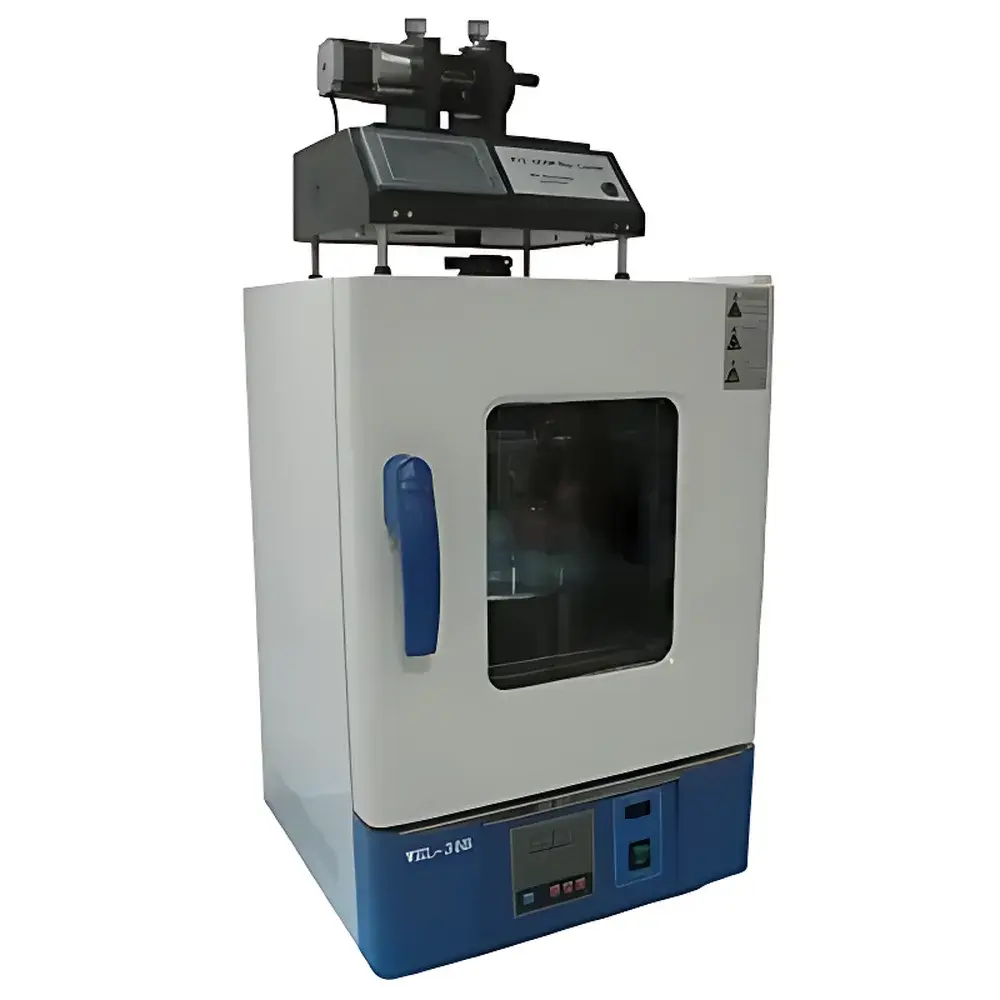
KJ GROUP PTL-OV6P Six-Position Dip Coater
| Brand | KJ GROUP |
|---|---|
| Origin | Liaoning, China |
| Manufacturer Type | Authorized Distributor |
| Country of Origin | China |
| Model | PTL-OV6P |
| Pricing | Upon Request |
| Certifications | CE Certified |
| Power Supply | AC 220 V, 50 Hz |
| Rated Power | 800 W |
| Withdrawal Speed Range | 1–200 mm/min |
| Temperature Control Range (Chamber) | RT + 5 °C to 100 °C |
| Temperature Uniformity | ±1.5 °C |
| Sample Dimensions (Max) | 75 mm × 25 mm × 2.5 mm |
| Immersion Length | 60 mm |
| Immersion & Drying Time Setting Range | 1–999 s |
| Number of Coating Cycles | 1–20 |
| Sample Capacity | 6 positions |
| Vial Specifications | Φ60 mm, 150 mL |
| Chamber External Dimensions | 460 mm × 510 mm × 695 mm |
| System Dimensions | 450 mm × 500 mm × 1060 mm |
| Net Weight | 40 kg |
| Required Workbench | 800 mm × 600 mm × 700 mm, ≥200 kg load capacity |
| Operating Environment | Altitude <1000 m, Ambient Temp. 25 °C ±15 °C, RH 55 % ±10 % |
| Grounding | Mandatory |
| Compressed Air / Water / Ventilation | Not Required |
Overview
The KJ GROUP PTL-OV6P Six-Position Dip Coater is a precision-engineered laboratory instrument designed for controlled, reproducible thin-film deposition via vertical dip-coating—a technique grounded in colloidal and interfacial science. It operates on the principle of controlled withdrawal from a precursor solution, where film thickness is governed by the balance between viscous drag, capillary forces, and solvent evaporation kinetics—described empirically by the Landau–Levich–Derjaguin (LLD) model. Unlike spin coating or spray methods, dip coating enables uniform coverage on irregular, fragile, or temperature-sensitive substrates without centrifugal stress or droplet impact. The PTL-OV6P integrates six independent sample stations within a thermally stabilized environment, allowing parallel processing under identical thermal and kinematic conditions—critical for comparative studies in sol-gel synthesis, perovskite photovoltaics, metal oxide nanocoatings, and functionalized biosensor surfaces.
Key Features
- Six-position modular station design enabling simultaneous, synchronized dip-coating of up to six substrates—each accommodated in individual Φ60 mm × 150 mL vials with independent positioning.
- High-resolution stepper motor drive system delivering precise withdrawal speed control from 1 to 200 mm/min (0.01 mm/min resolution), ensuring repeatable meniscus dynamics across multiple runs.
- Integrated thermostatic chamber maintaining temperature stability from RT + 5 °C to 100 °C with ±1.5 °C uniformity—essential for solvent-controlled evaporation rates and crystallization kinetics during film formation.
- Programmable multi-stage protocol: user-defined immersion time (1–999 s), withdrawal speed profile, post-dip drying interval (1–999 s), and total cycle count (1–20), stored in non-volatile memory.
- Vibration-isolated suspension mount for the drive motor minimizes mechanical perturbation during slow-speed withdrawal—preserving meniscus integrity for sub-micron film homogeneity.
- Compact footprint (450 × 500 × 1060 mm) and tool-free access facilitate integration into fume hoods or gloveboxes; all wetted components are chemically resistant and easily disassembled for cleaning.
Sample Compatibility & Compliance
The PTL-OV6P accepts standard planar substrates up to 75 mm × 25 mm × 2.5 mm—including silicon wafers, glass slides, ITO/PET films, ceramic plates, and flexible polymer foils. Its open architecture supports custom fixture integration (e.g., edge-clamped, wire-suspended, or multi-angle holders) for non-standard geometries. The system complies with EU Machinery Directive 2006/42/EC and carries CE marking, confirming conformity with essential health and safety requirements. While not inherently GLP/GMP-certified, its programmable parameters, timestamped operation logs (via optional RS232/USB interface), and stable thermal environment support audit-ready workflows compliant with ISO 9001 quality management systems and ASTM D1308 (coating adhesion) or ISO 2137 (viscosity-dependent film formation) test protocols.
Software & Data Management
The PTL-OV6P operates via an embedded microcontroller with intuitive membrane keypad interface and LCD status display. All process parameters—including speed ramping, dwell times, and temperature setpoints—are configured directly on-device with no external PC dependency. Optional firmware upgrade enables serial data logging (ASCII format) for traceability, supporting integration into LIMS or electronic lab notebooks (ELN). For regulated environments, users may implement supplementary 21 CFR Part 11-compliant validation packages—including IQ/OQ documentation, user access control templates, and audit trail configuration—through third-party validation services aligned with GxP practices.
Applications
This dip coater serves as a core platform in academic and industrial R&D for fabricating functional thin films where stoichiometric fidelity, interfacial continuity, and layer-by-layer repeatability are paramount. Key use cases include: fabrication of TiO₂ electron transport layers in perovskite solar cells; deposition of SiO₂ antireflective coatings on optical components; growth of hydrophobic silica aerogel monolayers; preparation of chitosan-based antimicrobial films on biomedical substrates; and sequential layering of polyelectrolyte multilayers (PEMs) for biosensing interfaces. Its ability to maintain constant temperature during both immersion and early-stage drying makes it especially suited for low-volatility solvents (e.g., ethylene glycol, DMF) and heat-sensitive precursors.
FAQ
Is the PTL-OV6P compatible with corrosive or high-viscosity precursor solutions?
Yes—standard vials and fixtures are constructed from borosilicate glass and PTFE-compatible stainless steel; optional quartz or PFA-lined vials are available for aggressive chemistries.
Can withdrawal speed be varied within a single cycle (e.g., ramped or stepped profiles)?
No—the current firmware supports fixed-speed withdrawal per cycle; however, multi-step protocols can be emulated by chaining sequential cycles with different speed settings.
What is the maximum substrate thickness supported by the standard clamping mechanism?
The standard holder accommodates substrates up to 2.5 mm thick; custom fixtures for thicker or tapered samples can be engineered upon request.
Does the system include temperature calibration certificates or NIST-traceable validation support?
Factory calibration is performed at three points (25 °C, 60 °C, 100 °C); full NIST-traceable calibration reports and IQ/OQ documentation are available as value-added services.
Is remote monitoring or network connectivity supported?
Native Ethernet or Wi-Fi is not integrated, but RS232/USB output allows connection to host PCs for automated script control and real-time parameter logging using LabVIEW or Python-based DAQ frameworks.



